Showing posts with label LAMR. Show all posts

Thursday, May 16, 2024

Other Earnings Notes (Q1 2024)

[Previously regarding Lamar Advertising, Intercontinental Exchange, Marriott International, Royal Gold, and Sprouts Farmers Market.]

Lamar Advertising
The market capitalization of LAMR at $122 per share is $12.5 billion and the enterprise value is $16.8 billion. During the first quarter of 2024 (release), the company reported net income plus depreciation and amortization of $154 million, up 3% from $149 million a year earlier. The quarter's NI+D yield on the market capitalization annualizes to 4.9%. Revenue for the quarter was $498 million, which was up 5.7% from the prior year quarter.

Intercontinental Exchange
For the first quarter of 2024 (release), ICE earned $877 billion of adjusted free cash flow on $2.3 billion of total revenue (less transaction-based expenses) for a royalty-like 38% free cash flow margin. Revenue (less TBEs) was up 21% from the prior year and adjusted FCF was up 30%. (The diluted share count is up 2.5% y/y.) The current market capitalization of ICE is $79 billion and the enterprise value is around $100 billion, so at a 3.5% free cash flow yield on the enterprise value it is not super cheap. We like ICE's M&A goals: "deepen moats, gain intellectual property, increase customer wallet-share".

Marriott International
For the first quarter of 2024 (release), MAR earned $1.09 billion of adjusted EBITDA (less SBC) on $1.5 billion of total revenue (excluding cost reimbursements) for a royalty-like 71% margin. Revenue (excluding reimbursements) was up 5.2% from the prior year and adjusted EBITDA (less SBC) was up 2.6%. The current market capitalization of MAR is $67 billion and the enterprise value is around $80 billion. The adjusted EBITDA (less SBC) annualized yield on the enterprise value is 5.5%. The diluted share count was down 6.2% year-over-year. Despite being a $67 billion market capitalization company, Marriott spent only $109 million on capital expenditures in the first quarter. The company spent $1.1 billion on share repurchases and $151 million on dividends, for a shareholder yield of 7.7%.

Royal Gold
Reported results: Royal Gold's net income plus depreciation was $86 million for the first quarter of 2024 versus $110 million the prior year. The company spent $100 million on debt repayment and $26 million on dividends. Net liabilities are down to $55 million. The market capitalization is $8.45 million so the enterprise value is $8.5 billion. The NI+D yield on the market capitalization is 4.1% (annualized).

Sprouts Farmers Market
We wrote about Sprouts back in October 2023. At that point, the market capitalization was $4.3 billion and the enterprise value was $5.8 billion. Shares have been on a tear and the market capitalization is now $7.7 billion at $77 per share (+79% since we wrote about it.). 

The enterprise value is $7.7 billion if you ignore the non-current $1.4 billion of operating lease liability, since the landlords finance their stores and they have no net financial debt (see 10-Q). They generated $213 million of cash from operations less stock-based compensation in the first quarter, and spent $51 million on capital expenditures, for $162 million of FCF. (A 8.4% annualized yield on the EV, or 7.1% if you capitalize the store leases into EV.) They bought back $60 million of stock and built the cash balance by $110 million. (The cash build was because of restrictions on being able to buy back shares.) Share count is down 2.7% year over year. They earned $1.12 per share so P/E is 17x. Sprouts is a growth monster at a reasonable price. They opened 7 stores in Q1, bringing total to 414 in 23 states.

Monday, February 26, 2024

Earnings Notes IV (Q4 2023)

Alpha Metallurgical Resources, Inc. (AMR)
Alpha Met is the largest U.S. met coal producer, representing about one-fifth of total U.S. production. According to their recent investor presentation, 71% of AMR's met coal production is exported, with India accounting for 37% of their export sales over the past five years.

The market capitalization of AMR is now $5.7 billion after earnings. AMR stock has been on an absolute tear since they are allocating lots of cash to share repurchases. (Up 151% since we mentioned last March.) Their current assets less total liabilities (ignoring deferred taxes) are now $255 million, so we would put the enterprise value at just under $6 billion.

For the fourth quarter of 2023 (release, 10-K), AMR's adjusted EBITDA was $266 million and for the full year (2023) it was $1 billion. That puts the EV/EBITDA at about 5.8x. AMR sold 4.6 million tons of met coal in Q4, 18% more coal than the prior year quarter. They got $184/t for met coal versus $155/t the previous quarter. Their cost of met coal sales was up slightly to $119 per ton from $110 per ton the prior quarter.

Cash from operations was $199 million and capital expenditures were $62 million for the quarter, for $137 million of free cash flow, an annualized yield on the enterprise value of 9%. That seems somewhat rich, especially compared with the FCF/EV yields of a coal royalty owner like Pardee, Beaver Coal, or Natural Resource Partners.

AMR had said that they were going to cease paying and focus their cash on share repurchases, "as long as buybacks make sense from a market, trading price, and valuation perspective." They paid $13 million of dividends for the fourth quarter and bought back $137 million of stock, for a shareholder yield of 10.5% (annualized) on the current market capitalization. They shrank the share count by 17% year-over-year!

AerCap Holdings N.V. (AER)
We mentioned aircraft lessor AerCap way back in the "What I Would Buy Instead of Tesla" post in October 2020. At that point the market capitalization was $3.3 billion, which was only a third of book value. They had $35 billion of aircraft (at book value net of depreciation), $10 billion of other assets, and $35 billion of debt, for a net of $10 billion of shareholder equity. It was trading for 3x earnings and we said, "If lots of airlines go bankrupt, this is a zero. If things return to normal, it's worth close to triple."

The market capitalization is now $16 billion and the share price did in fact triple. The share count and market capitalization grew in March 2021 when AER acquired GE's aircraft leasing business (GE Capital Aviation Services) for cash and stock. The other big development was when Russia invaded Ukraine, 152 AER aircraft were stranded in Russia. However, settlements were received from various Russian airlines and insurance companies.

Looking at the 2023 results, book value has grown to $16.6 billion as of year-end 2023. AerCap has $57 billion of "flight equipment," $14 billion of other assets, $46 billion of debt, and $8 billion of other liabilities. So the shares are now at 1x book value.

In 2023, AER earned $3.1 billion. Note that there were $1.3 billion of recoveries related to the Russian planes, so a real steady-state number would obviously be lower. Operating cash flow for the year was $5.3 billion. They spent $4.1 billion (net) on new aircraft and aircraft downpayments. They spent $2.6 billion on share repurchases which was more than their free cash flow, however they have some float from things like security deposits received from customers. With the $2.6 billion of repurchases, they shrank the share count by 18% during 2023.

We like specialty finance businesses with barriers to entry. Another example would be Burford (BUR). Good luck starting an aircraft leasing company; it's not like opening a bank to make mortgages at 4%. The concerns that we have with AER are the leverage (assets 4.4x their equity) and the China risk. They have 16% of their planes on lease to Chinese airlines so in the event of a Taiwan conflict, they could have a massive hole blown in their balance sheet. Why does China need to finance its planes with western capital, anyway?

Lamar Advertising Company (LAMR)
The reason that we initially became interested in Lamar was its high free cash flow margins - the signature feature of a "royalty-like" business.

The market capitalization of Lamar at $108 per share is $11 billion and the enterprise value is $16 billion. During the fourth quarter of 2023 (release), the company reported operating cash flow of $254 million, which was up 4% from the prior year quarter. This quarter's operating cash flow yield on the enterprise value (OCF/EV) annualizes to 6.4%.

Revenue for the quarter was $556 million, which was up 4% from the prior year quarter. Notice that Lamar enjoys a healthy operating cash flow margin of 46% of revenue. The quarterly dividend of $1.25 per common share was a total of $128 million returned to shareholders, a 4.6% dividend yield. (As a REIT, Lamar is required to distribute 90% of earnings to shareholders.)

For the entire year 2023 (10-K), Lamar generated $784 million of cash from operations (37% of revenues). The company reinvested $317 million in acquisitions and capital expenditures and paid $511 million in distributions to shareholders.

Let's compare Lamar's results for the year 2023 with those of 2018 (five years ago). Their shares outstanding have grown only 3% in five years, revenue has grown 30% (a bit better than the 25% PPI inflation), and cash from operations has grown 39%.

So, cash from operations per share went from $5.70 to $7.67, an increase of 35%. It is nice that this is comfortably outpacing PPI inflation. Obviously, CFO is different than free cash flow because it ignores both maintenance and growth capital expenditures, but by using CFO we normalize for the different levels of growth expenditures over time. And billboards do not exactly require tons of maintenance. (They actually said on the Q4 2023 earnings call that maintenance capex is $50 million in 2024 which is less than $500 per billboard.)

Management also mentioned on the call that they think that M&A and consolidation is going to "accelerate" over the next 18 to 36 months.

ONEOK, Inc. (OKE)
The market capitalization of ONEOK is $42 billion, not quite as big as Enterprise Products ($60B) or Enbridge ($73B). You may recall that OKE acquired our Magellan Midstream last year. For 2023, OKE earned $2.7 billion, generated $4.4 billion of operating cash flow, spent $1.6 billion on capital expenditures, and paid $1.8 billion of dividends. Earnings were obviously up significantly over 2022 thanks to the Magellan acquisition, which was funded with both cash and stock. Since the acquisition closed in September 2023, the best proxies that we have for the going-forward results are the Q4 2023 and management's guidance for 2024. Guidance in the investor presentation is for $2.6 to $3 billion of net income, $5.9 to $6.3 billion of adjusted EBITDA, and somewhere near $2 billion of capital expenditures, mostly for growth.

Friday, November 3, 2023

Lamar Advertising Company - Q3 2023 Earnings ($LAMR)

[Previously: Lamar Advertising Company - Q1 2023 Earnings and Lamar Advertising Company (August 2022).]

One of the things that initially attracted us to Lamar Advertising Company (LAMR) was its high free cash flow margins - the signature feature of a "royalty-like" business.

The market capitalization of Lamar at $95 per share is $9.7 billion and the enterprise value is $14 billion. During the third quarter of 2023 (release, 10-Q), the company reported free cash flow of $181 million, which was up 2.9% from the prior year quarter. This quarter's free cash flow yield on the enterprise value (FCF/EV) annualizes to 5.2%.

Revenue for the quarter was $543 million, which was up 2.9% from the prior year. Notice the very healthy free cash flow margin of 33%. The quarterly dividend of $1.25 per common share was a total of $128 million returned to shareholders, a 5.3% dividend yield. (As a REIT, Lamar is required to distribute 90% of earnings to shareholders.)

So far this year-to-date, using $529 million of cash generated from operations as well as additional borrowings of $90 million, the company has reinvested $246 million in acquisitions and capital expenditures and paid $383 million in distributions to shareholders. Notice too that cash from operations is almost equal to revenue.

Let's compare Lamar's results for the first nine months of 2023 compared with 2018 (five years ago). Their shares outstanding have grown only 3% in five years, revenue has grown 30% (exactly equal to PPI inflation), and cash from operations has grown 43% - better than inflation.

So, cash from operations per share went from $3.73 to $5.19, an increase of 39%. Obviously, CFO is different than free cash flow because it ignores both maintenance and growth capital expenditures, but by using CFO we normalize for the different levels of growth expenditures over time.

Lamar is not as cheap as Natural Resource Partners, but it is a "royalty-like" business with a healthy free cash flow margin and strong cash generation. As we have observed in the past, most of the world's businesses are crappy. They have to advertise to remind people that they exist. Even McDonald's franchisees have to hire Lamar for this, essentially paying them a royalty on their business.

Saturday, May 27, 2023

Lamar Advertising Company - Q1 2023 Earnings ($LAMR)

[Previously regarding Lamar Advertising.] 

Lamar Advertising Company (LAMR) is one of the largest outdoor advertising companies in the United States based on number of displays (possibly the largest), and rents space for advertising on billboards, buses, shelters, benches, logo plates, and in airport terminals. They offer a fully integrated service, from ad copy production to placement and maintenance. They operate three types of outdoor advertising displays: billboards, logo signs, and transit advertising displays. However, 90% of their revenue is derived from billboards, with 65% from static billboards. The average billboard (static and digital) grossed $10,491 during 2021.

The market capitalization at $91.10 per share is $9.3 billion and the enterprise value is $13 billion. During the first quarter of 2023 (10-Q), the company reported free cash flow of $113 million, which was down 16% from the prior year quarter. The quarter's free cash flow yield on the enterprise value (FCF/EV) annualizes to 3.5%. Revenue for the quarter was $471 million, which was up 4% from the prior year. That gives a free cash flow conversion of 24%. Reported earnings were $76 million, which was down 17% from the prior year. That gives an annualized earnings yield of 3.3% on the current market cap. 

The valuation is looking expensive because of the weak quarter. Some color from the conference call:

Categories of particular strength included services, amusements, entertainment and sports and restaurants. Real estate, predominantly local vertical, was relatively weak and insurance, which is primarily a national category, was also weak. Rate was up on both analog bulletins and posters while occupancy was slightly down. Our strongest regions were in the Atlantic and Gulf Coast and continue to trend that way. The Northeast, which is more reliant on national advertising, trailed our other regions.

Digging a little deeper into Q1 numbers, adjusted EBITDA was actually up 3.5% year-over-year. Something that hit free cash flow quite a bit was that interest went from $25 million the prior year to $39 million this most recent quarter. The other thing was that capital expenditures went from $29 million to $42 million.

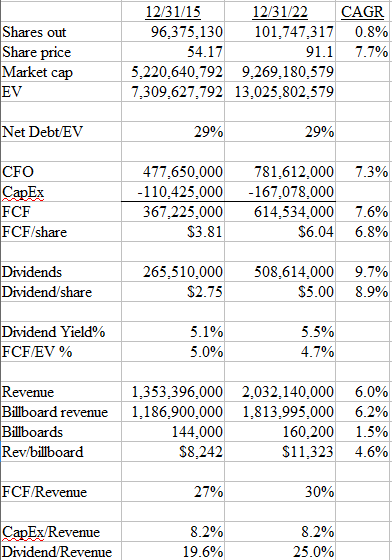
Last time we posted about LAMR, we did a comparison between 2015 and 2021. Let's update that with the 2022 full year results.

Lamar has been able to grow revenue per billboard by 4.6% compounded while also increasing the rate at 1.5% annually resulting in total revenue growing at 6% annually over the past seven years. They've done this while spending a constant ~8% or so of revenues on capital expenditures. (Compare with the 25% of total revenue paid to shareholders in 2022 as dividends, thanks to FCF/revenue conversion of 30%.) Lamar grows its billboard count partly through acquisitions, but shares outstanding have grown only at 0.8%. So the result is that FCF/share has grown at 6.8% compounded.

McDonald's franchisees are big advertisers, including on Lamar billboards. (We talked earlier this month about how McDonald's the franchisor has gotten quite expensive.) As we said in the first post on Lamar: most of the world's businesses are crappy. They have to advertise to remind people that they exist. It would not be too surprising if some of Lamar's customers spend a greater percentage of sales on marketing than their ultimate profit margins. Lamar is a beneficiary of that.

Friday, August 19, 2022

Lamar Advertising Company

Lamar Advertising Company (LAMR) is one of the largest outdoor advertising companies in the United States based on number of displays (possibly the largest), and rents space for advertising on billboards, buses, shelters, benches, logo plates, and in airport terminals. They offer a fully integrated service, from ad copy production to placement and maintenance. They operate three types of outdoor advertising displays:

  • Billboards: 153,800 billboard advertising displays in 45 states and Canada, comprised of two types, bulletins and posters. Bulletins are large, illuminated advertising structures that are located on major highways and target vehicular traffic. Posters are smaller advertising structures that are located on major traffic arteries and city streets and target vehicular and pedestrian traffic. There are 3,900 digital billboard advertising displays.
  • Logo signs are located near highway exits, advertising nearby gas, food, camping, lodging and other attractions. They are the largest provider of logo signs in the United States, operating 23 of the 26 privatized state logo sign contracts. They have 137,800 logo sign advertising displays in 23 states and the province of Ontario, Canada.
  • Transit advertising displays. They rent advertising space on the exterior and interior of public transportation vehicles, in airport terminals, and on transit shelters and benches in over 80 markets. They have 46,600 transit advertising displays in 23 states and Canada.

They operate in these three segments, but 90% of their revenue is derived from billboards, with 65% from static billboards. The average billboard (static and digital) grossed $10,491 during 2021.

Valuation
The market capitalization at $102.50 per share is $10.4 billion and the enterprise value is $13.7 billion. During the second quarter of 2022 (results), the company generated free cash flow of about $200 million, so the free cash flow yield on the enterprise value (FCF/EV) annualizes to about 5.8%. Revenue for the quarter was $518 million, giving a free cash flow conversion of 39%, in line with our cigarette-type businesses. (The current dividend yield is 4.6%. As a REIT, Lamar is required to distribute 90% of earnings to shareholders).

Take a look at Lamar's results for 2021 compared with 2015. Lamar was able to grow revenue per billboard by 4.1% compounded, and total revenue by 4.7% compounded, while spending only around 8% of revenues on capital expenditures. (Compared with around 20% of total revenue being returned to shareholders through dividends.) The result (thanks to operating leverage) is that cash from operations grew at 7.4% and free cash flow grew at 8.8% compounded.

Lamar mentions some competitive factors in the annual report:

Outdoor advertising is subject to governmental regulation at the federal, state and local levels. Regulations generally restrict the size, spacing, lighting and other aspects of advertising structures and pose a significant barrier to entry and expansion in many markets.

We own over 9,800 parcels of property beneath our advertising displays. As of December 31, 2021, we leased over 69,900 outdoor sites, accounting for an annualized lease expense of approximately $291.8 million. This amount represented approximately 18% of billboard advertising net revenues for that period. These leases are for varying terms ranging from month-to-month to a term of over ten years, and many provide us with renewal options. Our lease agreements generally permit us to use the land for the construction, repair and relocation of outdoor advertising displays, including all rights necessary to access and maintain the site. Approximately 74% of our leases will expire or be subject to renewal in the next 5 years, 17% will expire or be subject to renewal in 6 to 10 years and 9% thereafter. 

One of Lamar's bigger customers (no individual customer represents more than 2% of revenue) is Cracker Barrel Old Country Store. (We have all seen the highway signs for these restaurants.) Cracker Barrel earns a 4% net profit margin. 

Comments from the second quarter conference call:

"We were able to push pricing in Q2 with rates up high single-digits versus Q2 2021, both on analog posters and on bulletins."

"We expect as we move through the second half of the year, revenue growth to normalize to 3% to 5% and expense growth to normalize to 2% to 3%. Categories of particular strength in Q2 included education, retail and service, as well as amusement, entertainment and sports, which continues its recovery. In fact, all of our top-10 categories, including automotive, were up on a year-over-year basis in Q2. Political, while not a top-10 category, is also very strong right now, particularly on digital."

"Political is pacing up 82%, '22 over 2020, and about 50% of that spend ends up on our digital platform. Candidates really appreciate the flexibility to respond in real time that digital provides. By the way, digital revenue for us will top $500 million this year. And as I've said before, we are aggressively building out our network so that number will continue to grow."


Lamar is not super-cheap like our Canadian oil investments, but it is a high quality, niche real estate investment. (Our pipelines are also real estate investments, with impenetrable barriers to entry.) Most of the world's businesses are crappy. They have to advertise to remind people that they exist. It would not be too surprising if Cracker Barrel's percentage of sales spent on marketing is higher than its ultimate profit margin. Lamar is a beneficiary of that.