Showing posts with label @pdxsag. Show all posts

Wednesday, February 19, 2025

Guest Review of “A Century of War: Anglo-American Oil Politics and the New World Order” by @pdxsag

[From our correspondent @PdxSag. His previous guest posts on CBS include What I've Learned the Past Decade and A "Wonderlic" Test for Agency.]

A Century of War: Anglo-American Oil Politics and the New World Order starts out with a deep-dive into the British model for financial hegemony beginning with its origins in the 19th century. It follows its growth through and including World War II, culminating with the passing of the baton from the U.K. to the U.S. after World War II. 

The subtitle "Anglo-American" references the deep ties and overlapping management between the U.K pre-WWII and the U.S. post-war. Following World War II, the U.S. takes a more active roll in shaping policy and outcomes, which the result of is easy enough to see: the US is a super-power now, and the UK is decidedly not. Century of War ends, in the updated 3rd edition of 2011 (original edition was published in 1992), covering the Iraq War, its aims and consequences.

First, what is the British model? Very simply, it is to position yourself at the nexus of trade in a critical resource and make your currency the reserve asset for international commerce. Then you can profit from seigniorage.

Since the industrial revolution, energy generally and petroleum specifically is the critical resource. However its scarcity has been greatly exaggerated. The common theme through the 20th century was elaborate machinations to keep petroleum a scarce resource, mainly by keeping competitors out of the oil market.

Not since I reviewed A Bottle of Lies for CBS has one of my reviews felt so eerily timely. Consider that last month, CBS wrote the long essay on Cornucopianism. Then last week, USAID's cover was blown by DOGE and Elon Musk, and last night I listened to a podcast between Grant Williams (Boomer) and Demetri Kofinas (Millennial) as Williams came to terms with his disillusionment in the American Experiment (my words, not his) owing to the Trump meme coin.

Kofinas worked through his disillusionment some time ago and firmly pin-points the failure of the American experiment on the Bush-Cheney invasion of Iraq which was done under fraudulent pretenses.

As a Gen X, well, we stopped harboring idealism in our teens (years before 9/11 was a thing) and are simply un-disillusionable. Nonetheless, I definitely felt sympathy for Grant and Demetri. I wanted to jump in there and say, guys, guys, guys... the Iraq war wasn't the beginning at all. You should read Century of War. It has the the receipts.

The wrinkle of the British model is two-fold: how do you keep a resource's supply critical (ie. in a shortage), and how do you keep yourself at the supply's nexus. The answer to those questions is... Statecraft.

A nasty business statecraft is. It is lies, deceit, wars of convenience, and lying to your own people as a matter of course. All while you purport to grand ideals of fairness, democracy, and the rights of man. It is quite literally the stuff disillusionment is made from. Pity on us all.

Century of War is the receipts on a century of Anglo-American statecraft. (Nb.: we are aware that Normies are propagandized into calling these "conspiracy theories." However, the last 5 years have shown, if nothing else, conspiracy theories are never more than one undauntable autist away from documenting them to be conspiracy fact. In this case, Engdahl is our undauntable autist. He has sourced citations and footnotes for all of these events. In full disclosure, we mostly skimmed the footnotes and didn't follow citations.)

Here are some of the biggest:

  • Interference with German/Russian relationship after WWI – The Treaty of Versailles was the original IMF loan/student loan scam where no matter how hard Germany worked, they would never be able to earn enough hard currency to pay it off. The terms for late-payment were too onerous and the time between recessions too short to ever get it paid down. The Germans attempted to work-around the situation by, among a litany of maneuvers, setting up an oil barter program with the Russians. When the British got wind of the agreement they quickly scotched it and soon after came down on Germany harder by trumping up yet more onerous financial requirements.
  • Interference with Italy after WWII – An Italian, Enrico Mattei, almost single-handedly developed a domestic oil industry and successfully reduced Italy's reliance on middle eastern oil and American finished oil products. He was credited more than anyone else for the Italian post-war economic miracle. In October 1962, at the height of his success, as he was preparing to meet with US President Kennedy to discuss a detente between Italy and US' oil companies, he died in an airplane accident under mysterious circumstances. President Kennedy, for his part, would die just 13 months later, November 1963, under no less suspicious circumstances.
  • Club of Rome – A Kissinger op, the Tri-lateral Commission needed a plausible cover story for nations of the world to throttle their growth. Over-population and the world running out of natural resources, oil most of all, fit the bill. This helpfully reduced potential competition on resources with the West, while doing nothing to advance supply away from the existing establishment under US control.
  • 1973 oil boycott – Kissinger deliberately mis-relayed intelligence and communications between Israel and Egypt which directly lead to the outbreak Yom Kippur War. He then directed the Shah of Iran to launch the oil boycott in 1973 in response to the US siding with Israel. This immediately repriced oil which helpfully made the newly developed oil fields in Alaska and the North Sea economically viable.
  • 1978 oil boycott – British Petroleum took an extremely hard line negotiating a renewal of their oil lease with the Shah of Iran. At the same time, British and US intelligence services advanced the propaganda campaign of Islamist agitators, as well as being closely embedded with the Shah's secret police where they recommended increasingly brutal repression tactics which only served to fuel the Islamist propaganda. George Ball, a member of Bilderberg Group and the Tri-lateral commission and Under Secretary of State, recommended Khomeini over the Shah.
  • Three Mile Island op – In 1979, the world smarting from two oil price shocks in 7 years, a nuclear reactor in Harrisburg, Pennsylvania, had an improbable sequence of events culminating in an atmospheric release of nuclear radiation fall-out. Additional improbabilities: the newly formed agency, FEMA, whose existence according to the executive order that created it did not begin until April 1, had actually started its operation 5 days early on March 27, the day before the accident on March 28, and thus able to swoop in and assert authority and take control of the situation, including, most of all, censoring all information from plant workers to the media, thereby creating an information vacuum in which sensational rumors could run unchecked amongst the public. Earlier in that same month of March, the movie “China Syndrome” was released pre-suading the American public on the worst-case scenario for a nuclear accident. Finally, in the ensuing investigation, while industrial espionage was listed as one of the six possible root-causes, it alone of the six was never actually investigated. The sum total of TMI was that nuclear energy was suddenly verboten in the West and most of the developing world.
  • Saddam Hussein rug-pull – It's often told now that Saddam Hussein invaded Kuwait after an in-over-her-head diplomat intimitated to him that the US would not intervene in an Iraqi-Kuwaiti war. A proto-DEI hire accidentally kicking off a war certainly strokes the sensibilities of many on the popular right today. However in consideration of US petrodollar statecraft and Kissinger's m.o. leading to the Yom Kippur War, it is more believable she was directed to set-up Saddam by giving him the go-ahead so that a shocked, shocked I tell you! George H.W. Bush could invade Iraq and put their oil industry under the US thumb for a decade.
  • Second Iraq War – At the peak of US power, with the peace dividend from the collapse of the Soviet Union reaching its full fruition and the US budget ever so briefly in surplus and the deficit going down for the first time in decades, in response to the WTC terrorist attacks, planned by a Saudi royal family member living in the mountains of Afghanistan, the US goes to war in Iraq over fraudulant charges of weapons of mass destruction. It takes Iraqi oil production all but offline, plus creates a host of other regional instability issues. Note, at the time a common charge among the always wrong left-wing crowd both in the US and abroad was that US wanted to “steal Iraqi oil.” On the contrary, we can see that stealing the oil would not help US statecraft in the least. They didn't need it stolen. They needed it stranded.

The common thread through these events is the need to keep petroleum as an artificially scarce resource. Additionally, is the need to keep Anglo-Americans at the nexus of the physical petroleum trade, which is to say oil moves on the ocean and is subject to the US Navy's good graces. This is known as the petrodollar.

A perennial theme that I left out of the above list is Eastern European pipelines that always fall-through due to extenuating geo-political circumstances. Pipelines running through non-aligned countries really make the elites unhappy. One example would be the Kosovo War, but the best is the recent Nordstream pipeline episode.

The not so obvious implication in all this is that it takes a lot of work to maintain the scarcity of oil and hence the supremacy of the dollar. My theory is that if the scarcity of oil breaks down, so will the dollar.

The world is not running out of oil. It is especially not running out of fossil fuels, more broadly. The genie of that realization is not going back into the bottle. And thus the petrodollar is nearing the end of its line.

To be sure, other people have been warning of this outcome too. As Cornucopists ourselves now, we hopefully will be better prepared than most to accept this new and, frankly, inconvenient fact.

Fun aside: Herman Kahn gets a name drop in Century of War. Additionally, Malthus is called out as a fraud (pages 177-178). Malthus' paper, 1798, was a flimsy plagiarization and adaptation of Venetian Giammaria Ortes paper some 20 years prior which itself was written as an attack on Benjamin Franklin's 1755 positive population theory.

It certainly has some unsettling implications for any investment theses predicated on a return of oil to inflation adjusted prices commensurate with the 1970's, or even the late 2000's. This is not to say oil is a bad investment. Rather, one must avoid the oil bugs bemoaning price manipulation. They without realizing it, must wait for an exogenous supply crunch for their investments to become profitable. Of course, over the full cycle, including the cost of capital, they never are. Most oil and gas producers are trading sardines. Instead, we choose to pay-up for the highest-quality, lowest-cost producers and royalty streams. Make money on volume and don't stress about the commodity price.

Next, I hypothesize that Latin America will stop self-sabotaging their countries with bone-headed politics. That had been the model, because CIA was in there funding left-wing agitators and a coup every time they got someone competent and pro-growth in charge. Instead, they will start growing organically and moving up the development index curve. They will start consuming resources more commensurate with their share of the population. For resource investors, that is a good thing.

Expect that U.S. statecraft is not going to disappear. It will by necessity pivot away from oil scarcity being the foundation of U.S. hegemony. However, seigniorage is heady stuff. No country gives that up laying down.

Personally, I expect crypto-fiat to be what comes next (if the last decade doesn't feel like a long-con pre-suasion op for digital money, I don't know what else to tell you). But I am humble enough to know I have no idea what the end-game really is or how we get there.

If forced to guess, I'd say a three tier system: legacy Bitcoin which will be preferred by those outside U.S. direct sphere of influence; a Greenback coin for people and companies within the U.S. sphere of influence, including close allies such as Western Europe, Japan, Singapore, the Urban Middle East; and a central bank clearing house coin for balance of payments between countries, much as gold functioned prior to 1971.

We have to assume that a repricing of gold does not fit with US seigniorage interests. Indeed, if it were that easy, it would have been done in 1971, if not earlier. Gold will likely be a part of the final solution, thousands of years of history see to that, but to expect it to solve the whole or even the majority of the reserve currency problem seems long odds against the experience of 92 years without it in a modern, post-scarcity economy.

Finally, if nothing comes next, that's bad for the U.S. dollar far more than it's bad for oil. And bad for the U.S. dollar could be good for U.S. citizens. Empires aren't cheap. As we are seeing with DOGE, they run through a process of shuffling lots of money around in a very opaque manner and those with connections skim a nice little vig for themselves. If they are forced to stop shuffling money and there's no vig being siphoned, that value in the economy doesn't disappear, it stays allocated to the creators of it. It makes for a rocky adjustment period, but after the adjustment there will be a bigger economic pie than there had been before.

Monday, August 26, 2024

Guest Post: @PdxSag Summer Road Trip

[It's summer and that brings out travel blogs. Our Credit Bubble Stocks correspondent, @PdxSag, went on a two week road trip out west and sends the following to share.]

“Travel would be to drive an aged automobile with doubtful tires through Romania or Afghanistan without hotel reservations and to get by on terrible French. One who has hotel reservations and speaks no French is a tourist. Let the tourist be cushioned against misadventure, your true traveler will not feel that he has had his money’s worth unless he brings back a few scars.”

- from Abroad: British Literary Traveling between the Wars by Paul Fussell

Background
It has been nine years since we last went on a family extended road trip (not to be confused with an extended-family road trip, which seems not advisable). The biggest change this time compared to last time is that we are down a kid. The oldest is out of the house now and has a regular adult job. The second biggest change is the kids are teenagers, not sweet little rug-rats. Other than that, most things are the same. We have the same rig – a Sprinter with a DIY bed frame in place of two of the three rows of passenger seats – and we travel in the same manner: secondary roads, camping off-grid, and cooking most our own meals ourselves as we go.

There is an old saw about a certain class of sailboats to describe their size as “Drinks for six, dinner for four, sleeps two.” Adapting that for the Sprinter, I call it “Field trips for ten, road trips for four, sleeps two.”

I'm not gonna lie, having two kids instead of three was a far smoother operation. As Bob Metcalfe (father of two, ahem) would explain, removing one kid (33%) halves the drama factor from an 8 to a 4 (2^3 vs. 2^2). Plus, it means while underway there is now enough space that no one is ever forced to sit next to someone when they don't want to be next to that someone. One kid could be on the bed while the other could spread out on the bench seat.

For sleeping, we pitched a tent next to the van and the kids shared that. Again, two in a tent is a much smoother arrangement than three. It did mean we always had to stop where one could pitch a tent. When they were really small, in a pinch we could all fit three plus ourselves inside the van for the night. Sadly, those days are long gone.


Regarding the Sprinter, on the internet it's cool to have an RV conversion, whether DIY or factory. In real life, the passenger van with a bed temporarily installed on a raised platform/frame is superior. It is true that the passenger van gives up a closet and some drawers (meh), as well as the ability to cook and eat inside the van (not as great as it sounds), and a very cramped shower & toilet (gross). All that extra weight from a conversion kills driving performance and fuel economy. Then, the rest of the year the RV conversions are not hauling a gaggle of kids on a field trip, or a troop of scouts on a camping trip, or a cross country team to an out-of-town meet like the passenger Sprinter can. Anti-natalists don't want you to know this, but it's actually a lot of fun being the go-to guy for field trips, camp-outs, and cross-country meets.

Regarding the bed, this is the big compromise. It's just a twin. A twin doesn't take up the whole width of the van, which allows for more storage since you can stack more totes and coolers next to it than you could fit underneath it. It's also a lot easier to access frequently used items next to the bed than having them always stuffed underneath it. Being able to move from the front to the back of the van by walking instead of crawling over a bed is more convenient too. The compromise is obviously a twin is not as comfortable as a full size mattress. Fortunately, the missus and I are not Ameri-fats. If we sleep on our sides we fit well enough. Hey, it's a road trip. As Paul Fussell said, a little discomfort is part of the adventure.

Itinerary
I had never been to the Grand Canyon. Last year a friend who does a lot of outdoors-ing and grew up in Arizona couldn't believe it and said I had no idea what I was missing. I was also recommended to visit the North Rim. It has better summer weather and much, much smaller crowds. So I designed a road trip around visiting the North Rim of the Grand Canyon.

Our route was to go through southeastern Oregon, the Nevada Great Basin, Utah, hitting Zion National Park, then the Grand Canyon North Rim. After the GC we would go around the east side of the canyon to Flagstaff, then a couple nights in Sedona with hotel reservations, and finally Phoenix, to visit some
family friends.


The Great Basin is enormous. I generally like driving through flat, wide-open empty land with the road stretching ahead like a ribbon for as far as you can see. It's what I love most about Oregon east of the Cascades. But the Great Basin kind of broke me. I think half of it was the difference between 4-6 hours and 12-14 hours just hits different. The other half was it wasn't our destination. It was in the way of our destination, and I was feeling impatient about getting there. (And for getting home on the return leg.) Normally I'm pretty relaxed about getting to where I'm going and happy to make the journey part of the destination, but for a few reasons I didn't have as much time for the journey part as I would have preferred. Plus, 1400 miles from Portland to Phoenix by way of the Grand Canyon, and 1200 miles return taking the slightly more direct route via Las Vegas is A LOT of driving no matter how you slice it.

Zion National Park feels like a tourist trap. The west side, Kolob Canyons, was nice. But for the main park there is one way in and it is full of tacky signage for restaurants and lodging and paid parking. Once you are inside the park, the one road has a number of pull-offs for parking, but they are nearly all full. About 2/3rds of the way through there is a long tunnel, which is one of the focal points of the park. Past the tunnel traffic falls off by 80%. ("Where did all the people go?" was a common feeling I had on this trip.) If the park before the tunnel had been like the park after the tunnel, crowd-wise, I would have liked it a lot more and would rate it as worth going to again. As it stands, it's not high on my list of places I want to go out of my way to visit again. Maybe in the shoulder season with a backcountry permit would get me back.


The Grand Canyon is absolutely awesome. It's like the pictures, but so much bigger and so much more stunning in real life. Obviously, but still. It is definitely worth it to build a two-week road trip around visiting. Outside of the lodge and the campground we didn't see a lot of “Normies Americanus.” The most popular walking trails had people on them, but they weren't crowded by any means. Go 20 yards off the paved paths and you could climb out on some rocks and feel perfectly alone. Dry camping in the Kaibab National Forest was also super easy and I thought better than being in the park's campground.

Sedona has some incredible vibes. Despite the main drag being too California and too tourist-centered, the striking red rocks, the multitude of hiking trails with gorgeous scenic overlooks, and Oak Creek winding through the city as a literal oasis made me forget about the tourist-town feel. Like the Grand Canyon, I got the feeling I was suddenly inside pictures I'd seen my whole life. Unlike the Grand Canyon, with these ones I never realized where they were before now. Beyond that and despite all the woo-woo fools and hucksters, the area does have a great vibe. I've been to one other place with such an immediate and noticeable vibe. I'm sure there are more. That's just those that I've been to. I plan to go back. I wish it were closer and easier to get to from Portland.

The scenic back-way from Sedona to Phoenix, going through Jerome, is a great drive and well worth the extra travel time. I think it would have been neat to spend a few hours in Jerome walking around, but we didn't stop this time. We did stop at Arcosanti, an intentional community (aka hippie commune) still in operation from the 1970's. It was interesting, but didn't give off an energy like anyone with options would want to live there. It felt like an abandoned inner city skate park had been inhabited by a small group of survivor hold-outs in a Mad Max-like wasteland. For sure, the people were nice. We did the tour and bought a bell. But still. Something felt off. Too hot and too isolated. Felt like its purpose for the people there was to ignore the rest of the world. I could be wrong.

Earth itself has vibes. You want to live in a place with good vibes, not force it by trying to build something in a place with a bad vibe just because that's where you can find land that is cheap and available.

Phoenix in the summer is nuts. By 9:30 AM it was too hot to be outside. The daytime highs in June were 105 to 110+ F everyday. That a place so unfit for human habitation has grown by leaps and bounds for three decades and counting really makes one wonder. Is Phoenix the revealed preference for what whites will endure to live in proximity of a mestizo underclass instead of a black one? Fun fact: the one black person we saw in Phoenix, which we bumped into at the gas station, was a retiree from Oregon.

Post-travel Musings
I've always loved the Paul Fussell quote distinguishing between tourists and travelers. It is yet another illustration of one of the running themes at the CBS blog: high agency people are qualitatively different from most other people. What we recognize as high agency, Paul Fussell termed travelers.

Fifty years later and after 3000 miles across four states, I think I'm qualified to update his description to the present time:

A tourist has 4WD, GPS, and hotel or campground reservations.
Travelers have 2WD, bad photocopies of USGS maps, and no campground reservations.

It really was that stark.

Our first night at the Grand Canyon we were given a campground site from a random couple we met in line. They were not able to hang around and use their site and didn't want to see go to waste. After being on the road for three days and two nights at that point, it was quite a welcome gift.

The campground was full of new RV's of various sizes and levels of fanciness and a few very skookum overlanding rigs. In contrast, our 15 year old passenger Sprinter seemed quite pedestrian. (Empty America calls this phenomenon Mass Affluence.)

Our second night we dry-camped in the Kaibab National Forest which surrounds the North Rim National Park. Like all national forests, it has free dispersed camping. I was slightly worried we'd have a tough time finding a spot in the forest since the Grand Canyon, like all national parks, is notorious for being fully reserved months and months in advance. I figured there would be tons of people like us visiting the park and free-camping in the national forest just outside. I needn't have worried. We saw three other campers.

My favorite were these two guys in a loaded-down Prius with a couple mountain bikes on back. They rolled in at about 9 or 10 PM, pitched their tent using the car's headlights for light and then were up and back on the road in the morning before 7:00.

Another guy we saw, Boomer, parked in a small clearing well back from the road. He was sitting in a lawn chair in front of an older 4-door hatchback with a small tent pitched behind it. He was just sitting there, watching the road (with virtually no cars on it). He was either a serial killer, or wasn't able to hike like he could in the old days but still enjoyed coming out for the nature and solitude. In either case, definitely not a tourist type.

The third set of campers were a young couple with a diaper-less toddler, a yellow dog, and a 4 year old riding a miniature BMX bike. They were from Flagstaff, but could just as easily have been from Portland or Hood River. Definitely traveler people.

~~~

I started a joke with my kids about “Asian trails” and “Anglo trails.” Whenever they started complaining about maybe we weren't supposed to be hiking where we were, I would say, “no, it's perfectly fine. This is the Anglo trail. The Asian trail is the one we used to get to this one. You don't want to only hike on Asian trails do you?”

It was especially funny the one time in the Grand Canyon we crossed paths with a guided tour-group of Boomers. They all had walking sticks, water bottles, binoculars, and name cards hanging around their necks. About 1/3 of them had their ankles and knees wrapped up like an NFL linebacker. They stood out because they were the only whites we saw on that trail (a short hike along the rim from the campground to the lodge). The three other groups we crossed paths with were Indian (dots, not feathers) and Asian.

This applied to roads too. When we were on some rough dirt forest service roads with signs giving  warnings about only high-clearance 4WD vehicles, I would tell the kids these are the Anglo roads. Those 4WD warnings are for the Asians, so they know not to drive here.

~~~

Much to my chagrin, because of course their website hasn't been updated to tell of the new system, the in-person lottery for back-country permits is dead and gone. It ended in August 2023. It is replaced by an exclusively on-line system, which in theory allows for last-minute bookings but in practice cannot because when you're off-grid in a parking lot you can't be re-loading a web page every 10 minutes all-day to see if something new has opened up. Plus, the old system was easy to schedule your day around: get a lottery number anytime before close for the next morning. Be there at 8:00AM and make your pick first-come, first-served based on yesterday's numbers. If you didn't get what you wanted, you are given a new number and come back tomorrow at the same time and at the front of the line.

This was the biggest FUBAR of the whole trip. I had planned (and rushed!) to get to the Grand Canyon  by 4:00PM Wednesday so that we'd be in Thursday's lottery. This was strategic. I didn't expect to get any of the campsites I really wanted on Thursday, but it would give us first or nearly first dibs the next day on Friday. Well, the lottery system is dead and gone. All sites are only available via recreation.gov. Even the ranger office uses it. (They have a Starlink subscription.) If/when a cancellation occurs the campsite goes back up on recreation.gov immediately and it's first-reload-first-serve for the entire online public. If someone makes a reservation and no-shows, well, that's certainly a bummer for the on-site public that could have gone out in their place, but don't worry, the no-show pre-paid online so the parks service still gets their money. No refunds. (They still use the old-style wait list for a few spots in one campground below the rim, but all the above rim sites are exclusively online.)

~~~

Acrosanti has these massive 60 foot tall arches of cast concrete. Knowing what we know now about aging steel reinforced concrete structures and Boomer maintenance habits, I couldn't help but think if CBS knew I was standing under hundreds of tons of concrete built by a bunch of untrained volunteer hippies 50 years ago, he'd be laughing his butt off at me.

~~~

The most noticeable difference this time versus nine years ago was how people reacted to us in the Sprinter. When I got it in 2008 most Sprinters were white, contractor vans. While everyone could see the obvious potential as a camping/travel rig, very few were on the road being used that way. Whenever people saw us and our young family pile out of one, they smiled and waved and sometimes came over to talk and look. On the road people were polite and chill. Boy, have the Cali-bros and social media “influencers” burned through  goodwill. At best other people treated like just another car on the road, at worst they were openly rude. Sad!

~~~

Shifting gears slightly before ending, I'll offer a quick shout-out for Oakleys Prizm Road sunglasses. I hate Oakley's mark-up, but, a lot like Apple OS, what are you gonna do. There just aren't any other comparable options. Mitigating the cost is that I have the relatively good luck of only losing a pair of sunglasses on average about once every 8 years.

Last year was a lose year (forgot and left them on my head while jumping into a river from an overhead rock), so right before this trip I replaced them with a pair of Oakleys with the Prizm Road lenses. The thing I like most about Oakleys is the selection of tints. When it's overcast in the Pacific NW and I'd normally just want to stay in and hibernate, the right tint fools my brain into thinking it's a sunny day and I should be outside. On this trip, under the dazzeling and oppressive Arizona sun, the prizm road lenses made me forget how bright it was. I had no problem driving for hours on end, and it always looked and felt like a great day to be outside. Strong endorsement.

~~~

All in all, we had a great time. There were reasons, but I shouldn't have waited so long to do another one of these. I won't wait nine years for the next one.


Monday, January 22, 2024

Guest Review: @pdxsag on A Man for All Markets: From Las Vegas to Wall Street, How I Beat the Dealer and the Market

Noted investor and polymath Edward O. Thorp wrote an autobiography back in 2017: A Man for All Markets: From Las Vegas to Wall Street, How I Beat the Dealer and the Market (3/5).

His first book, which enjoyed huge popular success, was his guide to counting cards in blackjack, Beat the Dealer, published in 1962.

In 1967, he wrote Beat the Market, a guide to market arbitrage using warrants and convertible bonds. Five years later, Fischer Black and Martin Scholes would publish their options pricing model which would win the Nobel Prize, largely inspired by the work in Thorp's book.

This latest book by Thorp (his fifth for a popular audience) is mostly a memoir, though it finishes with a few chapters of general advice on investing, geared to a mostly non-investing public.

Man for All Markets starts with Thorp's earliest childhood memories as an odd-duck and prodigy, continues through high school in rural Orange County, California – back when it actually had oranges – then college at Berkley before transferring to UCLA, starting his career in academia, then his side-hustles in the gambling and the investment worlds, the latter of which turned into his main-hustle after he quit work as a college professor to run full-time the hedge fund which he had started several years prior.

As a timeline: born in August 1932, he graduated high school in 1949, graduated college in 1953, and received his PhD in Mathematics in spring of 1958. He did a post-doc stint in 1959-1961 at MIT, where he met Claude Shannon and among a bunch of fun side-projects, they invented the first wearable computer for predicting roulette. He taught at New Mexico State from '61 to '65, before moving to the then brand-new UC-Irvine where he would remain until retiring from academia in 1982.

I had seen Thorp name-dropped in fin-twit a few times. He was remarked upon for his phenomenal investing record running an arb shop, almost as a proto-Citadel or Reniassance Tech. Equally often remarked upon was his youthful visage, easily passing for someone 10 to 20 years younger. In fact, here is a photo of him taken this month looking remarkably youthful at the age of 91.

Here Ed is in a pair of Tim Ferris interviews in May and June 2022. Based upon the show notes, it appears the first episode covers the outline of Man for All Markets, and the second episode uses the book's latter third on investing advice as jumping off points for discussing a wider range of topics.

Our interest in this autobiography was three-fold. One, did his story add-up?

I hadn't heard of him before last year. I was curious whether he truly was as he was presented by others on twitter as a proto Jim Simons or Ken Griffin. He boasted their acumen and success, but from the late 60's to the late 80's. This was well before the financialization of the economy in the later Greenspan era in which the numbers put up by the biggest hedge fund managers on Wall Street, the 0.1%, beggar belief if you bother to think about them in terms of buying power, instead of just numbers on a screen.

Two, did he share any useful information on the source of his youthfulness?

Since this was a memoir and one of his popular anecdotes was how he got into strength training at college in the early 1950's, we wondered what else he might have to share on the topic of health and longevity. He certainly looks great for his age, but was it lucky genes or something else. As an autist before the era of the internet, he taught himself card counting and investing arbitrage; then wrote the book on each. Maybe he taught himself the keys to health and longevity in a similar fashion.

Thirdly, we always like to see if we can read between the lines and pick up interesting bits that are usually missed by the conventional reading public.

This also relates to assessing whether his story adds up. Reading between the lines, you can often figure out whether someone's story adds up, or whether they are relying on borrowed ideas and successful execution of partners, which they spin a story around to make themselves into the central character. This is particularly true for anyone lucky enough to be entering adulthood in the 1950's and 1960's. The second half of the 20th century for the United States was such a phenomenal growth engine, many people got incredibly far just by being lucky enough to be in the right place at the right time, such as, for example, moving to Orange County, California, in the late-1960's.

As fortune has it, after I read the book I saw that blogger Rational Walk had written a pretty thorough synopsis of Man for All Markets not long after it was first published in 2016. I'll save myself a couple thousand words and direct your attention to his longer synopsis and then (more recently) in ten bullet points.

As to the first question, did his story add up? It certainly did to me. I went to a large suburban high school and a small engineering college. I knew first-hand the type of incredibly smart, 1% of the 1%, math and science guys which Ed's anecdotes from his youth fit to a 'T': self-taught in chemistry and electronics, cringy sense of humor – particularly for practical jokes, treated academic performance as a competition just like athletes treat sports competitions – if you don't win first place, you lost. With that character, the story definitely fit.

He also rubbed elbows with some incredibly smart people before they were household names – Claude Shannon, Fischer Black, and Warren Buffett. He also caught a massive fraud decades before he infamously became a household name – Bernie Madoff. I have no doubt Ed was truly the central character in his gambling and investing hustles.

What did we pick up between the lines? There were a few interesting things.

* Ed was born in 1932, a Silent. From our reading of Helen Andrews' Boomers, we know Silents were really behind all the social liberalism Boomers gave themselves credit for. True to form, Ed couldn't resist slipping in a few socially liberal comments and opinions from events in college as an undergrad, and also with regard to the current events as of his writing in the chapters covering general investment advice. Just wanted it to be known, I guess. (CBS pointed out the same thing in John McPhee's latest work. McPhee and Thorp are the same age.)

* Some of the best asides were of his wife's sharp judgement of character. Physiognomy is real, readers. Could have used more of these in the book.

As Vivian said at the start, “this is going to be a waste of time. Norman's been doing this for years and you can tell he's barely getting by. Just look at his worn-out shoes and shabby clothes. And you can tell from the quality of his wife's old and dated outfits that they were once better off.” (p.149)

My wife was an almost unerring judge of character, motives, and future behavior. I was repeatedly amazed when she applied this to business and professional people I introduced to her for the first time. She did this easily, based on so little evidence I couldn't believe it. But over and over again, Cassandra-like if I didn't listen, she was right... After meeting one of the characters, she said, “He's greedy, insincere, and you can't trust him... You can see he's greedy from the way he drives. The insincerity comes out when he smiles. His eyes don't really smile, too; they mock you. And his wife has a sad look in her eyes that doesn't add up. The face she sees at home isn't the one he shows the world.”
(p.178)

* Post World War II really was easy-mode for anyone that was first to apply scientific rigor to some corner of business.

Much of what I read was dross, but like a baleen whale filtering the tiny nutritious krill from huge volumes of seawater, I came away with a foundation of knowledge. Once again, just as with casino games, I was surprised and encouraged by how little was known by so many. (p.146)

Our computers used so much electricity that the office was always hot. Our landlord didn't charge tenants for utilities, instead paying it form his lease revenues. When the heat got my attention, I calculated that the cost of the electricity we used was more than our rent. (p.169)

When the CBOE opened for business we appeared to be the only ones trading the [Black-Scholes] formula. Down on the floor of the exchange it was like firearms versus bows and arrows.
(p.176)

*The Efficient Market Hypothesis was dunked on every chance Ed got. As a hard science guy, his disdain of economics and economists was subtle but sharp.

When the S&P500 Index fell 23 percent on October 19, 1987, a leading academic finance professor said that if the market had traded every day for the thirteen-billion-year life of the universe, the chance of this happening even once was negligible.
(p. 190)

I also asked believers in the EMH to explain why the stock failed to recover in the eleven days after the hoax was exposed. The news for EMLX was good. So...?
(p. 227)

* On the successful "word-cel that never reads" type of guy:

I also learned early that when I gave Ned my opinion on anything, no matter how careful or reasoned, it didn't have much impact. Others had the same experience. To make a decision, Ned would simply poll everyone he knew for their opinion and then go with the majority view. Once I figured this out, I stopped wasting my time sharing my thoughts with him. The Ned polling method works remarkably well in certain situations... But like most simplifications, this has a flip side. Here [Bernie Madoff] there were just two answers, fraudster or investment genius. The crowd voted genius and got it wrong. I call the flip side to the wisdom of crowds the lunacy of lemmings. (p219-220)

Good stuff. Strictly speaking none of that is new territory at CBS blog, but we're always on the look-out for evidence that tests our rules, be it confirms or contradicts.

Now, returning to the second reason for picking up this book. What did Ed have to say about health and longevity? Is it a case of lucky genes or is it something more, and, more importantly, reproducible by us? The short answer is nothing definitive. The book barely made a couple oblique references on the topic. However, there are a few things that can be gleaned from Ed and his life. A long answer will be its own future post.

Monday, September 4, 2023

@pdxsag: "The 10 Most Important Things I Have Taught My Children"

[From our correspondent @PdxSag. His previous guest posts on CBS include What I've Learned the Past Decade and A "Wonderlic" Test for Agency.]

Last year our oldest child left home. While our youngest has several years yet before he leaves the house, and ordinarily it would be hubristic folly to memorialize the occasion this far ahead of schedule, extenuating circumstances have prevailed. In about a month a very dear friend will be having his first child. For him, and shared with my fellow “internet autists,” I humbly submit: The 10 Most Important Things I Have Taught My Children. 

I didn’t reveal these all at once. I doled them out over years as they became age-appropriate. Perhaps a little ironically, the first was last. But they are, roughly speaking, in order of importance. I did start with numbers 2 and 5 at a pretty young age; pre-kindergarten.

1. Choosing your religion is the most important decision you have in life.

2. Choosing your spouse is the second most important decision you have in life.

3. When choosing a spouse beware regression to the mean. The genetic odds are that your kids will be more like your spouse's parents and siblings than they will be like you or your spouse.

4. Don't make someone else's life problems your life problems. You can be helpful, of course. But never make their problems into your own personal sacrifice.

This is especially true before you marry someone. Never marry someone with big or serious life problems. As you get older you'll learn how to recognize the difference between being helpful to someone in need and enabling someone with their problems. Don't be an enabler.

What are life problems you ask? Life problems are those that can't be solved with money. A person may not have the money, of course, and not having the money to solve a problem in one's life is a pretty unpleasant position to find oneself to be in. However, you'll come to learn that money usually finds a way, be it friends, family, or Fate. And in those times money does not find its way to you, almost always in the fullness of time you'll come to realize you solved it by some other means, usually by going around it. And the new place you ended up is markedly better than had you had the money back at the beginning. (This is Fate's preferred way of working, btw.)

Addiction is the textbook example of a life problem, but there are more. Most often they are of the type that in the old days were called mental or physical infirmities. However, even something as simple as a negative attitude can be a life problem for a lot people. Beware of that one most of all because it is the easiest to miss early on when getting to know somebody.

5. Dress for the job you want, not the job you have. Simple. Old-fashioned, but no less true. People respect a uniform. So powerful is this, they do it no less for unofficial uniforms. Also known as “look the part.”

If 70% of life is just showing up, 20% is looking the part. When you think about it, you can get pretty far on those two simple hacks. 90% is an A- after all. Maybe that's where a “Gentleman's A” comes from.

6. Strong posture is crucial in life. In my life I've had two different people tell me on two separate occasions, “it's weird, I thought you were taller than you are.” I'm not short, but I am below the median for American men. They were co-workers and this was a while after getting to know me on a more friendship-based level. The first time we were talking about something random and the guy cocked his head looked at me intently and said it like it occurred to him in that very moment. The second time a co-worker and I were talking about office politics and what-not and kind of sharing a few confidences. He smiled and said it in the context of when he first got the job he assumed I was one of the unofficial big boss types.

7. Sugar rots your brain. So does soy. The modern diet is a minefield. Avoid all the crap Big Food is trying to sell you with extreme prejudice. Read labels. Or, if it's marketed to Normies you don't even have to read the label. You'll just know. Quality ingredients are expensive. Few people will make the effort to afford them. The profit margins are lower too. Between a smaller consumer market and lower profits per unit, it doesn't make business sense to advertise.

This leads to the more general case which is to avoid anything that is marketed at Normies and/or poor people. To be sure, not everyone poor is dumb, but enough of them are that it is an advertising gold mine for big business. You'll save a lot of time and effort just by avoiding anything advertised in the mass-market.

8. "Compounding" - as marketed by Wall St - is mostly a scam. Too many businesses go out of business or at least fall on hard times from lousy management (examples: 1, 2, 3, 4, 5). Wall St uses survivorship bias to gloss over that inconvenient fact so you'll let them hold onto your money for effectively forever.

However, compound interest is real. You can and should leverage it by investing in yourself with the life and career choices you make from 18 to 28 years old. Not appreciating the power of compound interest in themselves is why people will over-estimate what they can accomplish in 1-2 years and vastly under-estimate what they can accomplish in 10-12 years.

Make big hairy, audacious, goals for yourself. (Excellent book by the way, Built to Last.) These are the companies that are true compounders.) BHAG's are goals that would be impossible to accomplish in less than 2 years, but should seem entirely possible on a timeframe of 10 to 15 years. Doing this prevents you from falling into the short-termism trap. It also prevents you from having goals that are so far off there isn't much in the way of measurable specifics you can be doing right now to work towards them.

Goals need to be measurable, and they should have some milestones along the way. The milestones are the things you come up with working backwards from your BHAG to your present situation.

For example, if you want to sail around the world, an important milestone is live in a place that has sailboats. You can't learn to sail without water, sailboats, and other sailors to learn from. But depending on where you are in life, maybe that's not your first milestone. If you're a high school kid in the midwest, your first milestone might be get accepted at a college in a city with a recreational sailing scene. Or failing a city, at least a state. Maybe then after college you find a job in the city with a recreational sailing scene. Then you join a sailing club and volunteer to crew on race nights. Then you get fed leads on a good first sailboat to learn weekend cruising on.

The milestones along the way are where the compounded returns come from. A degree, a good city, a good community of well-off, like-minded hobbyists – each of these milestones has its own inherent value. When they are combined their value is compounded: 2*2*2*2 > 2+2+2+2. It's a virtuous cycle for living your life.

Starting when you are 18 and having a goal to get there in a series of small, but non-trivial steps by the time you are 28 will set you up for outsized returns the rest of your life in ways you could never predict, or even imagine. Success breeds success. Success in life comes from living it in interesting ways.

9. If you are fortunate enough in life to discover your arete, move to the premier place for whatever it is. Arete is your personal reason for being. It's that one thing in life that energizes you above and beyond all the other things in life. It's what you're most happy doing.

The energy of all the other people living their arete and doing the same thing in the premier place for it is infectious. You won't fail in life doing that. If you're serious about it, all the other people also doing it will look out for you and help you.

Caution: Normies call this “following your dreams.” Normies don't have an arete. They have "dreams," which are really just memes they've picked up from the media they consume. Dreams are usually an escape, arete is a calling. You should be able to feel the difference.

10. Family Max. For 99.99% of the people in this world, your one and only legacy will be your children. When the time is right embrace creating your family fully, joyfully, and with all your and your spouse's energy.

And don't over-plan it. The future is reserved for those that show up.

Be there for your family at meals and at night before they go to bed. For children (and wives), quantity time is quality time.

Speaking of meals, make them at home from quality, raw ingredients.  A woman that cooks for her family can ensure corners are not being cut for some corporation's profits. You don't have to go over-board with expensive boutique-organics either. A good diet these days is defined by what it doesn't have, rather than what it does. Follow rule #7. A lot of grocery shopping can be summed up as: if comes in a cardboard box, don't buy it.

Finally, there are no guarantees for anything in life, but a good, strong family is as close as it comes. It's also the one thing, more than any other thing, that you can (and will) take the most unabashed pride in for a job well-done. No one will be able to take it away from you. It's yours until, and on, your dying day. That is pretty awesome, and underscores why #2 is second most important.

Monday, June 5, 2023

Guest Post: @pdxsag on Petróleo Brasileiro S.A. (PBR)

[From our CBS correspondent @PdxSag. Previously on CBS regarding Petróleo Brasileiro S.A. (PBR).]  

Petróleo Brasileiro S.A. (better known by the portmanteau "Petrobras") is the partially state-owned Brazilian integrated oil company. Petrobras was created in 1953 under the government of Brazilian president Getúlio Vargas with the slogan "The Oil is Ours" (Portuguese: "O petróleo é nosso"). The company explores, produces, distributes, refines, transports and markets petroleum and its products. They operate worldwide, however Brazil represents more than 90% of production and almost all of its reserves, thanks to the large amount of proved undeveloped reserves offshore of Brazil.

The current market capitalization of PBR (at a $12.25 share price) is $45.5 billion, and the enterprise value is $118 billion. (For comparison, Canadian Natural Resources' market cap is $62B and its EV is $72B.) Petrobras reported earnings of $7.3 billion for Q1, which means that shares are trading for 1.5 times annualized earnings. (Again for comparison, CNQ's Q1 earnings were  $1.4B, for an annualized forward PE of 11.) For Petrobras, the adjusted funds from operations for the first quarter were $14 billion, which is an annualized AFFO/EV yield of 47%, Their free cash flow was $7.9B for a FCF/EV yield of 27%.

At present there is no stock buyback program, though the CEO has suggested they should start share repurchases. Dividends are statutorily mandated and the current dividend policy is to payout 60% of FCF when net debt is below $60B, which it is now. The first quarter dividend is $0.76/share paid in two installments, in August and September, which is a yield of 24%, if it were annualized. (Q4-2022 dividend was  $1.15/share, and an incredible $3.80/share for the entire year.)

Petrobras' stated goal is to be the last oil producing company in the world. They are offshore experts and over 90% of their crude and NGL production of more than 2.6 million BOE/d comes from offshore wells. Their first quarter earnings report lists 3 projects coming online this year with an incremental 275k BOE per day, and 9 projects through the end of 2027 with an estimated 1.35 million BOE/d attributable to Petrobras.

Their average cost of production plus royalties and taxes is approximately $21 per barrel. With Brent at $75 per barrel, another 275k barrels (equivalent) per day would be an incremental $1.3B per quarter (assuming they were all oil anyway). Call it perhaps $1 billion to account for current well depletion and that not all of the crude production will be exported. Still, that's a potential 12% increase in free cash flow by Q4 2023. Will that push the dividend back to $1 per quarter on a $11-12 stock?

Compared to domestic producers, these results are stupefying. (See the shale treadmill in the U.S.) Most people stop there and mumble something about too good to be true. Maybe they roll their eyes at Latin America and think that every country is one bad election away from Venezuela.

Consider, however, that these national oil companies are already majority owned by their governments. Over half the dividend payout goes to the government and funds their budget. The national governments need the huge dividends for their social programs. As far as expropriating the not-quite-half of the company they don't own to not-quite-double that part of their budget is obviously penny-wise and pound-foolish as they would not be able to access the much larger debt markets, put a stain on all their domestic corporations, and make hiring foreign expertise significantly more expensive. My assessment is an expropriation by Brazil is by no means zero risk, but it may be lower than what the market is pricing in at a 24% dividend yield.

My take is that you are getting a gigantic running yield for taking oil price risk (which everyone shuns) and Brazil risk. Let's stop for a moment and quote Lyall Taylor's essay about "fishing where the cod is":

I instead try to look at as many stocks as I can, spanning across all sorts of different countries and industries, and all up and down the quality spectrum, and I try to value them. Instead of looking at 1% of the world's investment universe, I try to look at as close to 100% of it as I practically can (of course this is a vastly unmet aspiration on account of time constraints).

Now, I am looking for exactly the same attributes in a good business as anyone else - I don't take issue with any of the Buffett criteria, or dispute they are not highly desirable. And I also do not deny that quantitatively cheap multiples don't, in and of themselves, indicate somethings is genuinely cheap, because factors such as capital allocation and competitive advantage genuinely matter. However, what I do when a company falls short of the perfect ideal, is I put a price on that shortfall. I say, ok, the governance is ok but not great; I'll take 30% off what I'm prepared to pay for it. Or the business' competitive position is ok, but not great, so I'll take another 30% off for that. Or there is some long term disruption risk, so maybe I'll take 50% off for that, etc. So I don't automatically disqualify stocks because they aren't pristine, regardless of price. I instead try to price risk and value companies.

Basically what I'm doing is not insisting on only buying companies that are 10s (out of 10), for 8, which is what most value investors are trying to do these days. I am happy to own an 8 and 5, or a 5 and 2. or even a 3 at 1. I don't care that the business is not a 10. I care that it's undervalued. And generally, the only time you get a chance to buy a 10 at 5, is when the 5s are priced at 1 (i.e. a recession), and so even then, they are often not the best investments on offer. And what you learn over time is that there is a tonne of money to be made owning 7s, 5s, and even 3s, as long as you can buy them cheap enough.

Don't like the corporate governance? Apply a discount. How much do you think is enough? 10%? 50%? 80%? 99%? 99.999%? Gazprom has probably a 90% discount for corporate governance at present, and trades at 2-3x earnings. And yet the vast majority of the global value investing community won't buy it. A 90% discount isn't enough? How much is enough then? 99%? What happens if current efforts in Russia to improve SOE corporate governance bear fruit? Most value investors would prefer to wait until after corporate governance reforms have happened and the price is 5 times as high

It should be noted here that this piece was written in 2019 and Lyall got obliterated in Russian stocks when they invaded Ukraine. Yet Lyall is right, as CBS has noted, it is just that Lyall did not size his Russia trade properly.

The current president of Brazil, Lula, is a left-wing populist. He has been the target of what I consider FUD tactics from former president Bolsonaro aligned politicians. Their two biggest charges are that he is a closet communist and that he will expropriate the company. They doesn't stand-up to scrutiny as Lula was previously president of Brazil from 2003 to 2010. That term overlapped with the prior oil commodity cycle during which time Petrobras stock appreciated 20X peak to trough, on top of paying-out generous dividends.

The other common charge from the Bolsonaro side is that Lula cronies will embezzle funds from Petrobras and shareholders won't see any benefit. Using the rule of thumb that politicians always blame the other guy for that which they are guilty of, I suspect Bolsonaro-ists were making serious kick-back bank under his presidency as Petrobras divested itself of many refining and midstream assets. I strongly suspect their motivation for the FUD campaign is they are salty that their gravy-train has ended. They are doing everything they can to ruin his administration to get themselves back in power. One of Lula's campaign planks was that Petrobras divestments were going to come to an end. I'm no expert on Brazilian politics, but comparing the rhetoric from both sides, I think I see what was going on there.

As far as too good to be true, it is because everyone says that, that the stock is so cheap. David Einhorn suggests that no one wants to do the work or step-up and take a chance. This is passive investing mindset. ("Passive" is the perfect name for it, in the sense of low-agency.) It is out-sourcing your thinking to a faceless committee that will pick the “market” for the S&P500, Dow, QQQ, etc. If your company is not in the “chosen” market ETF's, it is basically ignored by over 80% of the investing public. The 401K retirement funds, which are the marginal stock buyer, will completely ignore the company, while plowing 25% of every dollar into just 7 tech darlings. That is no problem to me. I don't care personally because I'm reinvesting the dividends to buy more under-valued shares. I'm stacking barrels in the ground and compounding my investment. 

A final point on the ADR's: there are two shares per ADR, so be mindful of that when reading press releases from the company. You have to double the stated dividends per share because an ADR gets two of them.

Also, and more importantly, are the two classes of shares and ADR's. The common shares get voting rights, however the Brazilian government owns over half the shares so their vote is the only one that counts. The preferred shares have no voting rights, but receive the same dividend, plus a nominal guaranteed dividend if there is not sufficient profit to fund a dividend for the year. The preferred shares trade at a 10% discount, but since they receive the same dividend, they are actually a much better value. I personally prefer the PBR/A over PBR. (Of course Twitter has a meme for it!)

Monday, November 14, 2022

@PDXSag on the Sam Bankman-Fried "FTX" Ponzi Scheme

[From our CBS correspondent @PdxSag. We mentioned FTX in our recent batch of Links, but not previously. Once you know that cryptocurrency is bogus, who cares about each individual fraud or Ponzi? But it turns out that this story really has everything: polygamous nerd freaks, regulatory capture, Democrat party and Ukraine money funnels, institutional investors who got suckered.] 

With the spectacular implosion of FTX (Sam Bankman-Fried's cryptocurrency ponzi) raging in the financial headlines, it seemed an excellent, and hopefully instructive, opportunity to visit one of our long-running themes at the CBS blog: Grift Club.

FTX and SBF raised more red flags than a freight-train switching yard, but somehow he was able to donate millions for social (engineering) causes and share the stage with the likes of Tony Blair and Bill Clinton. Not surprisingly once you know the signs to look for, his family has deep connections to Democratic causes and (of course) the WEF. Oh yeah, and there is a Ukraine connection too. (Coincidence Theorists are so mad.) SBF was literally second only to George Soros for Democratic fundraising in the 2022 election.

Early estimates are $8 billion of FTX customers' deposits missing. (This makes Jon Corzine stealing $600 million of customer money at MF Global look like a piker.)

Where did all the money go? It's not cheap running a fraud. They run on social proof and you have to pony up to buy it, and keep buying it. Everybody has their hand out wanting a piece of the action. As you move up the hierarchy of social proof, the only thing that changes is the size of the checks you need to cut.

Imagine gamify-ing social proof. The "Fake it 'til you make it" hack is tacit acknowledgement of the importance of social proof. Less mentioned, indeed unmentionable, is that the easiest, most trivial hack for social proof is to buy it.

Don't confuse easy with cheap. It may be easy to buy, but it doesn't come cheap. Tom Brady, Bill Clinton, MLB... The truth is they are easy, but they are not cheap.

To normal people living in the normal world, cheap and easy are virtually interchangeable; likewise for expensive and hard. Grifters hack this mental model by seeking out expensive endorsements. Normals assume those must be hard. So, by association, whoever has such an endorsement must be skilled and highly competent.

Now imagine a group of OCD, Adderall-abusing, polymaths, with a short-cut to the initial “in” from connected parents to get the ball rolling, treating social proof like a computer game, and where money is virtually unlimited. Well, of course... when (not if) they blow-up it will be with a hilarious dossier of top-tier endorsements. The stadium naming rights might be the most hilarious because it is the most textbook. (On the other hand, a Clinton endorsement is pretty textbook, and hilarious, too.)

Incidentally, this explains why stadium naming rights are such a solid heuristic for frauds right before they blow-up. It is not that the grifter's arrogance gets the best of them and they take their eyes off the ball. It is because they know the walls are closing in and they are desperate to keep up appearances a bit longer and hopefully bring in another round of “investors” so they can keep the ship afloat for a while longer.

As we've said previously, the only thing Lindy about crypto and SBF is that so many dorks have fallen for these dressed-up ponzi schemes before.

Addendum: even more hilarity ensues seeing the reaction from the biggest grifter of them all, Elon Musk. When approached about a $3-5B investment by SFB into Musk's take-private buyout of twitter, Musk's immediate response was, “Does Sam actually have 3 billion liquid?” Of course no one knows better than the world's richest man (on paper) the difference between wealth and liquid wealth.

Tuesday, August 16, 2022

@PDXSag on the "Three Masculine Archetypes"

[From our CBS correspondent @PdxSag.]

I loved the Stewart Brand article that was in the most recent Thursday Links. Of course, everyone loves a man versus the sea story, but Brand’s je ne sais quoi comes from his recognition and exploration of the three masculine archetypes.

The first archetype in the article is the man who sets out despite a lean budget and less than ideal apparatus. This man, forced by circumstance, must trust his wits and will to carry him through. To be sure, it is not a fool-hardy trust. It is a trust earned through many real-life experiences, first as an apprentice and later as a journeyman on his own. This man has picked up a few knocks along the way, but the knocks were survived and afterwards he can take some personal pride, and find strength in them. The common metaphor for this man is that of forging iron into steel.

The second archetype is the man that chases his fancy woefully under-prepared and hoping Providence will magically carry him through. When the going gets tough he mentally escapes by ignoring his most pressing problems and concentrating on the things that make him feel good. Men such as these can go pretty far in life, often to the amazement of friends and acquaintances. However, when it ends it always ends in catastrophe. “Who could have known?” some men of the other two types will snigger to each other.

The third archetype is the man who conscientiously prepares nearly every detail in advance such that the test itself is almost anti-climatic. The question is not will he succeed. Barring an event of random bad fortune, admittedly always a non-trivial possibility in endeavors such as these, everyone expects him to succeed. The only question is how well does he succeed. Interestingly, the type 3 sailor did experience a bit of random bad fortune when his bowsprit became seriously bent following a freak collision with a freighter while passing packages of mail. And just as aptly, he experienced an anti-climatic ending. On the home stretch he realized he had no interest in winning and all the publicity that would be expected of the winner. So he sent a message that he was withdrawing and decided to sail on alone for another 3 months and 10,000 miles to Tahiti.

We all know types 2 and 3 as the proverbial grasshoppers and ants.

Type 1, curiously, has no well-regarded analog from the animal kingdom. Perhaps in times past this type was simply how most men were. Compared to the way of the ant, that’s not something you want to teach your sons. On the other hand, where would we be if we never embarked on a challenge unless and until we had everything perfectly prepared and the conditions, too, were perfect? So I shall nominate the first type as the honey badger. If you can’t always find it in yourself to be the ant, then be the honey badger.

Tuesday, February 8, 2022

Guest Post: "Pension Crisis Averted" by @pdxsag

[This is a guest review by our CBS correspondent @PdxSag.]

Hypothesis: Spike protein gene therapy shots (the mRNA vaccines) might age the cardiovascular system and increase cancer risk by 10 years, or around one Gompertz interval.

Some puzzles that I sought to answer in formulating the hypothesis:

  •  Mortality worsened in 2021 vs. 2020 despite widespread vaccinations.
  • A "spike" (pun!) in mortality among younger, working-age individuals coincided with vaccine mandates.
  • The spike in younger deaths peaked in Q3 2021 when Covid deaths were extremely low (but rising into the end of September).

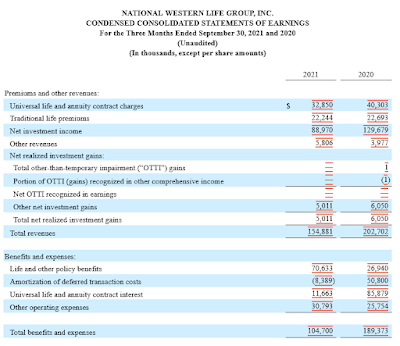
The conundrum is showing up most clearly in life insurers' results. Here, for example, is the NWLI income statement for Q3 2021:

Death benefit pay-outs up by over 2.5X?  It’s like these guys were underwriting life insurance in SF in 1985. And now we are seeing that Q4 2021 loss ratios have increased huge percentages over the Q4 2019 figures. Edward Dowd has started documenting life insurance company financial results for the 4th quarter 2021, and they are not good. Working-age claims (presumably the 55-65 demographic) are running 30-60% above pre-vaccine year-ago quarters of 2019 and 2020. Many life insurance companies swung from quarterly profits to losses. [ZH]

My hypothesis, that the spike protein is essentially doubling the mortality rate, may seem extreme. But that is what it would mean if it simply aged everyone by about eight years - again, one Gompertz interval.

Odds of dying in 10yrs [1]:
60 yo's -- 15% -> 30%
70 yo's -- 30% -> 65%
80 yo's -- 65% -> 95%
90 yo's -- 95% -> 99%

Present day, number of Americans [2]:
55-65 yo's    24M
65-75 yo's    18M
75-85 yo's    12M
85+ yo's    4M

Therefore, in 2030 revised demographic counts:
65-75 yo's 21M -> 18M
75-85 yo's 12M -> 6M
85-95 yo's   6M -> 0.6M
95+ yo's      de minimis

That is a 66% drop in the right-tail, and twice as many early deaths among the youngest cohort of pensioners. Pension obligations fall commensurately: pension crisis averted. Medicare and post-retirement health obligations are probably reduced as well.

This bears watching closely in the year ahead. Unlike the “trust-science” propaganda, death benefit payouts don't lie and can't be gamed. Finally, increased claims, and if we get them, rising interest rates are not going to be kind to most life insurers.

Life insurer results for Q2-2022 will tell the tale. Q1 confounded by boosters. If Q2 comes in ugly then we’ll know the damage is likely cumulative and long-term.