Showing posts with label PM. Show all posts

Thursday, April 20, 2023

Philip Morris International Inc. ($PM) - Q1 2023 Earnings

PM reported earnings and gave an investor presentation this morning. The current market capitalization (at $97 per share) is $150 billion and the enterprise value is $193 billion. Operating income in Q1 was $2.8 billion at a 34.1% margin. Smoke-free product revenues were 34.9% of total revenue. Total volume shipped was down 1.1% with heated tobacco up 10.4%. Management guidance for this year's adjusted diluted EPS is $6.10 to $6.22 per share, which puts the shares at just shy of 16x earnings. If they hit their guidance for 2023, that would be 7-9% growth in EPS over 2022 earnings. 

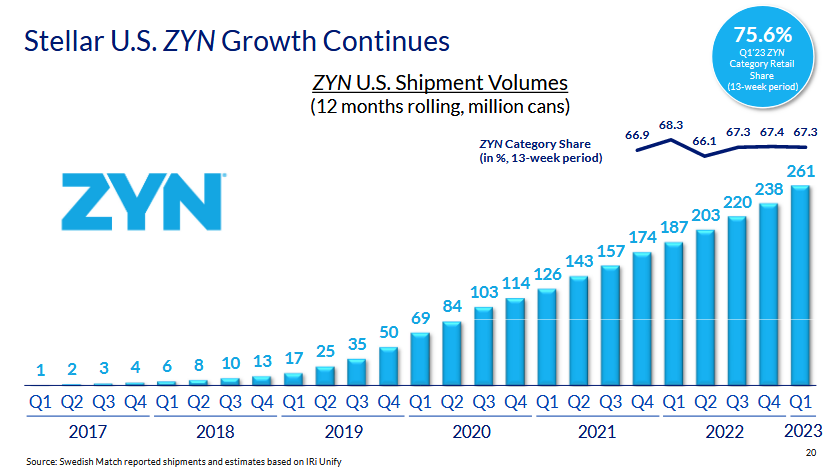
Almost painful to see how well Zyn is doing after the Swedish Match acquisition. If it were still a stand-alone entity, it seems likely that we would have consolidated all of our tobacco investments into it (in order to escape Altria's Bungles and the problem of the vaping competition free-for-all). The Zyn market share is 67% and the value share is 76% - this is a stronger monopoly than any cigarette brand or company has ever achieved.
Highlights from the conference call:

  • I am pleased to report that Q1 performance exceeded our expectations, with strong underlying momentum from IQOS, ZYN and our combustible business. As mentioned at our full-year earnings in February, we expected this quarter to be the weakest of the year due to a confluence of transitory factors impacting our top- and bottom-line. In this context, our business delivered robust results and we look forward with confidence to the remainder of the year.
  • Smoke-free net revenues made up almost 35% of total PMI, despite the impact of adverse timing factors on HTU shipments, with an increasing number of markets crossing the 50% threshold.
  • In combustibles, accelerated pricing across a range of markets helped to deliver robust organic net revenue growth. Swedish Match delivered impressive results, with a stand-out performance from ZYN’s 47% U.S. shipment volume growth compared to the first quarter of 2022.
  • While the increasing mix of HTUs in our business, at higher net revenue per unit, continues to positively impact our performance, lower shipments in Europe this quarter due to wholesaler and distributor inventory movements limited the benefit.
  • Our updated full year adjusted diluted EPS forecast of $6.10 to $6.22 includes an estimated unfavorable currency impact of 30 cents. Positive estimated impacts from the Euro and a number of other currencies are outweighed mainly by the weakness of the Japanese Yen, as well as the significant depreciation of the Russian Ruble and the Egyptian Pound.
  • Let’s examine ZYN’s recent U.S. performance in more detail. Superb progress continues with a record increase in 12-month rolling shipment volumes of 23 million cans, which equates to 40% growth. Category volume share remained essentially stable despite continued heavy competitive discounting from less premium offerings. Importantly, retail value share for ZYN also remains strong at 75.6%, highlighting its premium positioning and superior brand equity. There are two key engines driving the U.S. growth of ZYN, as covered at CAGNY. First is the progressive increase in distribution, with the number of stores 13% higher than Q1, 2022 at around 140,000. There remains ample opportunity to further increase this over time. Second are velocities, or the number of cans sold per store per week. ZYN velocities continue to grow sequentially and by an impressive 21% compared to prior year as the brand continues to resonate with adult nicotine users.
  • We continue to work on our IQOS U.S. commercialization plans for launch in Q2 2024, in line with the principles outlined at the recent CAGNY conference. With the benefit of the expertise and commercial tools from launching IQOS successfully in over 70 international markets, and a U.S. market with a clear regulatory framework and the ability to communicate with adult smokers, we remain very positive about the opportunity. Importantly, we believe we can make the necessary investments in the U.S. business, generating additional top-line performance while continuing to deliver strong bottom-line growth for PMI during the investment period.
  • Another key mid-term opportunity from the Swedish Match combination is the international expansion of nicotine pouches, notably with ZYN -- the world’s leading brand. 
  • While staying clearly focused on the heat-not-burn and nicotine pouch categories, which present the largest and most accretive growth opportunities, we are adjusting our VEEV e-vapor portfolio and approach. We intend to focus on commercializing in select markets and prioritizing profitability given the known category challenges. VEEV ONE is a new pod-based system providing an enhanced user experience with fully outsourced manufacturing of devices and consumables to optimize costs. VEEV ONE will replace the current VEEV product and, as a result, we no longer intend to file a PMTA for the former technology. Instead, we will focus our near-term FDA engagements on IQOS and ZYN. We will come back on future e-vapor FDA authorizations in due course.
  • I think we've already been clear that while we were clearly developing some offering on the vaping category, this was not our priority. We had IQOS. And now I would say we are even more taken by two priorities, which are IQOS and ZYN. When you have such a fantastic team and the potential that they have to deliver very strong top line growth, volume growth, revenue growth and in a very nicely profitable fashion, that's really the priority. I guess you listened to us at CAGNY and we expressed the questioning that we have on the vaping category today, which are around the absence of clear regulation in many country. The fact that, that is giving way to an appropriate marketing activities, risk of underage consumption. And also the fact that this is a category where so far it's difficult. I'm not saying impossible, but difficult to see a lot of profitable model being developed.

An interesting discussion in the Q&A about how European cigarettes are holding up better than U.S.:

  • [Gaurav Jain] [T]he U.S. cigarette volumes industry level are quite weak, minus 9%. And then looking at the European data that you shared, it is -- the industry volumes are flat on what were already very strong comps. And the reasons what have been mentioned for the U.S. industry weakness, which is macro, weak consumer, stimulus payments going off, disposable e-cigarette growth, I could apply the same logic to EU consumer -- EU smoker and still the volumes are so much better than trend. So is there a -- can you explain like why are the U.S. smoker and EU smoker, why are they behaving so differently?
  • [Emmanuel Babeau] Gaurav, I cannot -- and I will have to consider that I'm not the greatest specialist of the U.S. consumer for combustible cigarettes. So I wonder myself to given an analysis. I think it's in line with my previous comment on the fact that so far, we have been a pretty good resistance from the consumer to same price increase and coping with inflation in Europe. I'm not able to tell you why there is a difference here. We know that the social model in Europe is different. You may have some more protection, some more safety needs that are playing and maybe limiting the impact of inflation. There was maybe more compensation given from various government on trying to fight again energy price increase and sometimes compensating of agricultural product inflation across a number of geographies. So that can be one element to explain why the European consumer is resisting better. But I'm not going to pretend that I have the perfect answer to your question. 

Still hoping that PM can get a hold of Juul cheaply and get it FDA-authorized in the U.S. The comment about the challenges of vaping are not so encouraging on that front, but at the same time PM are clever negotiators and play their cards close to their vest. This could be a way of softening up the Juul shareholders. And at least we know that PM is not likely to blow $3 billion on an unprofitable vape company.

Thursday, March 9, 2023

Will "nicotine as a service" be as lucrative as cigarettes were?

Wanted to expand on this week's post about Altria's Bungles because we have been rethinking the tobacco trade more generally. Recall that in order for the big tobacco basket to work as an investment, we needed two things:

  1. "Re-nicotinization," where the number of people using nicotine (in whatever form) stops declining and preferably grows.
  2. A growing nicotine industry profit pool, with the vast majority of it captured by big tobacco: MO, PM, and BTI.

We are still confident in the first proposition. We see plenty of happy Zyn customers. We also see plenty of people vaping.

When oil prices spiked last summer, it hurt cigarette sales. However, when oil prices declined through the end of the year, cigarette sales did not recover or bounce. At Altria, cigarette volumes were down 11% year-over-year in the second quarter of 2022, and down 12% year-over-year in the fourth quarter

BTI's U.S. cigarette volume was down 13.4% in the first half of 2022, and was down 15.5% for the full year. If you back out the first half, that means that the U.S. combustible volumes were down 17% for the second half of 2022 vs 2021. 

What happened? We wonder whether high gas prices were a catalyst for some smokers to switch to a reduced risk nicotine product and quit cigarettes. That would explain the lack of a bounce after gas prices fell. If that is true, there is a negative asymmetry in the cigarette business; a one-way ratchet where bad circumstances push smokers away from cigarettes and nothing brings them back.

Why is it bad that people are quitting cigarettes? Wasn't that our "re-nicotinization" thesis? Yes, but that was assuming that the reduced risk product profit pool would be as big or bigger than the cigarette profit pool, and that it would be captured by the incumbent tobacco companies.

The cigarette business is basically a duopoly, hence very profitable. The reduced risk products have tons of competition. When we see people vaping now, we often see them using cheapo, open-tank products. The telltale sign is when the billowing smoke cloud smells like something like fruit or candy.

It is concerning that the big tobacco companies have growing sales of reduced risk products, yet the only reduced risk products that seem to be profitable are Zyn in the U.S. and IQOS in Europe. BTI lost 400 million GBP last year in "new category" (reduced risk products) on 2.9 billion GBP of sales. Altria's only reduced risk product before the NJOY acquisition is the "on!" nicotine pouch, which is almost certainly a money loser.

It is seeming possible that re-nicotinization is happening, but that the nicotine as a service business is going to remain fragmented enough such that the profit pool that used to exist in cigarettes is substantially diminished. 

Big tobacco is at a disadvantage in vaping because it has been playing by the rules. If you can only sell tobacco flavored vapes, you are going to lose out to "disruptors" who do not follow the rules and can sell watermelon or cotton candy flavored ones. BTI's U.S. subsidiary has asked the FDA to crack down on the illegal vapes, but they are still for sale. Can the FDA stop strip mall vape stores and gas stations from selling Chinese vaping trinkets to willing buyers? It's an open question. They do not have a police force.

And even if they can, what assurance do we have that the authorized reduced risk nicotine market is going to be a profitable duopoly the way that cigarettes were?

The premarket tobacco applications (PMTAs) required by the FDA were onerous, but not so onerous that only big tobacco companies participated. They received applications for millions of products. So far, they've approved products created by Japan Tobacco, NJOY, British American, and Philip Morris, and presumably will approve more. 

Also, once they have gone through all of the PMTAs and it is clear what kind of product they will accept, what stops competitors from launching me-too products that are also FDA authorized, so that they can grab some of the fat margins? (And perhaps the illegal black market open tank products are here to stay as well.) If you recall our original tobacco post from 2019, the idea was that big tobacco would have sufficient regulatory capture to have a moat around reduced risk nicotine products. 

Instead, reduced risk nicotine products are seeming like a free-for-all. If true, that would mean that the glory days of tobacco profits are going to come to an end.

It has been a good run. Since our post, "What I Would Buy Instead of Tesla" in October 2020, Altria is up 42% and has paid significant dividends. The performance of Philip Morris and British American has been even better.

Monday, March 6, 2023

Altria's Bungles

We only just finished speculating about the future of the tobacco and nicotine ("nicotine as a service") industry, but now we must discuss the latest moves by Altria. First, here is what we said last month about Altria and the "tobacco basket":

Altria management really bungled M&A over the past five years, by paying so much for Juul that they had no ability or inclination to bid when a really great asset (Swedish Match) got put on the block. They now have basically no reduced risk program, except what they can salvage from the Juul investment. [...]

As long as the cigarette business is doing well (i.e. earning north of $10 billion), it would not seem to make sense to sell Altria at this valuation. But this company is a mess, and it would be nice to see it cleaned up.

One option would be to exit all of the businesses besides smokables and traditional oral tobacco: sell the BUD stake, sell the Juul interest, and shut down "on!". Suppose that you could get $15 billion for that. We sure wouldn't mind getting, say, a $3.76 special dividend (equivalent to a current year's) with the rest to be used for perhaps debt reduction or share repurchases.

The problem with this is that a tobacco company without a reduced risk platform is vulnerable in the current political climate. It seems essential to be able to point to a "future after tobacco" to keep society's current anti-nicotine mood at bay.

If Philip Morris does not want to reunite with Altria, then Altria is probably going to just limp along selling mostly cigarettes. So the key questions will be: will the tobacco earnings keep growing, and is there any chance that they can get control of Juul and turn it into a profitable business. It is still the best and most popular vape thanks to the superior nicotine chemistry. [...]

We come away from this reflection thinking that the equal weighting of PM, MO, and BTI is still the right approach. There is no clear winner from an investment perspective, at least not yet, because of the wide dispersion in valuation. 

Right before the weekend, Altria announced that they sold (really, gave away) their entire 35% stake in Juul Labs, Inc., for which they paid $12.8 billion, in exchange for "a non-exclusive, irrevocable global license to certain of JUUL’s heated tobacco intellectual property". Then today, Altria confirmed a rumored purchase of NJOY Holdings: they are paying $2.75 billion (plus a possible further $500 million) for the company, which has an FDA-authorized pod vape called the NJOY ACE.

These are just very discouraging developments at Altria and some tobacco investors are kidding themselves thinking anything else.

Juul is the best vaping product, hands-down, the same way that Zyn is the best oral nicotine product. Last year, Altria let Philip Morris buy - practically steal - Swedish Match and Zyn without lobbing a bid or even expressing interest that might have raised the cost for its competitor. It would not surprise us if Philip Morris gets a hold of Juul (which still the vape leader with close to 40% market share) and turns it into a cash cow. (What would be really amazing is if PM uses its regulatory connections to get an authorization - MGO - for Juul vapes but only after buying it at a great price.)

But Altria won't make a penny off of a Juul acquisition or turnaround. All they are getting is a non-exclusive IP license for heated tobacco, which implies that they are going to waste more money trying to buy or acquire a heated tobacco product for the U.S. Didn't they learn from the poor performance of IQOS in the United States that heated tobacco does not appeal to U.S. nicotine consumers?

Then they went on to pay $2.75 billion for a vape which, while FDA-authorized, has only one-tenth the market share of Juul. In the release, Altria comments that "NJOY-branded products were not included among the most often used usual brand among middle and high school e-cigarette users in the 2022 NYTS." As though that is a good thing!

Altria gets the worst of negotiations. If they got the better of negotiations, they would not have walked away from Juul without getting cash. Nor would they have paid cash for NJOY. A respectable deal would have been to pay some nominal amount (maybe as low as $0) for 51% of the company with the promise to invest in building the brand and trying to grow market share from sub-3% to something serious.

What we would have liked to see is: get paid big bucks for Juul, pay nothing for NJOY (get a free option), and distribute the balance to shareholders. Even better would have been if Altria had gotten control of Juul. Imagine a "Marlboro" Juul.

Instead, the problem is the same as it was in 2018 when they bought Juul: they are desperate to get out of cigarettes. Perhaps this is rational, as we speculated in our February post. Maybe regulators and society will not tolerate a pure-tobacco company operating in runoff. But if that is the case, we can probably expect a couple billion dollars a year of cash wasted by Altria flailing unsuccessfully to create a reduced-risk product.

And, if that is the case (that they need some kind of reduced risk product in order to be able to enjoy their runoff cigarette profits), then they really should have tried to trade their BUD stake for Swedish Match last year.

We no longer believe in an equal basket of MO, PM, and BTI. Maybe a half-weight for Altria is appropriate, given the low valuation the market puts on Altria's cash flows from tobacco. But we probably need to assume that at least $1 billion of the cigarette cash is going to get eaten up every year on reduced risk bungles. It is almost like an extra tax on their cigarette business.

We wonder whether Altria will end up in a few years being taken-under by Philip Morris at a share exchange ratio that is less favorable than today's?

Friday, February 17, 2023

Tobacco - Q4 2022 Earnings Season

When we look at the FY 2022 results for our three tobacco companies (Philip Morris, Altria, and British American Tobacco), we have two questions: how did the cigarette businesses do, and how did the reduced risk ("nicotine as a service") businesses do?

Altria

Here is a good look at how the Altria cigarette and oral tobacco/nicotine businesses have been doing.


Q4 2022 Q4 2021 y/y ch Q4 2019 3 year change
Cigarettes (mm sticks) 19,707 22,423 -12% 23,116 -15%
Smokeable Revenue ($mm, net of excise) 4,456 4,457 0% 3,991 12%
Revenue per pack $4.52 $3.98 14% $3.45 31%
Smokeable operating income 2,576 2,493 3% 2,145 20%


Oral tobacco (mm cans) 197 206 -4% 200 -1%
Oral tobacco revenue ($mm, net of excise) 604 629 -4% 574 5%
Revenue per can $3.06 $3.05 0% $2.88 7%
Oral tobacco operating income 370 390 -5% 385 -4%

Earnings in the cigarette business have grown thanks to the time-honored formula of raising the price of the pack enough to offset big volume declines. As you saw in our earlier pipeline post, over the three year period from December 2019 through December 2022, the CPI rose by 15%. Altria has been able to raise the price of the pack by twice as much as inflation (31%) over the same period. Even with the volume declines, this has allowed the smokeable operating income to outpace inflation. (It should also be remembered that the high gas prices in 2022 made things very difficult for cigarette sales.)

Quick and dirty valuation of Altria: the market capitalization at $48 per share is $85 billion and the enterprise value is $114 billion. They own 10% of BUD which is worth about $12 billion at the current market price of $59 per share. Net income for Altria for 2022, adjusted for special items like non-cash charges, was $8.7 billion. So the market capitalization less BUD divided by that adjusted net income is about 8.4 times. That treats the Juul and Cronos stakes as worthless. We could also look at the Q4 operating earnings from the smokable and oral segments (before interest and tax) as being $11.8 billion annualized, which would be an 11.5% yield on the enterprise value.

Altria management really bungled M&A over the past five years, by paying so much for Juul that they had no ability or inclination to bid when a really great asset (Swedish Match) got put on the block. They now have basically no reduced risk program, except what they can salvage from the Juul investment. (Juul does still have the largest market share in vaping, at close to 40%, but Altria only owns a minority interest.) It seems quite likely that Altria's "on!" oral nicotine product (which they acquired in 2018) is depressing the profitability of the otherwise lucrative oral tobacco segment (selling Copenhagen and Skoal). 

As long as the cigarette business is doing well (i.e. earning north of $10 billion), it would not seem to make sense to sell Altria at this valuation. But this company is a mess, and it would be nice to see it cleaned up.

One option would be to exit all of the businesses besides smokables and traditional oral tobacco: sell the BUD stake, sell the Juul interest, and shut down "on!". Suppose that you could get $15 billion for that. We sure wouldn't mind getting, say, a $3.76 special dividend (equivalent to a current year's) with the rest to be used for perhaps debt reduction or share repurchases.

The problem with this is that a tobacco company without a reduced risk platform is vulnerable in the current political climate. It seems essential to be able to point to a "future after tobacco" to keep society's current anti-nicotine mood at bay.

If Philip Morris does not want to reunite with Altria, then Altria is probably going to just limp along selling mostly cigarettes. So the key questions will be: will the tobacco earnings keep growing, and is there any chance that they can get control of Juul and turn it into a profitable business. It is still the best and most popular vape thanks to the superior nicotine chemistry.

Altria's adjusted earnings per share has grown from $4 in 2018 to $4.84 in 2022, a 4.9% compounded annual increase which was slightly faster than inflation. Paying ~8x earnings for a business with earnings growing faster than inflation, and with an option (even if unlikely) on Juul does not seem like a bad deal.

Philip Morris

There is always a strong contrast between Altria and Philip Morris, the way there is with Magellan Midstream and Enterprise Products. Cigarette sales in PM's foreign markets are declining more slowly, and they have a heated tobacco product (IQOS) that is seriously growing in foreign markets. ("Full-year smoke-free net revenues reached almost one third of total PMI and over 50% in 17 markets.")

PM's cigarette volumes fell 2.8% between Q4 2021 and Q4 2022, but its heated tobacco units grew 26.1%, with the result that overall volumes grew by 1.2%. Year-over-year, net revenues for combustible tobacco grew 1% and smokefree grew 27%, resulting in overall revenue growth of 8%. (All figures excluding the effect of Russia/Ukraine, currency, and acquisitions.)

PM's current market capitalization (at $102 per share) is $156 billion and the enterprise value is $200 billion. Net income for the year was $9 billion - PM shares trade at a much more expensive 17 times earnings. PM does not disclose segment earnings for cigarettes versus smokefree (only the revenues).

But PM has better cigarette businesses and better reduced risk businesses, especially now that they own Swedish Match and Zyn. Here was their discussion of Q4 results:

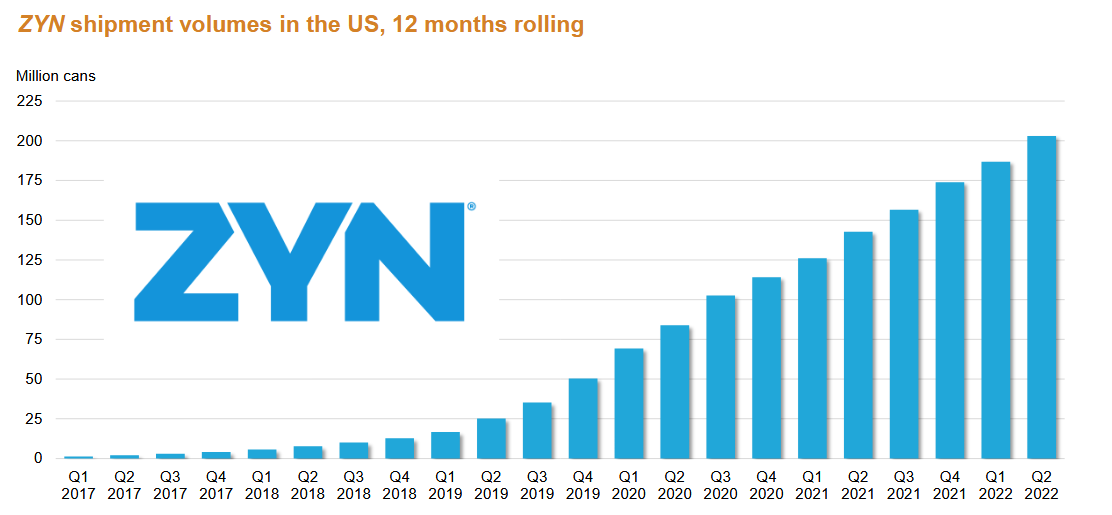
Now let's discuss ZYN's recent U.S. performance in more detail. Excellent progress continues with shipment volume growth of plus 37% in 2022 and plus 35% in Q4, reaching a record quarterly high. ZYN category volume share grew sequentially by one percentage point compared to the third quarter and by 2.2 percentage points compared to the prior year, further strengthening its position as the clear number one nicotine pouch brand despite continued heavy competitive discounting from less premium offerings. Importantly retail value share for ZYN remains strong at 75.7%, highlighting its premium positioning and high brand equity. 

That is in contrast with Altria's "on!", which we suspect Altria is giving away at a loss. Of all of our nicotine businesses, PM seems best positioned to benefit from re-nicotinization (we think that Zyn is going to continue to grow gangbusters), except that it lacks a good vape product! It was reported last month that Juul is in talks with PM, Japan Tobacco, and Altria.

Notice that Altria and PM had roughly the same net income last year even though PM's market capitalization is 84% higher. Altria makes almost as much money selling just cigarettes in the U.S. as PM does selling cigarettes and IQOS to the entire rest of the world.

Maybe the best case scenario is for PM and Altria to reunite. Then they can have the #1 cigarette worldwide (Marlboro), the #1 oral nicotine product (Zyn), the #1 heated tobacco product (IQOS), and the #1 vape (Juul). They could shut down a bunch of junky also-ran products, and focus some serious lobbying might on getting rid of open-tank vaping competition.

British American Tobacco

BTI is an interesting hybrid of PM and Altria: they sell in the U.S. and the rest of the world, and they have some decent reduced risk products. BTI has a market capitalization (at $38 per share) of $84 billion and an enterprise value of $131 billion. Last year they earned about $8 billion, putting the shares at around 11 times earnings.

BTI does not report quarterly results, but we have their annual results for 2022 now in hand. Their combustibles volumes were down 5.2% for the full year 2022 versus 2021, and revenues were down about 1% in constant currency. The combustibles business earned about $14 billion in 2022, roughly the same as in 2021.

Their "new category" (reduced risk) product volumes were way up for 2022 versus 2021. Their vape (Vuse) volumes were up 14%, heated tobacco (glo) was up 26%, and modern oral (Velo) was up 22%. Revenues in constant currency for those products were up 44%, 27%, and 46%, respectively. The new categories businesses reduced their operating loss from $1.1 billion in 2021 to $450 million last year. They have said that they expect this category (which now represents 15% of total revenue) to be profitable in 2024.

BTI combines worse cigarette brands than what PM and MO have (they were especially dependent on menthol) with a reduced risk portfolio that is certainly better than what MO has and in some spots (Vuse vape) better than what PM has. Another possibility for industry M&A would be for BTI and MO to combine. As with the PM and MO combination possibility, the Altria cigarette earnings would be very meaningful to BTI.

Conclusion

We come away from this reflection thinking that the equal weighting of PM, MO, and BTI is still the right approach. There is no clear winner from an investment perspective, at least not yet, because of the wide dispersion in valuation.

Monday, August 1, 2022

Tobacco Earnings - Q2 2022 ($MO $BTI $PM $SWMAY)

Tobacco stocks had a bit of a rough quarter and have had a rocky year so far. Altria fell from a 52 week high of almost $56 to as low as $41, but has recovered to about $44. Philip Morris collapsed from a 52 week high of almost $110 when Russia invaded Ukraine, almost got back there in late May, but took a tumble as well. British American Tobacco was affected by Russia/Ukraine exposure as well, and had a particularly ugly day this past Friday.

We don't care so much about the share prices, we care about how the businesses are doing and what kind of owner earnings and dividends we will be receiving. Maxim: "share prices are more volatile than corporate cash flow, which is more volatile than asset replacement cost." So, let us take a look at the product sales and earnings for our four companies.

British American Tobacco

British American Tobacco (previously) sells cigarettes (Camel, Lucky Strike, Newport, American Spirit) and "New Categories" (safer nicotine) products: the Vuse vape, the Glo heat not burn product, and Velo "modern oral" nicotine pouches. The safer nicotine products grew revenue 45% for the first half of 2022 vs 2021, and now represent 15% of total revenue. The biggest contributor is the Vuse vape product, responsible for about half of total new category revenue. Also notice that new category revenue was up more than volumes meaning that these products have pricing power. (But note that the reduced risk product category is not making money yet - the new category segment lost about $300 million the first half of 2022.)

In the U.S., the new category revenue was up 70% (1H 22 vs 1H 21), and that is almost entirely from the vape product. (Re-nicotinization! The concept is taking off.) Also noteworthy, the U.S. cigarette volumes were down 13% but revenue was still up 3% (though down 3.4% in constant currency). Overall, profit was up 9% in the U.S. and operating margin here improved slightly to 47%. Here is what management said about its U.S. vaping regulatory progress:

In May 2022, we were delighted to receive Vapour marketing authorisations for Vuse Ciro and Vibe in original flavour from the FDA. Together with our Vuse Solo authorisation from last year, this gives the Group the broadest portfolio of market authorisations provided to any vapour company in the U.S., and we believe it also supports further confidence in our Vuse Alto Premarket Tobacco Product Application (PMTA), which shares the same foundational science. Subject to the ongoing FDA discretion, all Vuse products currently available in the U.S. may continue to be marketed.

BTI had a market cap of $92 billion and net debt of $50 billion dollars for an enterprise value of $142 billion. During the first half of 2022, BTI generated about $5.2 billion of cash flow and returned $4.5 billion to shareholders. If you annualize that, it is a cash flow yield on the enterprise value of about 7%. The earnings multiple on the stock will of course be more attractive than this because of the leverage, probably about 10x or just below.

Altria


Altria (previously), of course, sells Marlboro cigarettes, Copenhagen and Skoal oral tobaccos, the On! nicotine pouch, and owns 35% of Juul, 10% of BUD, and 45% of Cronos. 

During the second quarter, Altria's smokeable products segment reported domestic cigarette shipment volume decreased 11.1%. That is a bad decline, but it was during the quarter with sky-high gasoline prices. Also, revenues net of excise taxes were only down 0.7% and the operating income for smokeable products was only down 0.5%. (It was $2.76 billion for the quarter and $5.3 billion year-to-date.) The smokeable operating margin is 59%.

Selling Marlboros in the U.S. is still a business that makes close to $11 billion a year pre-tax. Altria's market capitalization is $79 billion and enterprise value is $108 billion. The market cap of BUD is $92 billion, which is $9.4 billion for Altria's stake. If you adjust for that the MO market cap is $70 billion and the EV is $99 billion. So the valuation for the tobacco/nicotine business is currently about an 11% FCF yield on the EV, and about 8 times earnings. (And that is ignoring whatever value Juul and Cronos may have.) (Their guidance is for 2022 full-year adjusted diluted EPS in a range of $4.79 to $4.93, which would be a 9x P/E on the low end.)

Oral tobacco (which inclides on!) made $430 million in Q2 and $837 million YTD. Altria paid $11.7 billion for U.S. Smokeless Tobacco in 2008 and also got Ste. Michelle Wine Estates, which they sold for $1.2 billion last year. It was a great acquisition

What is sad is that the failure of the panicked, desperate investment of $13 billion in Juul at a $38 billion valuation has made them shy about strategic investments. I thought that Altria could and would buy Swedish Match:

If Juul's PMTA is approved, it makes sense for Altria to take-under the remaining Juul stake that it doesn't own, possibly structuring the transaction in a way that sheds the startup-era liabilities. (Maybe a bankruptcy or purchase an exclusive license of Juul combined with a sale of their minority stake back to the company for $1 to realize the tax loss.)

Altria should reunite with Philip Morris, and together they should buy Swedish Match. Together they would have the #1 cigarette (Marlboro), #1 closed tank vape (Juul), #1 oral nicotine lozenge (Zyn), #1 snus (General), #1 heat not burn tobacco product (IQOS), and the #1 and #2 dipping ("moist snuff") tobaccos (Copenhagen / Skoal).

And then... no more acquisitions! All that cash flow could roll on home to shareholders.

But as is often the case, after making one type of error (of commission), they proceed to make the inverse type (of omission). They are letting Philip Morris steal Swedish Match, which would've been a great acquisition in its own right, and a blocking move against PM, who want to take away distribution for IQOS from Altria and use the network Swedish Match has built up in the U.S.. Altria isn't even lobbing in a bid to make it more expensive for PM!

Altria's on! product is junk, so their only hope of being involved in re-nicotinization is to get PMTA approval for Juul. (Which is a great product.) The good news is that at the price we are paying for MO, we should do OK even if none of the reduced risk bets work out and we just get the tobacco earnings runoff. It is also interesting that tobacco gets hurt when oil prices squeeze and will presumably benefit in Q3 now that oil has fallen - it diversifies the energy portfolio.

Philip Morris


Philip Morris (previously) reported cigarette volumes up 1% in Q2 versus the prior year and heated tobacco units up 1.9%. (These numbers are dragged down by the loss of Russia and Ukraine business.)

Net revenues for the quarter were flat at $7.8 billion and operating income was down 2% at $3.1 billion. Note that the E.U. region contributes half of PM operating income ($1.55 billion) and the next largest, Middle East & Africa, contributes $500 million.

The current market capitalization at $99 per share is $153 billion, and the enterprise value is $178 billion. During the first half of this year, the company has generated about $4.8 billion of free cash flow. (And has returned $4 billion to shareholders, mostly through dividends.) This is pretty consistent with our past thinking of $10 billion of free cash flow for the year. (Current management guidance is $10.5 billion for this year.) 

That puts PM at a FCF/EV yield of 5.6%, noticeably more expensive than BTI or MO. The valuation premium exists because PM has a cigarette business that is still growing volumes, has a strongly growing reduced risk business (revenue up 10% over last year), is more geographically diversified, and in recent years has allocated capital better than Altria. You'll notice that when the regulatory capture revolving door swings, PM is where you go:

A Food and Drug Administration official with considerable power over authorization decisions for e-cigarettes and products aimed at curbing smoking resigned on Tuesday to work for Philip Morris International, the global tobacco conglomerate and maker of Marlboros.

The official, Matt Holman, was chief of the office of science in the agency’s Center for Tobacco Products. In a memo to the staff on Tuesday, Brian King, the center’s director, wrote that Dr. Holman had announced that he would be leaving — effective immediately — to join Philip Morris. The memo said Dr. Holman had been on leave and, consistent with agency ethics policies, had recused himself from all tobacco center work “while exploring career opportunities outside of government.”

An example of the great capital allocation is the purchase of Swedish Match. While I suspect that they are going to have to raise their bid, they're probably going to pay on the order of what Altria paid for just a 35% stake in Juul, and get whole ownership of a business that earns $643 million net, growing at a double digit rate.

Swedish Match


Swedish Match (previously) reported smokefree sales up 29% in the second quarter, with revenue in the US up 26%. We had called Swedish Match our "growth stock," and it looks as though it is going to be stolen from us too soon. (CBS: "Our style of value investing rarely buys hockey stick growth, but here is hockey stick growth available for 18x earnings.") 

As most are already aware, Philip Morris reached a deal to acquire Swedish Match for SEK 106 per share. (That is USD $10.47, a market capitalization of $16 billion.) While we think that PM will have to up their bid, it appears likely that this business is going to go into the PM fold, where it will contribute to profits and be used as a battering ram against Altria's on! and as a backdoor to distribute IQOS in the U.S. without Altria. Also disappointing that the Swedish Match board didn't negotiate for PM stock - we would rather be able to roll the exposure into PM tax-free.

Swedish Match was a great investment but it is also interesting because of what it is saying about re-nicotinization. Given a safe way of dosing nicotine (such as an oral pouch with no tobacco leaf carcinogens), thoughtfully designed with good user attributes, lots of people who were never smokers are going to want to use nicotine for a mood/productivity boost. (See Tucker Carlson and Edward Luttwak.) From the Q2 call:

[T]he nicotine pouch category is rapidly growing relative to cigarette. Measured by volume and according to IRI data, and we make 1 can of nicotine pouches equivalent to 1 type of cigarettes, nicotine pouch volume for the year-to-date period was well above the 10% benchmark in the west and exceeded 4% on a national level. Based on indications of average weekly consumption levels for consumer ranging from 2 to 3 cans, our estimate of the number of ZYN users relative to the number of cigarette smokers on a national level is in the range of 5% to 7%.

The FDA is attempting to stand in the way of beneficial re-nicotinization, just like they are constantly gunning for our OTC supplement regimens. But in a sclerotic country, it may be good to bet on regulatory capture and the status quo prevailing.