Showing posts with label SHLD. Show all posts

Monday, October 7, 2019

"Sears Wins Liquidation Plan Approval"

Today:

"Sears Holdings Corp. won court approval Monday of a chapter 11 liquidation plan requiring suppliers that kept its shelves stocked in bankruptcy to wait for their money or take a discounted payoff."
Our posts about the decline of Sears over the years: (1, 2, 3, 4, 5). Also,the post from last spring where we noticed the Sears capital structure mispricing. And our post last September about Eddie's last ditch attempt to keep Sears out of bankruptcy:
Here is something I do not understand about Eddie or Elon Musk. They each made a serious entrepreneurial mistake over a decade ago and have been dealing with the miserable consequences ever since. Why keep prolonging it?
Just finished a book called Dead Companies Walking by a short seller. He would say that Lampert and Musk are typical hyper-competitive types in business who do not know when to quit.

Tuesday, September 24, 2019

Sears Holdings Bankruptcy Update

To address the timing mismatch of the Debtors’ assets and administrative claims, the Debtors intend to proceed with confirmation now and prosecute litigation with the oversight of the Litigation Designees who will be appointed effectively immediately upon entry of the Confirmation Order (and, on the Effective Date, will become the initial members of the Liquidating Trust Board), but intend to go effective once the Debtors either reconcile or settle with certain Administrative Expense Claimants. But the Debtors believe and will prove at the Confirmation Hearing that they have been and remain administratively solvent. The Debtors have met with certain Administrative Expense Claim creditors and proposed a settlement to such creditors in exchange for accepting a reduced but accelerated recovery on their Administrative Expense Claims. A construct for Administrative Claim settlements is attached hereto as Exhibit B (the “Administrative Expense Claims Settlement Proposal”). Negotiations among the Debtors and a group of ad hoc administrative creditors holding certain asserted Administrative Expense Claims are ongoing. In the Debtors’ view, and as the evidence demonstrates, such a settlement is “nice to have”—not a “must have.”

Tuesday, July 9, 2019

Sears Holdings - Notice of Confirmation Hearing

1. Approval of Disclosure Statement. By order dated June 28, 2019 (ECF No.4392) (the “Order”), the United States Bankruptcy Court for the Southern District of New York (the “Bankruptcy Court”) approved the Disclosure Statement for Second Amended Joint Chapter 11 Plan of Sears Holdings Corporation and Its Affiliated Debtors dated June 28, 2019 (as it may be amended, modified, and supplemented, the “Disclosure Statement”) filed by Sears Holdings Corporation and its debtor affiliates, as debtors and debtors in possession in the above-captioned chapter 11 cases (collectively, the “Debtors”) (ECF No. 4390). The Bankruptcy Court authorized the Debtors to solicit votes with regard to the approval or rejection of the Second Amended Joint Chapter 11 Plan of Sears Holdings Corporation and Its Affiliated Debtors, dated June 28, 2019 (as it may be amended, modified, and supplemented, the “Plan”),2 annexed as Exhibit A to the Disclosure Statement. Any capitalized terms used herein and not otherwise defined herein shall have the meanings ascribed to such terms in the Plan.

2. Confirmation Hearing. A hearing (the “Confirmation Hearing”) to consider confirmation of the Plan will be held on August 16, 2019 at 10:00 a.m. (Prevailing Eastern Time), before the Honorable Robert D. Drain, United States Bankruptcy Judge, in Courtroom 118 of the United States Bankruptcy Court for the Southern District of New York, 300 Quarropas Street, White Plains, New York, 10601. The Confirmation Hearing may be continued from time to time without further notice other than the announcement by the Debtors at the Confirmation Hearing or any continued hearing or as indicated in any notice filed by the Debtors with the Bankruptcy Court, and the Plan may be modified, if necessary, prior to, during, or as a result of the Confirmation Hearing, without further notice to interested parties.

Thursday, April 18, 2019

Sears Files Plan of Reorganization

Highlights:

*The Plan contemplates a Wind Down of the remaining assets of the Debtors’ estates—primarily litigation claims—and a distribution to creditors in accordance with the absolute priority rule and certain settlements, as described herein. Specifically, the Plan provides for the approval of the settlement with the Pension Benefit Guaranty Corporation (the “PBGC” and, such settlement, the “PBGC Settlement”).

*On the Effective Date of the Plan, all of the Debtors’ assets will be transferred to the Liquidating Trust (defined below) and the Debtor legal entities will be dissolved. A Liquidating Trustee and board of directors will be appointed to carry out the terms of the Plan. The Plan constitutes a single chapter 11 plan for all of the Debtors and the classifications and treatment of Claims and Interests therein apply to each of the Debtors separately. The Plan does not propose to substantially consolidate the Debtors.

*On the Effective Date, all Existing SHC Equity Interests shall be cancelled. Each such holder thereof shall: neither receive nor retain any property of the Estate or direct interest in property of the Estate of SHC on account of such Existing SHC Equity Interest.

*Disclosure Statement Objection Deadline: May 9, 2019 at 4:00 p.m.
Voting Record Date: May 9, 2019
Disclosure Statement Hearing: May 16, 2019 at 10:00 a.m.
Plan Confirmation Hearing: July 23, 2019 at 10:00 a.m.

Monday, April 15, 2019

Sears Asks for More Time to File Chapter 11 Plan

Sears Holdings Corporation and its debtor affiliates, as debtors and debtors in possession in the above-captioned chapter 11 cases (collectively, the “Debtors” and, together with their non-debtor affiliates, “Sears” or the “Company”), file this motion (the “Motion”) for entry of an order further extending the periods during which the Debtors have the exclusive right to file a chapter 11 plan (the “Exclusive Filing Period”) and to solicit acceptances thereof (the “Exclusive Solicitation Period,” and together with the Exclusive Filing Period, the “Exclusive Periods”) by two (2) months through and including June 12, 2019 and August 13, 2019, respectively.

*The Debtors are seeking another modest extension of the Exclusive Periods at this critical juncture of their chapter 11 cases in furtherance of their fiduciary duties and to continue to try to broker a consensual chapter 11 plan among their various stakeholders. Despite receiving only a two-month initial extension of the Exclusive Periods pursuant to the first exclusivity order entered on February 15, 2019 (ECF No. 2626) (the “First Exclusivity Order”), the Debtors have made significant progress on a chapter 11 plan. Since the First Exclusivity Order was entered, the Debtors have drafted a proposed chapter 11 plan and accompanying disclosure statement and distributed the plan to their key stakeholders, including the Official Committee of Unsecured Creditors (the “Creditors’ Committee”), the Pension Benefit Guaranty Fund (the “PBGC”) and Cyrus Capital Partners, L.P (“Cyrus”). The Debtors have been working cooperatively with these parties and have conducted numerous calls and inperson meetings to negotiate the terms of the plan.

*Unfortunately, just over a month after obtaining approval of the sale transaction (the “Sale Transaction”) with Transform Holdco LLC (the “Buyer”) for substantially all of the Debtors’ assets, the Debtors have had to divert limited resources to take action to enforce the terms of the asset purchase agreement dated as of January 17, 2019 (as amended, “Asset Purchase Agreement”) against the Buyer to ensure that assets belonging to the Debtors’ estates are rightfully turned over to the Debtors. The Debtors have been pressing forward with their chapter 11 plan negotiations while simultaneously pursuing these assets. The outcome of this dispute will impact the analysis underpinning the plan, further bolstering the Debtors’ need for a modest extension of the Exclusive Periods.

Monday, March 11, 2019

Sears Holdings Expects to File a Chapter 11 Plan "in the coming weeks"

From an 8-K filing:

As previously reported, on October 15, 2018 (the “Petition Date”), Sears Holdings Corporation (the “Company”) and certain of its subsidiaries (collectively, the “Debtors”) filed voluntary petitions (the “Chapter 11 Cases”) in the United States Bankruptcy Court for the Southern District of New York (the “Bankruptcy Court”) seeking relief under chapter 11 of title 11 of the United States Code.

The Company does not believe that there will be sufficient funds or other assets in the Estate to allow holders of the Company’s common stock to receive any distribution of value in respect of their equity interests and expects to file a chapter 11 plan memorializing that belief in the coming weeks.
Our glorious efficient markets are working on pricing this in.

Monday, September 24, 2018

Eddie Makes a Sears Restructuring Proposal $SHLD

Eddie put out a presentation today called "Transforming Sears Holdings - A Proposal from ESL Investments, Inc." as a 13D exhibit. Some highlights:

  • Sears must act immediately to have sufficient runway to continue its transformation. To obtain this runway, Sears must extend near-term debt maturities, reduce its long term debt and eliminate the associated cash interest obligations.
  • We continue to believe that it is in the best interest of all stakeholders to accomplish this as a going concern, rather than alternatives that would substantially reduce, if not completely eliminate, value for stakeholders.
  • Sears now faces significant near-term liquidity constraints, including a $134mm maturity for Second Lien Notes due October 15, 2018.
The proposal to the second lien loan and noteholders is to choose between options A and B. The first option gives them new mandatorily convertible, zero coupon debt that would mature December 2021 instead of July 2020 for the 2nd lien loan and October 2019 for the 2nd lien notes. It would be convertible at the higher of $1 per share or the 20 day VWAP. The second option only applies to the 2nd lien notes, giving them the option to re-strike the conversion price to be equal to option A plus $1.25. Under option B, they get PIK interest at their existing rate. The maturity is pushed out until December 2022.

The unsecured debt holders also get two different options. (Actually, there are only two options for the holders of the cash unsecured notes, who did not accept Eddie's earlier exchange into PIK notes.) Option A is to exchange into mandatorily convertible, zero-coupon unsecured debt. The strike price would be $1 above the secured debt conversion price, and the conversion would take effect in December 2021, same as for the 2nd lien debt. Option B is that they can get taken out for 25 cents on the dollar.

So that is funny - zero coupon debt that is mandatorily convertible into equity is not really debt, it is just equity with a three year waiting period. There would never be any interest payments or cash flows for any secured or unsecured debtholders who exchanged into this. 

Eddie also proposes a "Real Estate Transaction". This is an odd one where a "Consortium" including ESL would refinance the debt encumbered real estate portfolio that Sears is currently marketing for sale. The members of the consortium would convert their loans to a PIK at an interest rate of 12.1%.

Overall, debt would be reduced from the current $5.6 billion to $1.2 billion (excluding the mandatorily convertible, zero-coupon debt). The result, if it takes place, is huge dilution of the current equity by the current 2nd lien debt and unsecured notes.

In the most recent quarterly report, there was a section called "Actions to Address Liquidity Needs".
The following actions, which are intended to fund liquidity needs over the next twelve months, are in various stages of completion as of the date of this filing. We believe these actions, some of which we expect, subject to our governance processes, including the process being overseen by the Special Committee, to include related party participation and funding and, in the case of Sale Assets that are sold to ESL, subject to approval by a majority of the disinterested stockholders of Holdings, if completed, would be sufficient to satisfy our liquidity needs for the next twelve months from the issuance of the financial statements.

[List:] Sales of properties securing the remaining principal amount of the Secured Loans to fund the repayment of such Secured Loans; Additional borrowings under the Mezzanine Loan Agreement, Term Loan Facility and the Consolidated Secured Loan Facility; Monetization of the Sale Assets; Extension of maturities beyond September 2019 of Line of Credit Loans under the Second Lien Credit Agreement; Additional borrowings secured by real estate assets, borrowings under the short-term basket, or other borrowings; Amendments to the terms of certain of our financing arrangements, including to allow interest on some of our debt to paid-in-kind; Further evaluation and right-sizing of our store base, including evaluation of our business categories; and Further restructurings to help manage expenses and improve profitability, including additional store closures and the accomplishments of our planned cost savings initiatives.

While we believe that completion of these actions would be sufficient to satisfy our liquidity needs for the next twelve months from the issuance of the financial statements, these actions have not been fully executed as of the date of this report and certain of the actions have not received necessary approvals (including but not limited to approval of the Special Committee and approval of a majority of the disinterested stockholders of the Company in the case of certain proposed transactions with ESL), and/or are at too early of a stage in the process to be considered probable of occurring under applicable accounting guidance as of the date of this report. Accordingly, because we cannot at this time conclude that these actions are probable of occurring under such accounting standards, substantial doubt is deemed to exist about our ability to continue as a going concern. The Company continues to move forward with these proposed actions, including the process being overseen by the Special Committee, and discussions with lenders, in order to complete these actions. The Company believes that completion of these actions, or in some cases substantial progress towards such completion, would alleviate or eliminate the substantial doubt. The Company will continue to reevaluate this assessment.

The PPPFA contains certain limitations on our ability to sell assets, including the Kenmore brand and related assets, which could impact our ability to complete asset sale transactions or our ability to use proceeds from those transactions to fund our operations. Therefore, the analysis of liquidity needs includes consideration of the applicable restrictions under the PPPFA and the ability to utilize related party borrowings to provide liquidity when there are short-term delays in the closing of transactions.

The success of the foregoing actions is subject to various risks, uncertainties and other factors, including market conditions, interest in specific assets and our ability to close the sales of assets at valuations and within time frames that are acceptable to us, our ability to effectively and timely execute the above actions to improve the operating performance of our businesses and, in certain cases, the approval and participation of third parties, including our creditors and the PBGC.

If we continue to experience operating losses and we are not able to generate additional liquidity through the actions described above or through some combination of other actions, then our liquidity needs may exceed availability under our Amended Domestic Credit Agreement, our second lien line of credit loan facility and our other existing facilities, and we might need to secure additional sources of funds, which may or may not be available to us. A failure to secure such additional funds could cause us to be in default under the Amended Domestic Credit Agreement or other financing agreement. Additionally, a failure to generate additional liquidity could negatively impact our access to inventory or services that are important to the operation of our business. Moreover, if the borrowing base (as calculated pursuant to our outstanding second lien debt) falls below the principal amount of such second lien debt plus the principal amount of any other indebtedness for borrowed money that is secured by liens on the collateral for such debt on the last day of any two consecutive quarters, it could trigger an obligation to repurchase our New Senior Secured Notes in an amount equal to such deficiency. As of August 4, 2018, our borrowing base was below the above threshold, and if our borrowing base is below the above threshold at the end of our third quarter of 2018, it would trigger an obligation to repurchase or repay second lien debt, in an amount equal to the excess of our funded debt secured by liens on our inventory as of November 3, 2018 over the borrowing base. If we fail to make such repurchase or repayment, we would be in violation of our covenants under our Second Lien Credit Agreement and the indenture relating to our New Senior Secured Notes.
On August 4th 2018, Sears only had $193 million in unrestricted cash. The October 2018 debt maturity that is being talked about is "$134 million during October 2018, in addition to $668 million of other debt maturing in the next twelve months."

Here is something I do not understand about Eddie or Elon Musk. They each made a serious entrepreneurial mistake over a decade ago and have been dealing with the miserable consequences ever since. Why keep prolonging it?

Wednesday, August 15, 2018

Update on Eddie's Proposal to Buy Kenmore from Sears

Via exhibit to a 13D amendment:

Fellow Board Members,

On April 20, 2018, ESL Investments, Inc. (“ESL” or “we”) wrote to the Board of Directors (the “Board”) of Sears Holdings Corporation (“Sears”) to confirm the view that we had recently expressed to the Board that Sears should aggressively pursue a divestiture of all or a portion of the Kenmore brand and related assets (“Kenmore”), the Home Improvement business of the Sears Home Services division (“SHIP”) and the Parts Direct business of the Sears Home Services division (“Parts Direct”), and to express ESL’s interest in participating in such divestitures.

Since our April 20, 2018 letter, we have worked with the Special Committee of the Board (the “Special Committee”) and its advisors to pursue these potential transactions, including by conducting significant diligence on Kenmore, SHIP and Parts Direct; engaging with a variety of potential financial and strategic partners with respect to these businesses; and negotiating potential asset purchase agreements.

We are writing to submit a non-binding proposal to acquire Kenmore and SHIP and to update the Special Committee regarding our plans with respect to Parts Direct and certain other transactions, as well as to re-emphasize our firm belief that these transactions should be undertaken together with tender and exchange offers designed to allow Sears to reduce its debt, extend its maturity profile and alleviate its liquidity challenges. Together, we believe these transactions would contribute to a comprehensive solution to create a viable and healthy Sears and would provide greater value to all stakeholders than would be available in pursuing other alternatives.

ESL proposes to pursue a cash acquisition of Kenmore based on a cash-free, debt-free enterprise value of $400 million, subject to adjustment in respect of the working capital assets and liabilities of the business at closing. The transaction would be on terms and subject to conditions consistent with those contained in the draft Kenmore asset purchase agreement (the “Kenmore APA”) provided by our counsel to the Special Committee and its advisors. With the Special Committee’s consent, ESL has been discussing with potential partners their participation in the acquisition of Kenmore. As provided in the Kenmore APA, the transaction would be conditioned on our receipt of equity financing from a potential partner on terms acceptable to ESL. We are confident that we will be able to secure such financing prior to closing.

Separately, ESL proposes to pursue a cash acquisition of SHIP based on a cash-free, debt-free enterprise value of $70 million, subject to adjustment in respect of the working capital assets and liabilities of the business at closing. We are prepared to make an additional contingent payment of up to $10 million if the 2018 Adjusted EBITDA of the SHIP business achieves 85% of the SHIP management projections (inclusive of stand-alone adjustments). The transaction would be on terms and subject to conditions consistent with those contained in the draft SHIP asset purchase agreement (the “SHIP APA”) most recently provided to the Special Committee and its advisors.

We are prepared to move as quickly as possible to complete our due diligence for transactions involving Kenmore and SHIP and to enter into definitive agreements related thereto as early as August 24, 2018. We believe it is possible to finalize the Kenmore APA and SHIP APA, and commence the “go shop” process that they contemplate, in a timeframe that permits us to close on these acquisitions within 60 to 90 days. As we noted in our May 25, 2018 letter to the Special Committee, speed and certainty here are critical. We believe, therefore, that an expedited process is in the best interest of all parties involved.

While ESL continues to evaluate a potential transaction involving Parts Direct, we have prioritized transactions involving Kenmore and SHIP in light of the complexities of separating Parts Direct from Sears Home Services and the timeline required to complete such a transaction.

Additionally, ESL is planning to engage with potential third party investors to solicit interest in a transaction involving all or portions of Sears’ encumbered real estate (including the assumption of the debt obligations secured by such real estate), with the expectation that such transaction would include an ongoing master lease for some or all of the stores to allow for their continued operation. We believe such a transaction could accelerate, and provide Sears with greater certainty than, its existing real estate divestiture efforts.

We further encourage Sears to engage with its existing debt holders to gather information about their objectives and expectations to help develop a view of how tender or exchange offers for certain series of Sears’ existing debt could be constructed. As a significant holder of Sears’ debt, ESL is prepared to participate in certain such transactions if they would result in a substantial reduction of Sears’ overall leverage.

Monday, April 23, 2018

"Sears Holdings Announces Receipt Of Letter From ESL Investments" $SHLD

See the letter here.

Eddie is interested in buying Kenmore, the Home Improvement business of the Sears Home Services division, the Parts Direct business of the Sears Home Services division, and "Sears' real estate" (all of it?).

But I thought this was the most interesting part:

Exchange and Tender Offers: The transaction would be undertaken in connection with (i) an exchange offer with respect to 50% of approximately $600 million in outstanding 2nd lien indebtedness not secured by real estate for equity in Sears of equal value, and (ii) a tender offer for 100% of Sears’ approximately $900 million in outstanding unsecured indebtedness at a discount to par reflective of the current trading prices or, alternatively, for Sears equity. ESL believes that the exchange offer and the tender offer would be beneficial to the debt holders, by providing liquidity, to Sears, by reducing its debt obligations, and to equity holders, by reducing risk and giving Sears time to pursue value maximizing strategies. Assuming the proceeds from the contemplated divestitures is sufficient to allow Sears to substantially reduce its overall leverage, ESL would consider participating in such exchange offer and tender offer. [...]

This proposal, including the exchange offer and tender offer and any alternative transactions with third parties, are part of a comprehensive solution to create a viable and healthy Sears, and will allow Sears to reduce its debt, extend its maturity profile and alleviate its liquidity challenges.
Wow, an exchange offer of stock for the unsecured indebtedness (e.g. 2019 notes) really highlights the capital structure mispricing that we pointed out last week.

Friday, April 20, 2018

Sears Capital Structure Mispricing?

Sears has two holding company debt maturities that are interesting to watch: there's an October 2018 maturity trading at 82 cents (~50% YTM) and then the 8% note due December 2019 that's trading at about 35 cents (>80% YTM).

Meanwhile, the equity market capitalization is $330 million. And there are options traded out to January 2020, which is after the 2019 debt maturity. For example, the $2 strike put which has traded for $1.00 recently. 

So if there's a capital structure mispricing, it should be possible to buy bonds and puts and come out ahead for the likely scenarios (restructuring vs survival) for the company.

Imagine that for every bond you bought 6.33 of the put option contracts. Given the current prices of $1 for the put option and $350 for each bond, there would be four possible scenarios that I can see:

First, if the company is able to repay in December 2019 but the stock is trading for more than $2 and the options expire worthless, the trade would make $650 in bond appreciation and $136 in interest per bond but lose the $633 of put premium on the offsetting hedge. That is a net profit of $153 on the current combined value of $983 per bond for a gross return on investment of 16 percent.

In the second scenario, if the company liquidates, it is quite possible that these bonds would have no recovery as they are subordinate to all of the company's other debt. However, in that case we would expect the stock to be worthless. If the $2 put options recovered full strike price, they would be worth double their current $1 value. That would be a profit of $633 per bond, minus the current $350 bond value, leaving $283 of profit on the current combined value of $983 per bond. Depending on when the company liquidated, bondholders would also receive some number of semiannual interest payments. The gross return for this scenario, not counting any interest received, would be 29 percent.

The third scenario is one where other creditors of the company (e.g. controlling shareholder and major lender Eddie Lampert) take their lumps in a massively dilutive out-of court restructuring that sees them exchanging their debt for practically all the equity. In this scenario, supposing that the stock declined to 50 cents and a bondholder held out from the exchange and received full payment, they would make $316.50 of profit on put options, $136 of interest, and $650 of bond appreciation for a total of $1,102 on the current combined value of $983 per bond.

A fourth scenario is one where something goes wrong that we cannot foresee. The question is whether Eddie and Sears have any way to wriggle out of the three scenarios above?

Monday, February 9, 2015

A Correspondent Visits Sears and Radio Shack at the Mall of America

This is the same correspondent who visited last May:

Sears has cleaned up its act, at least on its upper two floors that I saw. The lights are much, much brighter. There were a dozen or more customers on each floor. The disorderly heaps of blue-denim that looked like prison uniforms are gone, replaced by neatly sorted, bright-colored clothing.

Radio Shack had only two items of merchandise that were even remotely interesting: three or four soldering irons and a small display of flashlights. I was tempted to buy a set of four flashlights for $9.99. But noticed, just in time, that their brightnesses were only 20 to 30 lumens, compared with 150 lumens for key chain flashlight sold elsewhere. There were normal flashlights, but they were priced the same as similar flashlights at Amazon.

Thursday, January 15, 2015

Horizon Kinetics Fourth Quarter Market Commentary

Worth reading [pdf]. These guys are actually bearish on the indexes. Over the past few decades, equities benefited from falling interest rates (not repeatable), falling corporate tax rate, and rising P/E ratio.

Their way to play it is to own less liquid stuff that's cheaper and not in ETFs (mainly due to insider ownership). They've published commentaries on their major holdings: AN, DWA, HHC, JAH, PAH, SHLD, STRZA, WEN, LB, BAM, IEP, LYV, TPL, etc.

I like the original thinking, but I don't like a strategy that consists of losing less money than everybody else, which I think is what will happen to them in a bear market.

Just goes to show how hard it is for people to keep their powder dry, institutionally speaking.

Friday, October 31, 2014

"Sears Has a Deal to Offer Its Shareholders" $SHLD

Good discussion of the new rights offering:

"Sears needs money. It is at the point where it can only raise that money on fairly embarrassing terms. The most natural provider of money on embarrassing terms is its CEO, but it's a little awkward to take money from your CEO on embarrassing terms, and anyway he drives a hard bargain. The only way to make that look OK is by offering the same embarrassing terms to everyone. And if not all of them are able to accept, because they're not natural holders of bonds and warrants, then so much the better. The CEO will step up. There's your deal."

Tuesday, May 27, 2014

"Central Problem of Retail Merchandising"

Continuing the distressed retailer discussion,

"The central problem of retail merchandising is to extract the maximum dollars per square foot per year. There has to be a genius who selects an attractive, mutually-reinforcing product line-up, a genius who designs a clean, comfortable, well-lighted store, a genius who manages the supply chain, getting the right stuff in the right display space at the right tim of year at the right price and then marking it down the right amount at the right time to free the space for the next season. Sears used to be a genius at this. Now, it doesn't understand any of it. The difference is that the upper management doesn't know what a store is."

Positive Feedback Loops at Distressed Clothing Retailers

A correspondent writes to followup on the story about poor merchandising at the Mall of America Sears store,

"Stores that sell clothing have the special problem that their merchandise comes in a large range of individually-different sizes. That means they have to constantly sort stacks or racks of clothing into neat categories so customers can find their own sizes. If cost-cutting leaves too few store clerks to tidy up after customers, it quickly becomes very difficult or impossible for customers to find their sizes. So they stop coming in.

Untidy piles of clothing are a sign of a bankruptcy feedback loop. Watch for these in clothing stores."

Monday, May 12, 2014

A Correspondent Visits Sears and Radio Shack at the Mall of America $SHLD $RSH

The Mall of America is grim, except for a limited area on the ground-floor that has been brightened. The 3rd-floor is dark and dingy. Many of the business locations on the 3rd-floor are fast-food outlets offering food you wouldn't want to eat, prepared by people you wouldn't want to touch your food. The 3rd-floor also has T-shirt shops, jewelry stores offering necklaces for $2.79 and a Radio Shack store.

When we visited the Raadio Shack store on Monday afternoon, there was a homeless man and a kid looking at some antennas. There were no other customers in sight until two people entered the store as we were leaving it. About a third of the merchandise was cell phones. There was a display of Beat headphones at the front of the store. It looked like a jukebox with flashing lights. There were few radios and very few TVs. There were cables and connectors for linking various already-manufactured electronic objects. There were no raw materials for making anything.

We entered the mall's Sears store from the 3rd-floor level. There were narrow aisles clogged with display tables laden with clerance merchandise--dull, low-quality clothing. Regular display tables had aimless, messy piles of clothing. There were no customers in sight on the whole floor. There was one sales person. Otherwise, we were alone in this desolate space.

We next went to the 3rd-floor level of Nordstrom for comparison with Sears. Its aisles are wide and comfortable. The space is neat, clean and well-lighted. Clothing merchandise on Nordstrom's 3rd-floor level is stacked in squared-off piles on counters or neatly hung from racks.We saw half-a-dozen customers and several Nordstrom clerks.

Next, we went to the 2nd-floor level of Sears. It was grim. Listless, unappetizing piles of clothing lay jumbled together in messy piles on counters. We saw no customers. There was one clerk. There was a new sign of low service. It was a check-out station next to the main entrance to 2nd-floor Sears. There were no cashiers at the check-out stations. 2nd-floor Sears had one sad little sign of quality, an 800-square-foot area that sold Land's End-brand clothing for children and women (nothing for men, however). The Land's End clothing seemed lighter and brighter and of a bit higher quality than the rest. The stacks were neat and squared-off, too. Someone was trying.

Next, we went to 2nd-floor Nordstrom. It was a light and bright, neat and clean space. There were quite a few customers and quite a few clerks. Merchandise was well-chosen, in tune with the season  and well-cared-for. Somebody smart and skillful cared, all along the line.

Next, we went to 1st-floor Sears. It startled us, and not in a good way.

Right at the main 1st-floor entrance, where you would see a cosmetics department if you were in Macy's, was an appliance department: refrigerators, washing machines and kitchen ranges. Amazingly, there was a riding lawn mower and various other merchandise one might find in a hardware store--hand tools, for example.

So the Sears store at Mall of America is two floors of low-quality clothing, possibly from Bangladesh, and a ground floor combination hardware store and appliance store--and this is decades after the merchandise mix at covered malls has evolved away from hardware stores. The Mall of America Sears store shows no grasp of merchandising at any level. It's a chain on the way out.

Tuesday, September 24, 2013

Sears Short Interest Update ($SHLD)

Short interest was down to 15,931,810 as of 9/13. That was less than 700,000 shares fewer than at peak two weeks earlier.

Thursday, September 12, 2013

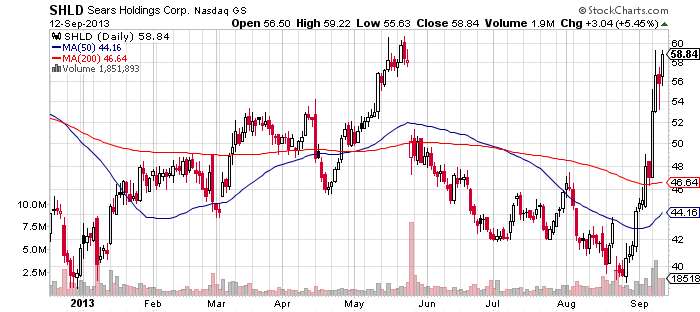
New Closing High for Sears ($SHLD)

Check out this chart from StockCharts.com for SHLD:

Visit StockCharts.com to see more great charts.

Wow!

Wednesday, September 11, 2013

More Sears Discussion at CB&F ($SHLD)

Link.

"Sears no longer needs the large retail footprint that it previously held in order to serve its customers. That's the whole anchor padding portion of the presentation. By reducing its retail footprint, Sears will be able to transition portions of any or all of their properties to a better higher use without having to sacrifice much, if any, of their retail operations.

It's telling that the Credit Suisse report does not address any of the conference call transcripts from SPG, GGP, et. al. while focusing only on their own internal numbers."
Also:
"The deals where they 'right size' the location like the anecdote in my town (and a number of the examples in the Baker street report), where they subdivide and throw in a Wholefoods (or other "growth" retailer) probably don't correlate at all to a decrease in SHLD retail EBITDA generated the location. In fact, it is probably more likely it would have a positive impact in terms of traffic and overall value of the parcel, even if it doesn't result in increased retail EBITDA generation by the SHLD retail ops remaining in place on the property."
Great discussion over there. Go read it.

Short interest numbers for the end of August were reported after the close today: 16.6 million shares, which was an increase of 862,173 from the middle August.

So it could be that this recent up move was from longs adding to their positions and not even short covering yet!

Monday, September 9, 2013

When Was the Last Good Market Corner? Volkswagen?

We've written about corners before: Joseph Leiter, the Hunt brothers, K-V Pharma's drug Makena, and Malaysian tin. Corners seldom happen now, perhaps because ownership disclosure requirements (e.g. 13D/G) have taken away the element of surprise.

It could happen again with Sears. Posters at CB&F have figured out that almost all the shares of Sears Holdings are owned by true believers with more than the remaining float sold short. (Between 85 and 95% "locked up", depending on how you define, and somewhere around 15% sold short.)

Baker Street Capital today released a very thorough report on Sears valuation, which also showed their calculations of short interest and float. They believe that 93.5% of shares are held by "committed shareholders," leaving 6.5% as the effective float, versus 14.8% sold short.

That would be 200% of the float sold short, about the same ratio (and absolute level) that was sold short at the start of the infamous Volkswagen squeeze. Which, by the way, was a thought that had occurred to people in advance. From a Risk.net article in 2008:

"Before the short squeeze occurred, various analysts had published research warning investors of the perils of trading VW stock. Adam Jonas, an analyst at Morgan Stanley in London, had cautioned clients of the dangers of playing 'billionaire's poker' in his research note on October 8, and suggested the size of short positions on VW far outweighed the true economic free float of the company. He added that Porsche needs VW to ensure its long-term survival, noting the company would not develop or manufacture a car in the future without significant resource sharing with VW or Audi (a car brand owned by VW). 'This 'need' for Porsche to control VW, combined with Porsche's long-term horizon, can create shorter-term share price anomalies that could take investors by surprise,' Jonas wrote."
Even though shorts are systematically smarter than many other types of investors, that academic research is more applicable in situations where institutional ownership is small and declining. In this case Sears is practically a private company.

Shorts can be wrong sometimes.


We've seen it from both sides now.