Showing posts with label deflation. Show all posts

Tuesday, September 8, 2020

Guest Post: @pdxsag on Episode 5 of The End Game by Grant Williams and Bill Fleckenstein

This is a new feature from our correspondent @pdxsag. He has volunteered to “sit through podcasts so we don't have to.” Although, he adds, you should still listen to them, because he is only going to review the podcasts which are excellent -- so excellent you don't want to risk missing-out on anything. The latest is Episode 5 of The End Game by Grant Williams and Bill Fleckenstein, with guest Russell Napier. PDXsag wrote up Episode 6 last month, which had Lacy Hunt as the guest. 

Episode #5 (iTunes) is the counter-point to last month's Episode 6. Lacy Hunt believes unless and until the Fed starts monetization via direct commercial lending, the disinflation cycle will remain operative, up to and ultimately including negative nominal interest rates.

Russell Napier was a fellow disinflation-ist with Lacy Hunt until the Covid crisis. He argues the PPP lending program and similar programs in other developed countries are the leading wave of monetary largess which will result in an inflation cycle among developed countries that nearly every active market participant has not experienced in their lifetime. Napier expects, and perhaps the litmus test of his prediction, a 4% consumer inflation rate by Q2 2021, likely sooner.

Like last time, below are summaries I made of various key-points. Emphasis are mine. Occasional opinions interspersed within square brackets are also mine.

3 min: Fleck asks Napier to go into his process that shifted his thinking to being an inflationist.
Napier always expected the “next recession” to lead to a change. He thought it would be MMT, but one afternoon realized bank credit guarantees are “it.” They didn't exist in February or March, but suddenly they did, and universally in all developed countries.

5 min: Williams suggests loan guarantees are a lot easier politically to get through than MMT, which is very controversial. Napier concurs. Loan guarantees are hard to argue against when they are loans to small businesses in need. And  as contingent liabilities it is easy to pretend they don't exist on the government balance sheet. There is no increase recorded in the national debt. And they can be rolled at 0% interest indefinitely. [A rolling loan gathers no loss.]

7 min: Spain, Germany, Britain all have debt guarantee programs analogous to the US PPP. As an example of loan programs just being extended, Spain's emergency lending started as a 100 day program, then one day by edict it was a 150 day program. Napier concedes if these are a one-and-done pulse then his argument fails, but so far that doesn't appear to be how any of these programs are trending.

Even the Germans[!] are in on the game. They have the fastest growing banking system in Europe.

Britain has the “Bounce Back” program. Loans are up to 50k pounds, ie. to small biz, and 23 billion was disbursed in the first 6 weeks. The loan quality of the “Bounce Back” loans was such that 50% are expected to fail. Under traditional QE none of these loans would have been made. This is a fundamental difference. QE money sits on banks' balance sheets because the credit risk is still the banks' problem. Loan guarantees remove the credit risk, so the loans happen and lead to new money getting into the real economy. The loans are 3.6% for 6 years. Everyone who could, took a loan whether they actually needed one or not. Proof is the gang-busters business boats and sports car dealerships are doing.

Bank credit growth in Japan is shooting up as well. It's everywhere you look.

10 min: Williams says pieces for inflation are everywhere, and yet no one believes inflation can happen. Napier thinks it is entirely a timing question. Pros are paid to leave the party one minute to mid-night. So they are still in the no inflation camp because they think it's still 2-3 years away.

11 min: When every country has double digit money growth it's time to pay attention. 6 months ago OECD released a money growth number that was lowest since 2009. Four months later the rate has more than doubled. [He doesn't state the exact numbers though.]

12 min: If we had a blended inflation rate that took into account asset prices instead of just consumer prices we would be measuring inflation and no one would be arguing otherwise. Napier says he can argue there's a big difference between central bank balance sheet growth and broad money supply growth and their respective effect on asset prices and consumer prices. However, no one wants to argue that point. They justify the last 10 years of CB balance sheet growth only effecting asset prices like it's a good thing [which it's not, unless you're one of the Boomers that already own all the assets you ever are going to need], and use it to act like broad money supply growth won't affect consumer prices either.

17 min: Fleck highlights the distinction Napier made between asset inflation and consumer price inflation and asks why people act like one is good and the other is bad. Napier responds it's because of the amount of debt in the system. The pros realized that asset inflation is a one-way bet in our highly geared system. Even a slight amount of asset price correction would cause the whole system to crash. So pros are able to call policy-setters' bluff by loading up on debt and knowing central banks will act.

20 min: Williams mentions the only time in the last 35-40 years where top 10% incomes have fallen more than bottom 90% was during the S&L crisis. S&L was when asset prices deflated and were allowed to deflate. And it's not talked about much anywhere. The crisis came and went and everyone remembers Charles Keating [ahem, and John McCain], but the game of inflating asset prices since then has become crucial. Napier agrees – recounts he used to see Paul Volcker once a year or so. Napier finally asked him where did it all go wrong. Volcker was adamant that it was LTCM. LTCM was the bail-out where it all went wrong. [Proud to say I've been saying this for 20 f*cking 2 years.] Since then everyone who could gear-up money has bought assets on the belief that they won't be allowed to lose money. Napier continues that there are good reasons we have inequality today – for instance, not everyone is a Steve Jobs – but there are some really bad ones. And a select class being able to gear-up debt to buy assets and get all the tax advantages of that, which equity doesn't get, and know they'll be bailed out if anything goes wrong is one of the bad ones. This isn't an argument against assets or capitalism, it's an argument against one kind of overly favored class. [ahem, more equal] Napier calls it financial engineering vs. capitalism. He laments financial engineering may well prove to be bad for capitalism. [We've all seen enough Millennials cheering on AOC to know he's right about that.]

22 min: Fleck concurs LTCM was the Fed's Rubicon.

23 min: Napier reminds us of the Time cover with Greenspan, Summers, and Rubin, “Committee to Save the World”. It wasn't just Greenspan.

24 min: Williams asks what may happen from here. The return of inflation creates a whole new set of problems, some of which from the point of view of bankers and law makers are pretty dramatic.

Napier: Correct, 1) you have to create inflation and 2) you have to keep interest rates from rising. Not just short term, but long term too. We've done this before. Read “The Deficit Myth.” Yield Curve Control was done from 1941 to 1952, which the author uses as an example of a success, without mentioning during that time the US had rationing, price controls, credit controls, and capital controls including forced purchases of government debt. There was massive inflation in the black and grey market, and of course shortages in the regular market. Next, they forced (institutional) savers to buy government bonds.

What you're really doing is wiping out savers through forced taxation. If we do that, the richest people in the world will get around it. They have the tax advisors and attorneys to get around it. What you're really doing is wiping out the middle class. They can't afford to avoid it. Societies that wipe-out their middle class pay a really high price for it. Yield Curve Control sounds so innocuous and rather technocratic and very boring, but actually it changes the nature of what a society is.

28 min: Napier comments on how they could enforce YCC – They won't force individual savers to buy government bonds. However, life insurance, pension, mutual funds are all regulated entities. Being regulated, the government can say to them, you must buy X% of government bonds. They'll call it Macro Prudential Regulation. Who is going to come out against that? You'd be mad to be against prudential regulation. It's like mom and apple pie. [And universal healthcare coverage.]

29 min: Williams: the pernicious effects of this change from deflation to inflation is going to do more harm to more people than ever before. Napier corrects that it's savers that are harmed, not all people. It moves money from savers to debtors and it strikes at a schism in society. It's a redistributive tax without legislative accountability.

31 min: Napier: Soft money regimes are a product of democracy. We shouldn't forget that. The gold standard ends as soon as women get the vote. [Based!] Now a lot of people support the gold standard, but I don't. I prefer democracy. [Sad trombone] But I would think hard currencies and democracies are incompatible.

32 min: Fleck: what do you say to the people that are in the camp that there's too much debt.

Napier: There's not too much debt, there's not enough money. [lol wut] For the last 20 years we've tried to let Central Bankers create more money and they've failed to achieve it. So finally they've found a way around that with these lending programs. There are several ways to bring down a debt to GDP ratio and inflation is the least painful, and that's why it's preferred over defaults and preferred over austerity. The post-WWII gives us the model. Policy makers point to the 1945 to 1980 period as a triumph. But to put into context for listeners, what was it like to be a saver in that time period? If you owned British gov bonds you lost 85% of your purchasing power. There are modern policy makers that believe that to be one of the greatest success stories in history.

35 min: Napier: It's a supreme irony that every one I talk to believes Central Bankers are all-powerful, just as they've lost all their power to government policy makers. Government usurped Central Bank control by dictating the commercial banks' balance sheet growth and contraction. If banks are mandated to increase lending, they will have to make the loans and that money will enter the system. Admittedly people push back and say these lending programs are temporary, and if they are temporary I will be proven wrong. But, I'm not, that's how government can overwhelm Central Banks. It's capitalism with Chinese characteristics.

38 min: Napier brings up Euro and how this model with 19 member nations doesn't bode well. There will come a time when Germany wants to stop and countries like France or Italy are still very keen on keeping the money growing, and that's where the schism comes into the Euro, which raises questions about a single currency.

39 min: Fleck asks about End Game in Japan.

Napier: Start from the premise that Central Banks will never shrink their balance sheets. Is it really debt then? It is a perpetual non-interest bearing transfer. Where I come from a perpetual non-interest bearing transfer is a gift. [lol] Even Goldman couldn't sell a perpetual non-interest bearing transfer.

Japan's broad money growth is 5.9%, a 30 year high! People may ask why didn't they do this to begin with. Because they didn't create debt they created Reserves. Historically, if you created too many reserves in the system you got massive bank loan growth and inflation, but this time around those reserves just sat there: no loan growth, no new money, ergo no inflation.

For eight years I have been saying this is how it would end. They just mandate commercial bank balance sheet growth. I didn't see them doing it through bank credit guarantees, but here we are.

We've done bank balance sheet limiting to fight inflation. Nixon did it. The revolution of the 1980's was using interest rates to regulate money growth, not government regulation. Now we've come full circle. We're using government regulation to induce inflation, not fight it.

45 min: Napier: under the new model, fire everybody and hire Brazilians. If somebody can grow capital in Brazil that person deserves respect and admiration. You should have Brazilians on the End Game program. Developed world investors have learned everything they know under 40 years of disinflation. Emerging markets have a different skill set. By way of example, the skill set you needed from 1945 to 1979 is a different skill set than you've needed from 1980 to the present. [CBS - investor genotypes in an investing ecosystem]

47 min: Fleck asks Napier to give investors of today a short-hand for what financial repression means and how it operates.

Napier: Yeah, so I have a 90 minute presentation on this, so in other words we're really going to have to really, really, really get going. 1.) Prepare for capital controls. 2.) Inflation above interest rates – the firms that are prepared for that are minuscule in market cap. If you've had a 40 year trend in inflation and the winners are all those that benefited from disinflation, when you turn that around, those are not going to be the ones suited to the new environment. 3.) Look at Japan. They've not benefited from high fixed costs in a world of disinflation, so higher inflation should benefit them now. [Very interesting that Buffett made news this week with a $5 Billion investment in Japan] 4.) Read about the 1945-1979 period 5.) Gold is the stand-out asset. I'm not a gold-bug. It's not a productive asset, but it is the stand-out asset when we are dealing with financial repression.

50 min: Williams: with the caveat you're absolutely not a gold bug, could you talk a little bit about gold.

Napier: I'll set aside the inflation bit. That's the part everybody “gets.” The other bit is the interest rates, mandating they be below inflation. In response people go for that thing that isn't a paper asset that can be interfered with. If government wants to interfere with return on equity it's easy, they can double the corporate tax rate. If government wants to interfere with return on bonds they can do that by creating inflation and forcing you to buy bonds. The only way government can interfere with returns on gold is to take it off you. That's not impossible, but it is unlikely. [CBS - Actually very likely since it already happened during the 20th Century.]

If you look at gold now it's taking off while inflation hasn't. That's a reflection of government interfering and creating a premium for that which cannot be interfered with, because if it's inflation driving it, gold is way above where it should be.

53 min: Williams: where are inflation expectations?

Napier: They are still at incredibly low levels. Indicated inflation rates are 0.5% for whole of Europe. Italy is below 0.2%. US is higher. South Africa and Brazil are higher. But they are still incredibly low. France is below where it was in 2009.

Put another way, except for Japan most of the break-even inflation rates are at levels of inflation over the next five years that none of these countries has ever achieved. [It's Stag Mark's world and we're all just livin' in it. :)] Even Germany. Germany has never achieved the level of inflation they are expected to achieve over the next 5 years. So yes, inflation expectations are higher, but they are no where near what might be considered break-out levels. It's just not happening yet. So it's interesting about gold. Whatever is moving it is not inflation.

55 min: Fleck responds: Bond markets have been anesthetized. They've been an administered market for so long no one knows what to do. Conversely gold it still a “free market” where participants think for themselves and know how to act. So they are ready to respond to inflation expectations faster than the bond markets.

58 min: Interesting take on China military action potentially driving gold too. The medium range missile treaty Trump got US out of wasn't done because of Russia. It was done because of China. So now the US needs a country in Asia to stage medium range (3000 mile) missiles.

1 hr: Williams: What do you think of all the V-shape recovery talk.

Napier: Using SARS in Hong Kong as something of a guide, it all reverted to normal within 18 months. I have this incredible faith – and dismay – [lol] in human beings' ability to revert to form. Think of what human being have been though... the Blitz, SARS, etc. But they want to go back to what they had before. And on whole the achieve it, and they achieve it far more quickly than you'd think. So that's not a V-shaped recovery, but if in 18 months if consumption relative to savings is back to what it was in January; if we have the same GDP as before and broad money growth stabilizes at 15% a year from now, 4% inflation doesn't sound so unrealistic.

1 hr 5 min: Fleck: on the subject of inflation, CPI has been bastardized in the US. So when you say 4% do you mean CPI at 4? I think we'd need inflation at 10 or 12 because it's such a bad measure.

Napier: No I think the reported number can reach 4. [record-scratch] 4 isn't so outrageous. We were close to 4 in 2007, 2011, 2000, 1996. I have a long presentation on why 4 is important.

Those were all periods of China producing and periods of massive technological breakthrough. And those were periods of money supply growth closer to 10 than 4, and even then you got to 4 on the measured number. I think it's a fairly straight-forward forecast. Where it gets difficult is what happens after that, because above 4 it can spiral out of control very quickly. That's what's significant about 4.

There's been four times in the US where it's gotten to 4 and stopped. [Um, by crashing the equity markets.] I don't think it will this time. But it's hard enough to convince people it will even get to 4.

That's an interesting part of history. I don't think there's been a fiat currency that's stopped at 4. That's an achievement of sorts. It's come at a very high price if you ask me.

Fleck: we've had two bubble bursts to achieve that.

Napier: that's what I mean by it's come at a high price. But if the market believes we can cap it at 4. And through that time period we've just added more and more debt, meaning we really have to inflate it away. Maybe that's why people think it can't go above 4 – “because it's never been above 4 in my lifetime,” – which means that you're very young. [Ok, wow! Good points.]

1 hr 8 min: Williams: Can you tell people how they can follow you more?

Napier: Well there's kind of bad news. I write at my website, but you're only allowed into my website if you're a regulated financial institution. That's just how it is under British law. The good news is that lots of people steal it and appears all over the place. Using [Bing] and the year 2020 it's amazing where it will crop up. Some day we will pursue those vagabonds, but for now you can get it if you are resourceful. [lol]

1 hr 10 min: Closing comments.

Fleck to Williams: Wow. That's gonna blow some people's minds. [Guilty] I mean, I believe everything he's said. He's articulated it better than I ever could. I thought about the point Michael Green made, that the game you're playing might not be the game that's being played. Napier said it differently, but maybe the game is changing to something you'd have to have a lot of grey hair to have seen before.

Williams: That's what this series is all about. You have to stay alert to changes in the game. They will change the rules and when they do it's going to be really fast, before anyone can react to the rules having changed, or what's the point of changing the rules? [Indeed. Lots of quotes about lying central banks and lying politicians come to mind here.]

Sunday, December 18, 2016

A Correspondent Writes About "Inflation or Deflation"

I think the question of hyperinflation or crash is a political question, and in that sense it isn't "predictable" because it depends on what actual individual political actors decide is their best-worst option when the time comes. Neither hyperinflation nor a crash is a phenomenon of nature, deterministic and with a mind of its own. Hyperinflation requires central monetary authorities to increase the money supply at an increasing rate. A crash requires them to hold the money supply constant relative to a growing or unstable debt burden, or to even sharply reduce the money supply in the face of such a debt burden, causing mass liquidations and a flight to cash. But either one of these is a political decision.

We can broadly understand the consequences of hyperinflation or deflation (asset prices rise and rise in money terms, or fall and fall in money terms), but we can't really predict which one will happen ahead of time. That being said, hyperinflation destroys the monetary system itself by completely undermining confidence in the medium of exchange, which is something you'd think a modern central banker would be hesitant to commit to as a policy because they'd be destroying their own franchise, or at least creating gross uncertainty about their future ability to influence such a franchise. With deflation/crash, certain crony capitalists get wiped out, which would be very "annoying" for the central banker who has relationships with them, but the monetary franchise remains in tact.

This is probably why we see modern economies "wobble" between inflationary growth and deflationary crashes from time to time-- the central bankers are essentially playing a big game of chicken where they veer from one risk to the other, not quite going all the way. The economy almost "overheated" in 2007/2008, so they engineered a crash... the crash was devastating so they engineered a reflation with quantitative easing. At no point has the system been "allowed" to fully experience one extreme or the other, either a hyperinflation and monetary reset, or a full liquidation of bad investments during a crash with an economic/financial reset. Every time they play chicken, they undermine the real economy even more. What Dalio is arguing, and I would agree, is that they probably play with things so much that it gets to a point where they can't play any further and the decision about how to reset is essentially made for them.

Friday, June 26, 2015

Bullish on the Dollar

Great comment by "Fritz" on Twitter:

6/25/15, 6:32 PM
Case for USD cash one of the best in history: 1) bonds are exp 2) stocks are exp 3) inflation is 0% 4) EM USD borrowing short pos $9 tril
Absolutely.

Saturday, November 8, 2014

"Here is the new bond king’s view of the world today" (#Gundlach)

Forbes interview - Gundlach and I agree often:

The Fed may raise the federal funds rate for the wrong reasons.

“They don’t really need the rates to be higher, but they seem to want to reload the gun so they aren’t stuck at zero without any tools.”

Deflationary forces will accelerate if the Fed raises rates.

“With a tightening, the dollar is going to not just be strong, but it will run up like a scalded dog. If that happens, then commodity prices are going down, we will import deflation and you will see an episode of deflationary scare.”

The long end of the Treasury curve will stay put and possibly go down further.

“There’s a 30% chance that importing deflation creates a panic into Treasurys creating a ‘melt-up,’ moving rates to German Bund levels today of around 1%. What is fascinating is, if you sell junk bonds and buy Treasurys, the minute the Fed hikes the first time, going back to 1980, in every case you did well.”

Don’t be surprised to see the yield curve flatten and possibly invert.

“Long rates have done nothing but fall. That tells me the market is saying to the Fed, ‘Go ahead, make my day.’ The curve is going to invert when and if fed funds hit 2.5 to 3%.”

Be long the dollar, especially in emerging market bonds.

“We have been all dollar [denominated in our foreign bond holdings] since 2011. For a while it didn’t really matter, but now it matters a lot. If you are nondollar you are really in trouble.”

Stay away from homebuilders, TIPs and mortgage REITs, and oil will fall further.

“I am convinced the Saudis want the price of a barrel of oil to go to $70. They don’t care if they run a short-term deficit if it slows down U.S. fracking and turns the screws on countries in their region that mean them harm.”
I agree with all of those points. The profile and story of his exit from TCW are good too.

Wednesday, October 29, 2014

The Probability Of Deflation Has Diminished?

The Fed said

"the Committee judges that the likelihood of inflation running persistently below 2 percent has diminished somewhat since early this year"
Yeah right! Look at a chart of the 30 year yield (down almost 100 bps ytd) or of a commodity index like DBC. Deflation!

What this tells you is that their concern about deflation is situational, conditional. Deflation that threatens the big banks that own the Fed is bad. Deflation that squeezes the proles out of their assets and makes them renters is good.

The big banks have been recapitalized and the proles are making a bit too much money flipping paper [1,2]. Maybe the Fed thinks it's time to pull the rug out from under them?

Removing the inflationary supports in conjunction with a nonsensical propaganda statement is consistent with pulling the rug out. Is it consistent with anything else?

Remember I said four years ago that the Fed was throwing the deflation game? Silver and gold are both significantly lower than when I wrote that post.

The biggest consensus in the market today - by far and away - is that the Fed is just kidding around and will print at the first sign of weakness, and that the printing will take asset prices to new highs. People have staked everything on the conjunction of those two assumptions.

Thursday, October 9, 2014

Commodities And Producers Are Just Leading The Deflation/Inflation Cycle

A commenter on my crude oil futures post pointed out,

"Commodities and commodity producing stocks are the only stuff out there that is reacting to fundamentals! The resource sector is telling the truth. The cocktail stocks and momentum favorites are telling lies!!"
Commodities do seem to be the quickest to pick up on changes as we move through this cycle:
Inflation/mania -> tightening -> deflation/crash -> printing
This is a positive feedback loop. One would expect the oscillations to become wilder as people attempt to "get in front of" the next step, and that does seem to be what has happened over the past 15 years or so.

The alternative to cycling the printing on and off is to attempt to use "tawk" to keep the goldilocks economy:
"Wednesdays action was quite incredibly naive. The Fed is halting QE, it is no longer lowering rates. In short, the Fed is tightening, and at the same time successfully counteracting the market effects of that tightening with dovish talk at their conference in which they decide to remain on the tightening course. That is the whole purpose of forward guidance - to get the stockmarket to react to their words and speeches and to ignore what they actually do, or neglect to do."
But tawk and no printing makes people nervous. No one can afford to get left behind in a change in the inflation/deflation cycle. The way you make a lot of money is to get in front of it.

What happens if China loses the ability to build concrete and steel boondoggles at the same time the Fed is shifting into a tightening cycle? Well, commodities get crushed:

They're trading at a four year low, and the deflationary cycle has just started! The DBC index is heavy on energy (65% various energy products), the rest is agricultural and metal. But they are all falling.

A reason the oscillations could get wilder is that investors want to avoid drawdowns, and they get trained by experience as we go repeatedly through the loop. If the Fed doesn't "have your back", you don't want to own any commodity, producer, or maybe even anything at all as the deflation spreads. But when they stop tawking and start printing, there will be a violent reversal.

Wednesday, July 16, 2014

"Fed kicks off global dollar squeeze as Janet Yellen turns hawkish"

Deflation!

"Monetary tightening is coming sooner than the world expected, with sober implications for overheated bourses, and for those in Asia, eastern Europe and Latin America that drank deepest from the draught of dollar liquidity.

We can expect a blistering dollar rally, perhaps akin to the early 1980s or the mid-1990s. It is fortuitous that the BRICS quintet of Brazil, Russia, India, China and South Africa have just launched their $100bn monetary fund to defend each other's currencies. Some of them may need it."
This confirms what Prechter says about the Fed. Inflation is really very modest - a couple percent - and yet Yellen has political pressure from Fed board members to clamp down on inflation already! (Of course, their "Fed put" has caused other problems besides inflation, like egregious misallocation of capital.)

Anyway, just because the Fed could "drop money out of helicopters" doesn't mean they would or will.
"The BRICS, the mini-BRICS and much of global finance have taken out a colossal short position on the US dollar. Mrs Yellen has just issued the first margin call."
Margin, call gentlemen. Hint: if you borrowed dollars to buy assets, you are short the dollar.

Thursday, July 3, 2014

Cheap Deflation Insurance

Silver put options.

Silver was a parabolic bubble that ended in spring 2011, and parabolic bubbles typically end below their starting point, which would be $5-10 per ounce. Coincidentally, that is still approximately the marginal cost of silver production.

A $15 SLV put for Jan 2016 costs 35 cents. A $10/$15 put spread would cost a net of about 30 cents. That implies a 6% chance that silver will retrace its bubble and go back to the marginal cost of production over the nest 18 months.

Saturday, March 22, 2014

Recent Stagflationary Mark Posts

Funny comment about agriculture and almonds,

"[C]entral part of my diet is almonds. I eat one serving a day religiously. $4B+ in revenue for CA growers, that's 3M ounces of gold at current prices -- Canada's (#8 on the gold producer list) entire gold output. I love ag. So magical, having wealth just appear on plants every year. No game really captures this, I mean the strategic importance of the ag economy. There's Farmville of course, but how food is produced and distributed is fascinating. It's so important to our economy yet the Fed focuses on 'nonfarm' so much. When you take a fly-over of e.g. Germany, it's nothing but farms! Only 2M workers apparently in the US. (one serving a day is 22lbs a year, ~ten 38oz Costco containers (actually I buy my almonds from Trader Joes) and ~10X the current US per-capita consumption rate."
Banks don't believe rising interest rates.
"Based on the chart, banks sure aren't buying the rising interest rate story. Perhaps it might have something to do with the growing deposit glut. No matter how much lip service the rising interest rate story gets, banks still look at their deposits and no doubt wonder where the rising interest rates will ultimately come from. It's not like they are going to suddenly offer 5% CDs on a whim, now are they?"
Bond market versus stock market.
"Put another way, the bond market props up the stock market. The stock market does not prop up the bond market. As a long-term bond investor, rapidly falling stock prices are about as likely to hurt me as rapidly rising stock prices helped me. Not much. The same cannot be said of stock market investors in reverse. As a long-term bond investor, if I am financially ruined then I will be taking stock market investors with me. Of that, I have no doubt. Why can't more people see this?"

Monday, March 3, 2014

New "Stagflationary Mark" Posts

  • Here we go again: "[R]eal personal consumption expenditures growth per capita (excluding food and energy). If you have your party hat on, then you better hope that the trend reverses soon."
  • Acceleration of MZM Money Stock: "I believed and continue to believe that it will be harder and harder to make money off of money. There's already so much of it trying to earn interest as it is. I don't believe that the Fed can create inflation adjusted prosperity over the long-term. I don't believe the Fed can prevent the next recession."
  • The Bond Yield Bubble of 2013: "The Fed cannot force me to spend more with ZIRP. The lower interest rates go, the less I spend in order to compensate (lest my nest egg run dry before I die). The Fed cannot permanently prop up the stock market. Pent-up demand will eventually become pent-down demand."
  • Once Again, This Is Not 1982: "We're pretty much back to 'as good as it gets' yet again. I seriously doubt the next 'unexpected' surprise will be to the upside."

Friday, February 7, 2014

The Avaricious Baby Boomers, a Failure to Reproduce, and Deflation

I said in the comments that,

"I've become very bullish on long bonds after realizing that the natural owners of them (older baby boomers, retirees) have been scared into buying much riskier stuff (SPY index, tech stocks, MLPs) with the mantra about how interest rates are going to go up real soon now."
Commenter Nathan pointed out that,
"It seems like prices in many markets are driven by what present holders of those assets need to rationalize their decisions, not any rational expectations of the future. In particular, baby boomers keep holding their equities and real estate, hoping for greater fools and 'household formation'. It never occurs to them that what they're proposing to younger generations is such a bad deal that many will simply refuse to play along, as they have in Japan."
Which led me to reflect more on Japan and deflation. His comparison to Japan is apt. What happened the U.S. early 2000s bust is that we hit the same worker/retiree inflection point that Japan hit in 1990.

Basically we are on course to follow their trajectory with about a 20 year lag, except that our elites are doing selected things to make the problem worse like spending 5% of GDP on warmongering, and importing hostile illiterates in a misguided attempt to fix the R/W ratio.

Money printing makes no difference. The BOJ has printed oodles of yen since their demographic collapse started - 4x increase in monetary base since 1990.

As Cornelius Vanderbilt would say, "that amounts to nothing." The Nikkei fell 65% anyway during the same time period (75% peak to trough), and - best part - their 10 year bond yield has fallen to 60 bps. Their 30 year yields 1.6%.

Further, the Japanese price index has not changed in 20 years. On a long term view, Japanese CPI increases seem to have stopped right around the time that serious yen printing started.

The "increased monetary base causes increased CPI" thesis has sprung a leak, and the inflationists are out of buckets. Clearly there is a different, lurking variable. In fact, an increase in monetary base and a fall in the inflation rate both look like dependent variables of population!

Tuesday, January 7, 2014

NYT: "Another Worryingly Low Inflation Rate for the Euro Zone"

The deflation "mystery".

"The European Central Bank seeks to keep price growth steady at about 2 percent. The situation now, in which the rate of inflation is falling, is known as disinflation. If the situation continues in this direction, Europe could face outright deflation..."
The US and EU will probably respond to deflation like Japan, with huge devaluation schemes that do nothing yet trigger unpredictable stock market rallies of 50-100%.

Tuesday, February 21, 2012

The Important Point From the Hugh Hendry Interview in Barron's

Which we agree with:

"The road to hyperinflation is via hyperdeflation. That is why it’s proving so difficult for hedge funds to make money. How does the rational mind that anticipates hyperinflation own 10-year government Treasuries yielding less than 2%? It can’t. That’s why people are struggling. To lay the seeds of hyperinflation, you need really, really bad things to happen."
That was why we made the - ultimately correct - long Treasury bonds call starting two years ago. We are now neutral on Treasuries.

As I've pointed out before, there is a huge divergence between Treasury yields, which are still low, and the equity markets, which have rallied significantly off of the October lows. One theory is that Treasury yields are "artificially" depressed, either by Fed intervention or by the flight-to-safety bid, and that there are significant risks to owning Treasuries if the equity market is in fact correct this time. Technical "analysts" point to a "double top" in the Treasury bond.

And it is true that the earnings yield on the S&P 500 has the biggest spread ever over Treasury yields.

Is what we are experiencing a false recovery like the one we saw last year? Or, is there significant pent-up demand for consumer durables like automobiles?

Thursday, December 29, 2011

Forestry Mowers


That is awesome.

Wednesday, September 28, 2011

Trade Idea: Treasuries vs Copper ($TLT $JJC $DBB)

Noted deflationist Gary Schilling via Zero Hedge:

"I'm agnostic on the precious metals. We have in our portfolios been short copper. Copper peaked out in February and it's down about 25% from its peak. I think it will go a lot lower. As you pointed out, copper goes into almost anything manufactured. It's a great indicator of global industrial production. What I think will really knock the pinnings out from under all commodities is a hard landing in China, which is what we're forecasting."
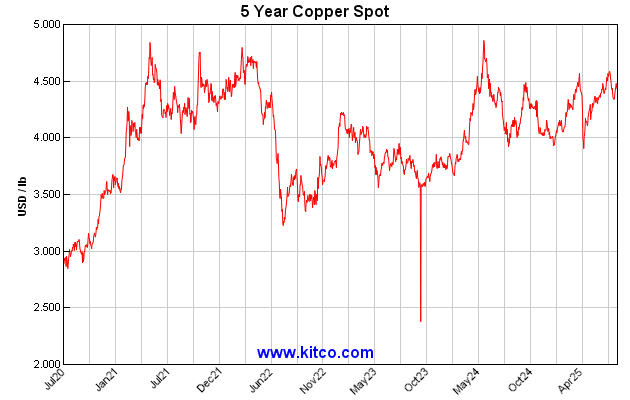
Copper is the best deflationary bet. In fact, you could short the 30 year Treasury and short copper and probably do well either way. To put it another way, last time long-term interest rates were this low, the price of copper was closer to $1/lb instead of the current $3.20/lb.

One of my favorite types of trade is to look at two different markets that should be keying off of the same fundamental variable, but aren't, implying an inconsistency. [That way, you are agnostic about what exactly the future will look like, just betting that an empirically and logically justifiable relationship should continue to hold.] So the long-term U.S. interest rates are screaming deflationary depression but copper prices aren't.

Why might this be? A regulatory arbitrage scheme in China seems to have artificially boosted the demand for copper over the past several years. Apparently, importing copper is or was a way for Chinese businesses to circumvent their government’s restrictions on lending.

My understanding is that the long-run marginal cost of copper is in the mid $2s/lb, i.e. 25% lower than the current spot price. However, if there was going to be a depression of the type that the Treasury market is implying, the price of copper should be closer to the 2008 low. That would happen instantly if the Chinese copper stockpiles were put on the market, perhaps due to forced liquidations.

Sunday, May 29, 2011

This Time Is Not Different

Barron's says the only way out is for Greece to restructure. "Europe's official approach has been to muddle along and hope the problem will go away. It won't." The European banking system is like the U.S. banks in the summer of 2008. Total reality denial mode. It will cause a panic flight to Treasuries when their house of cards finally topples.

Greece talks about setting up a "bad bank". Doesn't anyone notice this is right out of the 2008 crisis playbook? Kicking the can is what you do when a crisis is too big to solve. They have been having "emergency meetings" every weekend. Does that remind you of anything?

There is going to be another deflationary bust that ruins the delusional, moral hazard crowd. Albert Edwards agrees with the Credit Bubble stocks thesis: "we still expect to suffer another deflationary bust that will take government bond yields to new lows before government profligacy and the Fed's printing presses take us back to both double-digit inflation and bond yields."

No one remembers the obliteration that happened three years ago. Here is a reminder: Arizona Land Sells for 8% of Price Calpers Group Paid at Peak.

Thirty years of non-stop rally has created a mainstream investment management community whose investing styles expressly exclude the possibility of severe bear markets/depressions. Most investors - and all long-only investors - are resigned to failure and capital impairment should a severe bear market occur.

This doesn't bother them because they figure they will "make it up" on the next wave up. And, as Prechter puts it, "most of the time, ill-timed optimism is harmless because most of the time, recessions are indeed mild and brief. [...] Small, mild retrenchments occur more frequently than large ones so forecasting errors are only mildly damaging."

The bull-market-only investing genotype is an evolutionary dead end. Investors need a money manager whose style contemplates severe bear markets, otherwise they are doomed to severe capital impairment. Picture a plane crashing into mountain with full afterburners on. There is a lot of money to be made at the expense of the dip buyers before they figure out what is happening.

Tuesday, May 3, 2011

A Whiff of Deflation (SLV, TLT, SPY)

Very interesting to see that silver is getting smashed and the other risky/inflationary bets (equities, oil) are falling too.

Meanwhile, Treasuries have been quietly rallying since they bottomed on February 10. No one has even noticed the strong performance - sentiment is still negative - as the long bond ship is slowly pulling out of the harbor. Implied volatility of treasury call options has risen only slightly.

Monday, March 14, 2011

Review of Conquer the Crash: You Can Survive and Prosper in a Deflationary Depression (Second Edition) By Robert R. Prechter, Jr.

I just finished Conquer the Crash: You Can Survive and Prosper in a Deflationary Depression by Robert Prechter, the author and stock market analyst who has popularized Elliott Wave Theory. Prechter gets a lot of flak because his market predictions are typically "too early", i.e. "wrong" for the American investor addled by television and a short attention span.

Elliot Wave Theory (EWT) is the idea that prices unfold in specific patterns called Elliott waves. The theory is named for Ralph Nelson Elliott (1871–1948), a professional accountant who developed the theory in the 1930s. Prechter has extended the theory to collective human psychology, which he believes develops in natural patterns, via buying and selling decisions reflected in market prices.

I am agnostic about the actual EWT. The most suspect part of the theory is the idea of "wave counts", which are really tenuous sometimes. The wave counts may seem obvious retrospectively but are never so clear prospectively, and so practitioners of the theory cannot consistently identify when a wave begins or ends. As David Aronson writes in Evidence-Based Technical Analysis, the theory's ability to "fit any segment of market history down to its most minute fluctuations" is because of its "loosely defined rules and the ability to postulate a large number of nested waves of varying magnitude".

What is interesting is that if the waves exist, they would meet the definition of a fractal, a geometric shape that can be split into parts that are smaller copies of the whole, which is a property called self-similarity. The fractal nature of prices is good theory and has been written about by other researchers (e.g. Mandelbrot).

I tend to agree more with John Hussman, who notes in this week's letter that a parabolic bubble tends to look like a cosine wave fluctuating at increasing frequency, so that corrections become shallower and more frequent within the parabolic trend. But as he put it, "I think it's a bit ambitious to use log-periodic functions and other purely mathematical tools to identify bubbles and gauge crash hazards. We prefer more fundamental approaches."

But Prechter, and Conquer the Crash, are much more than Elliot Wave Theory. His more interesting idea is socionomics, a term he coined to describe his hypothesis that social mood drives financial, macroeconomic, and political behavior, in contrast to the conventional notion that such events drive social mood. The rationale for the effect of social mood on markets is that when investors value financial assets, they form "judgments in sympathy with or in reaction to the opinions and behavior of others. This surrender of responsibility makes them participants in a collective. (p25)"  [My review of Prechter's 1999 work on socionomic theory, The Wave Principle of Human Social Behavior, will be forthcoming.]

I also appreciated Prechter's discussions of the long-term deterioration in economic performance in the United States. He notes that the economic improvement in the great bull market since 1982 (i.e. a "wave five formation") has not been commensurate with the stock market increase during that time. It is interesting to read articles about decaying infrastructure in the U.S. with that in mind:

The stakes are particularly high not just for Mr. Brassell and the other 4,000 residents of Lake Isabella, but for the 340,000 people who live in Bakersfield, 40 miles down the Kern River Canyon on the edge of California’s vast agricultural heartland. The Army Corps of Engineers, which built and operates the 57-year-old dam, learned several years ago that it had three serious problems: it was in danger of eroding internally; water could flow over its top in the most extreme flood season; and a fault underneath it was not inactive after all but could produce a strong earthquake.
How can we have these life-threateningly derelict pieces of critical infrastructure if we are so rich? But Prechter's explanation for this incongruity is that "third waves are built upon muscle and brains. Fifth waves are built upon cleverness and dreams. During third waves, people focus on production to get rich. During fifth waves, they focus on finance to get rich. [...] A prime symbol of the deterioration... is General Electric... its vaunted company [is] a cardboard edifice of credit services. It is the United States in microcosm. (p48)"

Prechter's discussions of market sentiment and cycles are second to none. His socionomic theory predicts the ephemeral federal budget surpluses that occurred at the end of the Clinton administration: "government surpluses generated by something other than a permanent policy of thrift are the product of exceptionally high tax receipts during boom times and therefore signal major tops. They're not bullish; they're bearish and ironically portend huge deficits...(p254)"

But Conquer the Crash has a broader and very important intellectual significance: a framework for thinking about market cycles that includes severe bear markets and crashes. Most investors do not have a theoretical framework for this.

I often write about mainstream asset managers like Buffett, Ken Fisher, and Bill Miller, whose investing styles expressly disconsider the possibility of severe bear markets/depressions. Most investors - and all long-only investors - are resigned to failure and capital impairment should a severe bear market occur.

This doesn't bother them because they figure they will "make it up" on the next wave up. And, as Prechter puts it, "most of the time, ill-timed optimism is harmless because most of the time, recessions are indeed mild and brief. [...] Small, mild retrenchments occur more frequently than large ones so forecasting errors are only mildly damaging. (p66)"

This led me to a very important realization about investor genotypes in an investing ecosystem. Think about an investor's "style" (i.e. decision rules and heuristics) as a genetic code. Evolutionary theory predicts that selection will operate whenever variants differ in characteristics that are transmitted through some form of retention or differential culling of variants and whenever these characteristics are consistently related to performance of the entities in which these variants are expressed.

I have often thought about the number of lines of computer code it would take to model an investor's decision processes or style. For some, it has become almost as simple as "buy the dip."

The investors whose styles produce the best results are selected in favor of those whose styles produces inferior results. As Wolfgang Sterrer put it, "an organism represents a hypothesis of its environment, continually tested by selection for its predictive value and modified by adaptation for a better fit."

The problem with investing is that this is measured on the wrong timescale. The different parts of economic cycles occur so infrequently that the intervals between them exceed the working lifespans of investors. As Geerat Vermeij describes it in Nature: An Economic History, "The key to economic control is to affect, and respond adaptively to, conditions on the longest and largest scales of time and space possible (p37)."

For example, during the bull market (1982-2000) within a bull market (1932-2000), any style that stopped to consider the possibility of a bear market would have been maladaptive. If you think about it in terms of expected value, for any value of caution regarding a bear market, such a framework would only have lowered expected value and could only have been maladaptive.

As a result, this "genotype" has largely been purged from investing. If you were cautious, this means your boss took you aside and explained that you just didn't "get it" about how the new economy worked and maybe managing money wasn't for you. It also took the form of investing tropes about "stocks for the long run", "buy the dips", and the equity risk premium.

In contrast, people who "got it" for whatever reason have gotten constant, positive, psychic feedback for three decades. They have been carefully programmed to ignore the types of issues that we discuss on Credit Bubble Stocks. Buying the dips always seems like a sure thing, because they have been investing for their entire careers during a "cycle wave V during a supercycle wave V", that is, a bull market inside of a bull market.

The result is that quite a few investors with really lame investing methods feel like geniuses. For example, The Big Short tells a story about "two guys and a Bloomberg terminal in New Jersey," which was "the Wall Street shorthand for the typical CDO manager. The less mentally alert the two guys, and the fewer questions they asked about the triple-B-rated subprime bonds they were absorbing into their CDOs, the more likely they were to be patronized by the big Wall Street firms."

Another example is the investing philosophy variously described as trend following, momentum investing, or relative strength. This is the idea of buying securities with high recent returns (regardless of fundamentals) and selling securities with poor recent returns. Richard Driehaus, the "father" of momentum investing, once said that "far more money is made buying high and selling at even higher prices." During the recent earnings season, we saw one of the the downsides of the relative strength strategy: the price-insensitive buyers become price-insensitive sellers.

So now, the investing genome is a monoculture of permabulls. They say things that make us hit our head against the wall. We have seen how they performed since 2000. It is going to be more of the same until they are purged from the business.

Unfortunately for them, the bull-market only investing genotype is going to be an evolutionary dead end. Investors need a money manager whose style contemplates severe bear markets, otherwise they are doomed to severe capital impairment. Picture a plane crashing into mountain with full afterburners on.

If our thesis is right, we will be able to make a lot of money at the expense of the dip buyers before they figure out what is happening. As Prechter writes,"the presumption that the old uptrend and expansion are the natural order of things remains as firm as ever. (p61)"

Lots of the ideas in Conquer the Crash stand on their own whether or not Elliot Wave theory is true. I am giving it 5/5.

Monday, February 7, 2011

Something Deflationary this Way Comes

From a very important WSJ article "Panel Floats Idea of U.S. 'Century' Bonds"- published on Friday afternoon, natch:

"Wall Street is pushing the U.S. government to lock in low interest rates for the next few decades by issuing ultralong bonds that would mature in 40, 50 or even 100 years."
Aha! Remember my deflationary thesis.

You cannot inflate away really short term debt. "Inflating debt away" is just fancy talk for theft. The only way you can steal from a creditor is if they have no choice. But creditors - Treasury buyers - who have lent money on a very short term basis do have a choice. Every time the Treasury rolls over its debt, these creditors have the opportunity to demand higher yields. If the Fed is inflating, creditors will demand higher yields to compensate!

I have argued that deflation would suit the government's purposes best. Look how low the yield on the 30-year was during the crash in fall 2008. During an equities selloff, they could sell tons of long term Treasurys at low yields! Their biggest priority will be selling lots of long term Treasurys, so the yield won't necessarily spike so low this time.

But, lengthening the maturities to "40, 50, or even 100 years"? That would be a masterstroke. That is downright greedy of them! I hope they do it.

It would be easier to make money if the Fed would follow its own rational self interest, which is to preserve the financial strength of the empire.

In his speech last week called "The Economic Outlook and Macroeconomic Policy", good ol' Benny Bernanke tossed us another deflationary morsel:
"Moreover, diminishing investor confidence that deficits will be brought under control would ultimately lead to sharply rising interest rates on government debt and, potentially, to broader financial turmoil. In a vicious circle, high and rising interest rates would cause debt-service payments on the federal debt to grow even faster, causing further increases in the debt-to-GDP ratio and making fiscal adjustment all the more difficult."
Double aha! That is what I have been saying for a year!

If the Federal Reserve and Treasury were clever enough to implement this deflationary scheme, one place to look for clues would be the Schedules of Federal Debt published by the Treasury. As of the January 31, 2011 report, the marketable treasury bills outstanding were $1.76 trillion - roughly the same as six months ago. The treasury notes, which are longer maturities than bills, have increased from not quite $5 trillion to $5.67 trillion. And the treasury bonds have increased from $816 billion to $900 billion.

Triple aha! Over the past six months, they are lengthened - at a rather slow pace - the average maturity of the federal debt.

How could we play a return to deflation? One obvious choice is TLT - the long term treasury bond ETF. Implied volatility is low and thus the calls are cheap. Another idea is to short or buy puts on TBT, the ultrashort Treasury ETF. This is attractive because all of the ultrashort ETFs are terminally defective. Third idea would be to buy ZROZ, the zero coupon treasury (very long duration) ETF which would benefit the most from falling interest rates.