Showing posts with label tobacco. Show all posts

Thursday, October 26, 2023

Altria Shares Crushed After Cigarette Volumes Drop 11.6% ($MO)

Altria released third quarter 2023 earnings today. Their cigarette revenue was down 5.3% year-over-year and their cigarette operating income was down 1.7%. Their cigarette volumes were down 11.6% year-over-year with Marlboro down 10.5% (so they must have raised prices by 7.1%). Altria CEO Billy Gifford is blaming illicit e-vapor products.

The shares were down more than 8% today. At CBS we had been writing about the illicit vapor threat recently. In May of this year we considered Altria as a short idea:

Another idea for this basket comes from a very important investing precept: if you sell an investment, you should consider shorting it. (Since people have a tendency to sell winners too early, a corollary would be not to sell something unless the valuation is so extreme that you would short it.) Recall that we sold Altria last quarter after owning it happily and collecting dividends for several years. (Dividends are great; you just have to be very careful that they are sustainable. Altria is a retail investor favorite because of the dividend.)

We sold Altria even though nicotine usage is growing, because the growth is occurring in reduced risk vaping products that are illicit (non-FDA-authorized) yet better than what big tobacco can sell. They are truly being disrupted: these new products are cannibalizing their cigarette sales and impairing the time honored strategy of raising the price of the pack to offset the volume declines.

As of the first quarter, Altria's cigarette operating income was shrinking at a 2.2% annual pace. If you have a ten percent cost of capital, you can only pay 8x earnings for an income stream shrinking at that rate. But the 2.2% that we have just seen is rather trivial. Altria's cigarette volumes actually shrank 11.4% and revenues declined 3.3%, indicating that the price of the pack was increased by a little over 9%.

The question is, what would happen if that formula breaks? The answer is that earnings shrink, and the multiple that people will pay for Altria stock rerates much lower. Let's say that investors have a 10% cost of capital and they believe that Altria earnings are going into a permanent four percent annual decline. This could mean ongoing 8% volume declines coupled with the ability to raise prices only as fast as inflation: 4%. That would justify a 7x valuation for the tobacco earnings.

That would justify about $62 billion enterprise valuation on the after-tax earnings. The current market capitalization is $82 billion, and there is also about $15 billion of debt net of cash and the (current) value of the BUD stake. Deduct that $15 billion from the $62 billion pro-forma value and you get $47 billion for the equity; about 57% of the current market cap, or a share price of $26. A January 2025 $25 call option seems to be going for $22.4, for a breakeven of $47.4 (versus the current price of $46.67)

In April we wrote:

Ask yourself why the macro environment is so bad for cigarette sales, yet McDonald's had a great quarter (U.S. comp sales up 13%), Chipotle had a great quarter (comp sales up 11% with margins also up), PepsiCo had a great quarter, and Valero had a great quarter (with demand for gasoline and diesel at record highs).

The difference is that cigarettes have better, cheaper competition. There are the "open tank" vapes which the user refills with his own nicotine-containing liquids ("juice"), which we think appeal to the downscale ex-smokers, as well as the pothead users who have experience using them with THC liquids.

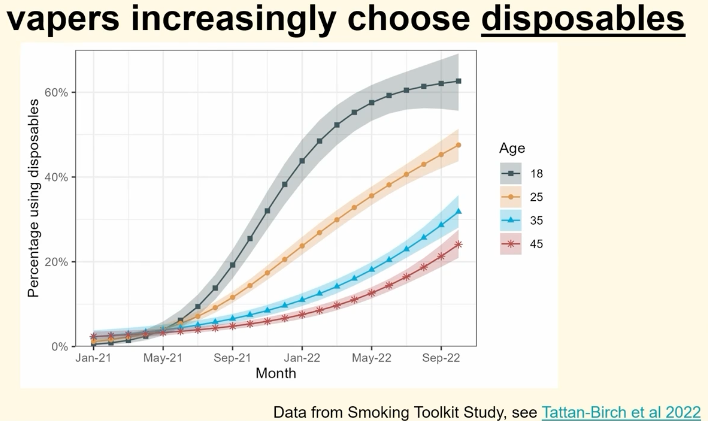
For the younger crowd (which probably has never-smokers), you have closed tank products like Juul or the Elf Bar, which are illicit but selling like hotcakes.

The biggest thing that tobacco longs are missing is that competitive intensity in nicotine delivery has gone from sleepy (the cozy Marlboro and Camel duopoly) to ferocious.

That is going to make it very difficult for big tobacco to keep raising the price of the pack of cigarettes enough to offset the volume declines. It is also likely to shrink the overall nicotine delivery profit pool (which is more of a function of industry structure than market size) and divide whatever profit pool does exist among more players.

Bearish. We think the time to get out of this industry is when you see the competitive intensity increasing. By the time it is obvious in the quarterly numbers, it may be too late to sell at a good price.

In March we wrote:

It is seeming possible that re-nicotinization is happening, but that the nicotine as a service business is going to remain fragmented enough such that the profit pool that used to exist in cigarettes is substantially diminished. 

Big tobacco is at a disadvantage in vaping because it has been playing by the rules. If you can only sell tobacco flavored vapes, you are going to lose out to "disruptors" who do not follow the rules and can sell watermelon or cotton candy flavored ones. BTI's U.S. subsidiary has asked the FDA to crack down on the illegal vapes, but they are still for sale. Can the FDA stop strip mall vape stores and gas stations from selling Chinese vaping trinkets to willing buyers? It's an open question. They do not have a police force.

And even if they can, what assurance do we have that the authorized reduced risk nicotine market is going to be a profitable duopoly the way that cigarettes were?

And a few days earlier in March:

Right before the weekend, Altria announced that they sold (really, gave away) their entire 35% stake in Juul Labs, Inc., for which they paid $12.8 billion, in exchange for "a non-exclusive, irrevocable global license to certain of JUUL’s heated tobacco intellectual property". Then today, Altria confirmed a rumored purchase of NJOY Holdings: they are paying $2.75 billion (plus a possible further $500 million) for the company, which has an FDA-authorized pod vape called the NJOY ACE.

These are just very discouraging developments at Altria and some tobacco investors are kidding themselves thinking anything else.

Juul is the best vaping product, hands-down, the same way that Zyn is the best oral nicotine product. Last year, Altria let Philip Morris buy - practically steal - Swedish Match and Zyn without lobbing a bid or even expressing interest that might have raised the cost for its competitor. It would not surprise us if Philip Morris gets a hold of Juul (which still the vape leader with close to 40% market share) and turns it into a cash cow. (What would be really amazing is if PM uses its regulatory connections to get an authorization - MGO - for Juul vapes but only after buying it at a great price.)

But Altria won't make a penny off of a Juul acquisition or turnaround. All they are getting is a non-exclusive IP license for heated tobacco, which implies that they are going to waste more money trying to buy or acquire a heated tobacco product for the U.S. Didn't they learn from the poor performance of IQOS in the United States that heated tobacco does not appeal to U.S. nicotine consumers?

Monday, May 22, 2023

Young Vapers Like "Watermelon Ice"

Here are two interesting slides from presentations at the E-Cigarette Summit UK, 2022 that was held in December at the Royal College of Physicians in London.:

Young people like vapes, and vapers like flavors.

Our thesis of re-nicotinization is playing out. People who had never smoked cigarettes are consuming nicotine in much safer ways: oral nicotine pouches and vapes.

The problem is that these new products will not necessarily be profitable for big tobacco, which is why we had to sell the big tobacco companies. Both spaces are ferociously competitive. Zyn has been dominating the U.S. pouch market, but if you go to SnusDirect you can see that the pouch market in Scandinavia is very crowded. You can get a JalapeƱo Lime flavored pouch from LOOP or an extremely strong Skruf mint flavored pouch. 

Perhaps the managers of Swedish Match sold the company because they knew an onslaught of competition would eventually reach America? They had two-thirds market share with Zyn in the U.S., but only about ten percent market share in Scandinavia (see slide 7)!

Competition in vapes seems even worse. The second slide shows that young vapers do not care for the taste of tobacco - they want the types of fruit and candy flavors that Elf Bar sells.

It seems like Philip Morris knows they are outgunned in vaping which is why they are trying for something that would have a stronger "razor & razorblade" model: heated tobacco. 

Big tobacco investors have been conditioned to be complacent. We have a mutual on Twitter who says, "I've seen doomsday proclamations for going on 20 years now despite ever higher earnings and dividends."

The companies - quite ingeniously - settled the 1990s litigation in a way that resulted in very profitable competitive dynamics. That does not mean that selling nicotine is inherently profitable. 

If the cigarette businesses go away and the replacement risk market is fragmented, some of the tobacco enterprises values may be smaller than the outstanding liabilities.

Thursday, April 20, 2023

Philip Morris International Inc. ($PM) - Q1 2023 Earnings

PM reported earnings and gave an investor presentation this morning. The current market capitalization (at $97 per share) is $150 billion and the enterprise value is $193 billion. Operating income in Q1 was $2.8 billion at a 34.1% margin. Smoke-free product revenues were 34.9% of total revenue. Total volume shipped was down 1.1% with heated tobacco up 10.4%. Management guidance for this year's adjusted diluted EPS is $6.10 to $6.22 per share, which puts the shares at just shy of 16x earnings. If they hit their guidance for 2023, that would be 7-9% growth in EPS over 2022 earnings. 

Almost painful to see how well Zyn is doing after the Swedish Match acquisition. If it were still a stand-alone entity, it seems likely that we would have consolidated all of our tobacco investments into it (in order to escape Altria's Bungles and the problem of the vaping competition free-for-all). The Zyn market share is 67% and the value share is 76% - this is a stronger monopoly than any cigarette brand or company has ever achieved.

Highlights from the conference call:

  • I am pleased to report that Q1 performance exceeded our expectations, with strong underlying momentum from IQOS, ZYN and our combustible business. As mentioned at our full-year earnings in February, we expected this quarter to be the weakest of the year due to a confluence of transitory factors impacting our top- and bottom-line. In this context, our business delivered robust results and we look forward with confidence to the remainder of the year.
  • Smoke-free net revenues made up almost 35% of total PMI, despite the impact of adverse timing factors on HTU shipments, with an increasing number of markets crossing the 50% threshold.
  • In combustibles, accelerated pricing across a range of markets helped to deliver robust organic net revenue growth. Swedish Match delivered impressive results, with a stand-out performance from ZYN’s 47% U.S. shipment volume growth compared to the first quarter of 2022.
  • While the increasing mix of HTUs in our business, at higher net revenue per unit, continues to positively impact our performance, lower shipments in Europe this quarter due to wholesaler and distributor inventory movements limited the benefit.
  • Our updated full year adjusted diluted EPS forecast of $6.10 to $6.22 includes an estimated unfavorable currency impact of 30 cents. Positive estimated impacts from the Euro and a number of other currencies are outweighed mainly by the weakness of the Japanese Yen, as well as the significant depreciation of the Russian Ruble and the Egyptian Pound.
  • Let’s examine ZYN’s recent U.S. performance in more detail. Superb progress continues with a record increase in 12-month rolling shipment volumes of 23 million cans, which equates to 40% growth. Category volume share remained essentially stable despite continued heavy competitive discounting from less premium offerings. Importantly, retail value share for ZYN also remains strong at 75.6%, highlighting its premium positioning and superior brand equity. There are two key engines driving the U.S. growth of ZYN, as covered at CAGNY. First is the progressive increase in distribution, with the number of stores 13% higher than Q1, 2022 at around 140,000. There remains ample opportunity to further increase this over time. Second are velocities, or the number of cans sold per store per week. ZYN velocities continue to grow sequentially and by an impressive 21% compared to prior year as the brand continues to resonate with adult nicotine users.
  • We continue to work on our IQOS U.S. commercialization plans for launch in Q2 2024, in line with the principles outlined at the recent CAGNY conference. With the benefit of the expertise and commercial tools from launching IQOS successfully in over 70 international markets, and a U.S. market with a clear regulatory framework and the ability to communicate with adult smokers, we remain very positive about the opportunity. Importantly, we believe we can make the necessary investments in the U.S. business, generating additional top-line performance while continuing to deliver strong bottom-line growth for PMI during the investment period.
  • Another key mid-term opportunity from the Swedish Match combination is the international expansion of nicotine pouches, notably with ZYN -- the world’s leading brand. 
  • While staying clearly focused on the heat-not-burn and nicotine pouch categories, which present the largest and most accretive growth opportunities, we are adjusting our VEEV e-vapor portfolio and approach. We intend to focus on commercializing in select markets and prioritizing profitability given the known category challenges. VEEV ONE is a new pod-based system providing an enhanced user experience with fully outsourced manufacturing of devices and consumables to optimize costs. VEEV ONE will replace the current VEEV product and, as a result, we no longer intend to file a PMTA for the former technology. Instead, we will focus our near-term FDA engagements on IQOS and ZYN. We will come back on future e-vapor FDA authorizations in due course.
  • I think we've already been clear that while we were clearly developing some offering on the vaping category, this was not our priority. We had IQOS. And now I would say we are even more taken by two priorities, which are IQOS and ZYN. When you have such a fantastic team and the potential that they have to deliver very strong top line growth, volume growth, revenue growth and in a very nicely profitable fashion, that's really the priority. I guess you listened to us at CAGNY and we expressed the questioning that we have on the vaping category today, which are around the absence of clear regulation in many country. The fact that, that is giving way to an appropriate marketing activities, risk of underage consumption. And also the fact that this is a category where so far it's difficult. I'm not saying impossible, but difficult to see a lot of profitable model being developed.

An interesting discussion in the Q&A about how European cigarettes are holding up better than U.S.:

  • [Gaurav Jain] [T]he U.S. cigarette volumes industry level are quite weak, minus 9%. And then looking at the European data that you shared, it is -- the industry volumes are flat on what were already very strong comps. And the reasons what have been mentioned for the U.S. industry weakness, which is macro, weak consumer, stimulus payments going off, disposable e-cigarette growth, I could apply the same logic to EU consumer -- EU smoker and still the volumes are so much better than trend. So is there a -- can you explain like why are the U.S. smoker and EU smoker, why are they behaving so differently?
  • [Emmanuel Babeau] Gaurav, I cannot -- and I will have to consider that I'm not the greatest specialist of the U.S. consumer for combustible cigarettes. So I wonder myself to given an analysis. I think it's in line with my previous comment on the fact that so far, we have been a pretty good resistance from the consumer to same price increase and coping with inflation in Europe. I'm not able to tell you why there is a difference here. We know that the social model in Europe is different. You may have some more protection, some more safety needs that are playing and maybe limiting the impact of inflation. There was maybe more compensation given from various government on trying to fight again energy price increase and sometimes compensating of agricultural product inflation across a number of geographies. So that can be one element to explain why the European consumer is resisting better. But I'm not going to pretend that I have the perfect answer to your question. 

Still hoping that PM can get a hold of Juul cheaply and get it FDA-authorized in the U.S. The comment about the challenges of vaping are not so encouraging on that front, but at the same time PM are clever negotiators and play their cards close to their vest. This could be a way of softening up the Juul shareholders. And at least we know that PM is not likely to blow $3 billion on an unprofitable vape company.

Thursday, March 9, 2023

Will "nicotine as a service" be as lucrative as cigarettes were?

Wanted to expand on this week's post about Altria's Bungles because we have been rethinking the tobacco trade more generally. Recall that in order for the big tobacco basket to work as an investment, we needed two things:

  1. "Re-nicotinization," where the number of people using nicotine (in whatever form) stops declining and preferably grows.
  2. A growing nicotine industry profit pool, with the vast majority of it captured by big tobacco: MO, PM, and BTI.

We are still confident in the first proposition. We see plenty of happy Zyn customers. We also see plenty of people vaping.

When oil prices spiked last summer, it hurt cigarette sales. However, when oil prices declined through the end of the year, cigarette sales did not recover or bounce. At Altria, cigarette volumes were down 11% year-over-year in the second quarter of 2022, and down 12% year-over-year in the fourth quarter

BTI's U.S. cigarette volume was down 13.4% in the first half of 2022, and was down 15.5% for the full year. If you back out the first half, that means that the U.S. combustible volumes were down 17% for the second half of 2022 vs 2021. 

What happened? We wonder whether high gas prices were a catalyst for some smokers to switch to a reduced risk nicotine product and quit cigarettes. That would explain the lack of a bounce after gas prices fell. If that is true, there is a negative asymmetry in the cigarette business; a one-way ratchet where bad circumstances push smokers away from cigarettes and nothing brings them back.

Why is it bad that people are quitting cigarettes? Wasn't that our "re-nicotinization" thesis? Yes, but that was assuming that the reduced risk product profit pool would be as big or bigger than the cigarette profit pool, and that it would be captured by the incumbent tobacco companies.

The cigarette business is basically a duopoly, hence very profitable. The reduced risk products have tons of competition. When we see people vaping now, we often see them using cheapo, open-tank products. The telltale sign is when the billowing smoke cloud smells like something like fruit or candy.

It is concerning that the big tobacco companies have growing sales of reduced risk products, yet the only reduced risk products that seem to be profitable are Zyn in the U.S. and IQOS in Europe. BTI lost 400 million GBP last year in "new category" (reduced risk products) on 2.9 billion GBP of sales. Altria's only reduced risk product before the NJOY acquisition is the "on!" nicotine pouch, which is almost certainly a money loser.

It is seeming possible that re-nicotinization is happening, but that the nicotine as a service business is going to remain fragmented enough such that the profit pool that used to exist in cigarettes is substantially diminished. 

Big tobacco is at a disadvantage in vaping because it has been playing by the rules. If you can only sell tobacco flavored vapes, you are going to lose out to "disruptors" who do not follow the rules and can sell watermelon or cotton candy flavored ones. BTI's U.S. subsidiary has asked the FDA to crack down on the illegal vapes, but they are still for sale. Can the FDA stop strip mall vape stores and gas stations from selling Chinese vaping trinkets to willing buyers? It's an open question. They do not have a police force.

And even if they can, what assurance do we have that the authorized reduced risk nicotine market is going to be a profitable duopoly the way that cigarettes were?

The premarket tobacco applications (PMTAs) required by the FDA were onerous, but not so onerous that only big tobacco companies participated. They received applications for millions of products. So far, they've approved products created by Japan Tobacco, NJOY, British American, and Philip Morris, and presumably will approve more. 

Also, once they have gone through all of the PMTAs and it is clear what kind of product they will accept, what stops competitors from launching me-too products that are also FDA authorized, so that they can grab some of the fat margins? (And perhaps the illegal black market open tank products are here to stay as well.) If you recall our original tobacco post from 2019, the idea was that big tobacco would have sufficient regulatory capture to have a moat around reduced risk nicotine products. 

Instead, reduced risk nicotine products are seeming like a free-for-all. If true, that would mean that the glory days of tobacco profits are going to come to an end.

It has been a good run. Since our post, "What I Would Buy Instead of Tesla" in October 2020, Altria is up 42% and has paid significant dividends. The performance of Philip Morris and British American has been even better.

Monday, March 6, 2023

Altria's Bungles

We only just finished speculating about the future of the tobacco and nicotine ("nicotine as a service") industry, but now we must discuss the latest moves by Altria. First, here is what we said last month about Altria and the "tobacco basket":

Altria management really bungled M&A over the past five years, by paying so much for Juul that they had no ability or inclination to bid when a really great asset (Swedish Match) got put on the block. They now have basically no reduced risk program, except what they can salvage from the Juul investment. [...]

As long as the cigarette business is doing well (i.e. earning north of $10 billion), it would not seem to make sense to sell Altria at this valuation. But this company is a mess, and it would be nice to see it cleaned up.

One option would be to exit all of the businesses besides smokables and traditional oral tobacco: sell the BUD stake, sell the Juul interest, and shut down "on!". Suppose that you could get $15 billion for that. We sure wouldn't mind getting, say, a $3.76 special dividend (equivalent to a current year's) with the rest to be used for perhaps debt reduction or share repurchases.

The problem with this is that a tobacco company without a reduced risk platform is vulnerable in the current political climate. It seems essential to be able to point to a "future after tobacco" to keep society's current anti-nicotine mood at bay.

If Philip Morris does not want to reunite with Altria, then Altria is probably going to just limp along selling mostly cigarettes. So the key questions will be: will the tobacco earnings keep growing, and is there any chance that they can get control of Juul and turn it into a profitable business. It is still the best and most popular vape thanks to the superior nicotine chemistry. [...]

We come away from this reflection thinking that the equal weighting of PM, MO, and BTI is still the right approach. There is no clear winner from an investment perspective, at least not yet, because of the wide dispersion in valuation. 

Right before the weekend, Altria announced that they sold (really, gave away) their entire 35% stake in Juul Labs, Inc., for which they paid $12.8 billion, in exchange for "a non-exclusive, irrevocable global license to certain of JUUL’s heated tobacco intellectual property". Then today, Altria confirmed a rumored purchase of NJOY Holdings: they are paying $2.75 billion (plus a possible further $500 million) for the company, which has an FDA-authorized pod vape called the NJOY ACE.

These are just very discouraging developments at Altria and some tobacco investors are kidding themselves thinking anything else.

Juul is the best vaping product, hands-down, the same way that Zyn is the best oral nicotine product. Last year, Altria let Philip Morris buy - practically steal - Swedish Match and Zyn without lobbing a bid or even expressing interest that might have raised the cost for its competitor. It would not surprise us if Philip Morris gets a hold of Juul (which still the vape leader with close to 40% market share) and turns it into a cash cow. (What would be really amazing is if PM uses its regulatory connections to get an authorization - MGO - for Juul vapes but only after buying it at a great price.)

But Altria won't make a penny off of a Juul acquisition or turnaround. All they are getting is a non-exclusive IP license for heated tobacco, which implies that they are going to waste more money trying to buy or acquire a heated tobacco product for the U.S. Didn't they learn from the poor performance of IQOS in the United States that heated tobacco does not appeal to U.S. nicotine consumers?
Then they went on to pay $2.75 billion for a vape which, while FDA-authorized, has only one-tenth the market share of Juul. In the release, Altria comments that "NJOY-branded products were not included among the most often used usual brand among middle and high school e-cigarette users in the 2022 NYTS." As though that is a good thing!

Altria gets the worst of negotiations. If they got the better of negotiations, they would not have walked away from Juul without getting cash. Nor would they have paid cash for NJOY. A respectable deal would have been to pay some nominal amount (maybe as low as $0) for 51% of the company with the promise to invest in building the brand and trying to grow market share from sub-3% to something serious.

What we would have liked to see is: get paid big bucks for Juul, pay nothing for NJOY (get a free option), and distribute the balance to shareholders. Even better would have been if Altria had gotten control of Juul. Imagine a "Marlboro" Juul.

Instead, the problem is the same as it was in 2018 when they bought Juul: they are desperate to get out of cigarettes. Perhaps this is rational, as we speculated in our February post. Maybe regulators and society will not tolerate a pure-tobacco company operating in runoff. But if that is the case, we can probably expect a couple billion dollars a year of cash wasted by Altria flailing unsuccessfully to create a reduced-risk product.

And, if that is the case (that they need some kind of reduced risk product in order to be able to enjoy their runoff cigarette profits), then they really should have tried to trade their BUD stake for Swedish Match last year.

We no longer believe in an equal basket of MO, PM, and BTI. Maybe a half-weight for Altria is appropriate, given the low valuation the market puts on Altria's cash flows from tobacco. But we probably need to assume that at least $1 billion of the cigarette cash is going to get eaten up every year on reduced risk bungles. It is almost like an extra tax on their cigarette business.

We wonder whether Altria will end up in a few years being taken-under by Philip Morris at a share exchange ratio that is less favorable than today's?

Friday, February 17, 2023

Tobacco - Q4 2022 Earnings Season

When we look at the FY 2022 results for our three tobacco companies (Philip Morris, Altria, and British American Tobacco), we have two questions: how did the cigarette businesses do, and how did the reduced risk ("nicotine as a service") businesses do?

Altria

Here is a good look at how the Altria cigarette and oral tobacco/nicotine businesses have been doing.


Q4 2022 Q4 2021 y/y ch Q4 2019 3 year change
Cigarettes (mm sticks) 19,707 22,423 -12% 23,116 -15%
Smokeable Revenue ($mm, net of excise) 4,456 4,457 0% 3,991 12%
Revenue per pack $4.52 $3.98 14% $3.45 31%
Smokeable operating income 2,576 2,493 3% 2,145 20%


Oral tobacco (mm cans) 197 206 -4% 200 -1%
Oral tobacco revenue ($mm, net of excise) 604 629 -4% 574 5%
Revenue per can $3.06 $3.05 0% $2.88 7%
Oral tobacco operating income 370 390 -5% 385 -4%

Earnings in the cigarette business have grown thanks to the time-honored formula of raising the price of the pack enough to offset big volume declines. As you saw in our earlier pipeline post, over the three year period from December 2019 through December 2022, the CPI rose by 15%. Altria has been able to raise the price of the pack by twice as much as inflation (31%) over the same period. Even with the volume declines, this has allowed the smokeable operating income to outpace inflation. (It should also be remembered that the high gas prices in 2022 made things very difficult for cigarette sales.)

Quick and dirty valuation of Altria: the market capitalization at $48 per share is $85 billion and the enterprise value is $114 billion. They own 10% of BUD which is worth about $12 billion at the current market price of $59 per share. Net income for Altria for 2022, adjusted for special items like non-cash charges, was $8.7 billion. So the market capitalization less BUD divided by that adjusted net income is about 8.4 times. That treats the Juul and Cronos stakes as worthless. We could also look at the Q4 operating earnings from the smokable and oral segments (before interest and tax) as being $11.8 billion annualized, which would be an 11.5% yield on the enterprise value.

Altria management really bungled M&A over the past five years, by paying so much for Juul that they had no ability or inclination to bid when a really great asset (Swedish Match) got put on the block. They now have basically no reduced risk program, except what they can salvage from the Juul investment. (Juul does still have the largest market share in vaping, at close to 40%, but Altria only owns a minority interest.) It seems quite likely that Altria's "on!" oral nicotine product (which they acquired in 2018) is depressing the profitability of the otherwise lucrative oral tobacco segment (selling Copenhagen and Skoal). 

As long as the cigarette business is doing well (i.e. earning north of $10 billion), it would not seem to make sense to sell Altria at this valuation. But this company is a mess, and it would be nice to see it cleaned up.

One option would be to exit all of the businesses besides smokables and traditional oral tobacco: sell the BUD stake, sell the Juul interest, and shut down "on!". Suppose that you could get $15 billion for that. We sure wouldn't mind getting, say, a $3.76 special dividend (equivalent to a current year's) with the rest to be used for perhaps debt reduction or share repurchases.

The problem with this is that a tobacco company without a reduced risk platform is vulnerable in the current political climate. It seems essential to be able to point to a "future after tobacco" to keep society's current anti-nicotine mood at bay.

If Philip Morris does not want to reunite with Altria, then Altria is probably going to just limp along selling mostly cigarettes. So the key questions will be: will the tobacco earnings keep growing, and is there any chance that they can get control of Juul and turn it into a profitable business. It is still the best and most popular vape thanks to the superior nicotine chemistry.

Altria's adjusted earnings per share has grown from $4 in 2018 to $4.84 in 2022, a 4.9% compounded annual increase which was slightly faster than inflation. Paying ~8x earnings for a business with earnings growing faster than inflation, and with an option (even if unlikely) on Juul does not seem like a bad deal.

Philip Morris

There is always a strong contrast between Altria and Philip Morris, the way there is with Magellan Midstream and Enterprise Products. Cigarette sales in PM's foreign markets are declining more slowly, and they have a heated tobacco product (IQOS) that is seriously growing in foreign markets. ("Full-year smoke-free net revenues reached almost one third of total PMI and over 50% in 17 markets.")

PM's cigarette volumes fell 2.8% between Q4 2021 and Q4 2022, but its heated tobacco units grew 26.1%, with the result that overall volumes grew by 1.2%. Year-over-year, net revenues for combustible tobacco grew 1% and smokefree grew 27%, resulting in overall revenue growth of 8%. (All figures excluding the effect of Russia/Ukraine, currency, and acquisitions.)

PM's current market capitalization (at $102 per share) is $156 billion and the enterprise value is $200 billion. Net income for the year was $9 billion - PM shares trade at a much more expensive 17 times earnings. PM does not disclose segment earnings for cigarettes versus smokefree (only the revenues).

But PM has better cigarette businesses and better reduced risk businesses, especially now that they own Swedish Match and Zyn. Here was their discussion of Q4 results:

Now let's discuss ZYN's recent U.S. performance in more detail. Excellent progress continues with shipment volume growth of plus 37% in 2022 and plus 35% in Q4, reaching a record quarterly high. ZYN category volume share grew sequentially by one percentage point compared to the third quarter and by 2.2 percentage points compared to the prior year, further strengthening its position as the clear number one nicotine pouch brand despite continued heavy competitive discounting from less premium offerings. Importantly retail value share for ZYN remains strong at 75.7%, highlighting its premium positioning and high brand equity. 

That is in contrast with Altria's "on!", which we suspect Altria is giving away at a loss. Of all of our nicotine businesses, PM seems best positioned to benefit from re-nicotinization (we think that Zyn is going to continue to grow gangbusters), except that it lacks a good vape product! It was reported last month that Juul is in talks with PM, Japan Tobacco, and Altria.

Notice that Altria and PM had roughly the same net income last year even though PM's market capitalization is 84% higher. Altria makes almost as much money selling just cigarettes in the U.S. as PM does selling cigarettes and IQOS to the entire rest of the world.

Maybe the best case scenario is for PM and Altria to reunite. Then they can have the #1 cigarette worldwide (Marlboro), the #1 oral nicotine product (Zyn), the #1 heated tobacco product (IQOS), and the #1 vape (Juul). They could shut down a bunch of junky also-ran products, and focus some serious lobbying might on getting rid of open-tank vaping competition.

British American Tobacco

BTI is an interesting hybrid of PM and Altria: they sell in the U.S. and the rest of the world, and they have some decent reduced risk products. BTI has a market capitalization (at $38 per share) of $84 billion and an enterprise value of $131 billion. Last year they earned about $8 billion, putting the shares at around 11 times earnings.

BTI does not report quarterly results, but we have their annual results for 2022 now in hand. Their combustibles volumes were down 5.2% for the full year 2022 versus 2021, and revenues were down about 1% in constant currency. The combustibles business earned about $14 billion in 2022, roughly the same as in 2021.

Their "new category" (reduced risk) product volumes were way up for 2022 versus 2021. Their vape (Vuse) volumes were up 14%, heated tobacco (glo) was up 26%, and modern oral (Velo) was up 22%. Revenues in constant currency for those products were up 44%, 27%, and 46%, respectively. The new categories businesses reduced their operating loss from $1.1 billion in 2021 to $450 million last year. They have said that they expect this category (which now represents 15% of total revenue) to be profitable in 2024.

BTI combines worse cigarette brands than what PM and MO have (they were especially dependent on menthol) with a reduced risk portfolio that is certainly better than what MO has and in some spots (Vuse vape) better than what PM has. Another possibility for industry M&A would be for BTI and MO to combine. As with the PM and MO combination possibility, the Altria cigarette earnings would be very meaningful to BTI.

Conclusion

We come away from this reflection thinking that the equal weighting of PM, MO, and BTI is still the right approach. There is no clear winner from an investment perspective, at least not yet, because of the wide dispersion in valuation.

Thursday, June 16, 2022

David Samuels and Edward Luttwak on Re-Nicotinization

From a Q&A ("Three Blind Kings") in Tablet:

THE NICOTINE CRISIS

Why do educated people believe in obvious stupidities like the crushing power of hybrid warfare in such a herdlike way? A big reason of course is class interest—they are getting rich off it. Now there is also the role of Twitter and other networked social platforms in reinforcing the dominance of the mass mind, and punishing dissenters from the consensus from which everyone else is making money.

A reason that is less well-explored, I believe, is the West’s war on nicotine. The massive brain outages we see throughout the West, and particularly in America, are in no small part due to the war on smoking, which both makes people smarter and kills them before they become senile.


Absolutely. One book I’ve never written, is “The Impact of the Arrival of Nicotine and the Scientific Revolution.” A big jump in intellectual achievement that took place among Europeans, all of whom smoked. The social history of nicotine begins with the sharpening of the brain. I stopped smoking long ago but still I miss it.

So what’s your solution?

Nicotine patches. You may not like it aesthetically, and I agree, but it actually does give your brain the fix that it needs. Take away my nicotine patches, and I am immediately 5-10 IQ points stupider, which I can’t afford.

Are you on them now?

Yeah. I’m permanently addicted to nicotine patches, which have the advantage of not causing a slow, painful death from lung cancer.

I have been thinking about that. An easy remedy for the stupidity of mankind is to go back to nicotine.
Re-Nicotinization: "An easy remedy for the stupidity of mankind is to go back to nicotine."

Wednesday, February 16, 2022

Swedish Match Reports Earnings for 2021

We mentioned Swedish Match AB (SWMA.ST/SWMAY) as one of the likely survivors in yesterday's writeup on the tobacco industry. They are a Swedish multinational tobacco company, headquartered in Stockholm, with businesses that date back to the 19th century. A great indicator of the company's attitude toward shareholder value is this page on their site, "shares outstanding", which shows a declining share count thanks to buybacks.

Now they have three business segments, smokefree, cigars, and "lights". The smokefree business includes the new Zyn nicotine pouch product, traditional Swedish snus (brands include General and Gƶteborgs RapƩ), and moist snuff tobacco. The cigar business is divided into "homogenized tobacco leaf" and natural leaf cigars. "Lights" are cigarette lighters and matches. They have announced plans to spinoff the cigar business to shareholders so that the remaining company can call itself entirely smokefree. The smokefree business is responsible for 67% of sales and 74% of revenues. Even though it is a Swedish company, 64% of total sales, 56% of the smokefree revenues, and 100% of cigar revenue is from the U.S.

The market capitalization of Swedish Match is $12.1 billion (USD). Net income for 2021 was $684 million which puts the company at just under 18x earnings. Sales were up 11% in 2021 over 2020, net income was up 27%, and earnings per share were up 31%.

What is amazing about the company is how quickly the Zyn business is growing. This, in turn, is because Zyn is widely acclaimed as the best nicotine lozenge:

People say things like, "I very much prefer the specific buzz Zyn gets me." As with the nicotine vapes, subtle differences in chemistry and manufacturing matter for the user experience. (It is not for nothing that Swedish has long experience with a traditional oral tobacco product, snus.) The product superiority translates into huge volume growth for Zyn.


Our style of value investing rarely buys hockey stick growth, but here is hockey stick growth available for 18x earnings.

Shipment volumes of Zyn in the U.S. were up 56% in Q4 2021 from Q4 2020, and were up 4% from the third quarter of 2021. Zyn had 64% market share in the U.S. in the third quarter, more than outselling the #2 (Altria's On!), #3 (BTI's Velo) and the #4 (Rogue products) combined. Zyn has 64% market share by volume but 70% of revenue share because the other guys have to discount. A highlight from the conference call:

We are very pleased to have shipped more than 48 million cans of ZYN in the fourth quarter, bringing the full year volume to 174 million cans. This corresponds to an impressive year-on-year growth rate of over 50%, both in the quarter and for the full year. Once again, while increased distribution for ZYN has been a supporting factor for the volume growth, higher velocities have been the primary driver. In fact, according to MSA data that captures shipments from distributors to the trade, out of the total growth in the fourth quarter relative to the prior year, more than 75% of the growth was sourced from higher velocities to existing retail shops. The impressive growth was fueled by strong development in both the Western region where we started to launch the brand in 2016 and in regions outside of the West where we started building meaningful presence in mid-2019.

It is interesting that Swedish launched Zyn in the U.S. in the Western states first. According to a slide in their presentation, the Western region has about triple the usage of other regions outside the west. 

Zyn has giant growth potential, it is profitable, and yet it is available for a value stock price. If you saw a company selling a high margin, recurring usage non-tobacco product with a hockey stick chart like the one above, the company would be selling for 18x sales right now, not earnings.

Tuesday, February 15, 2022

Thoughts on Big Tobacco and Compendium of Tobacco Books Read in 2021

Humans have been using tobacco for longer than civilizations have existed. Every Indian tribe was using it when Europeans made contact with the Americas (the ones who could not grow it because of climate traded for it), and tobacco was a sensation everywhere that Europeans took it. This universality surpasses other widely-desired but not quite ubiquitous intoxicants like ethanol and cannabis. As a novel substance with psychoactive effects, it was also controversial everywhere it went, leading to moral panics and futile attempts at prohibition. 

In the past, tobacco tended to be smoked out of a pipe, as a whole-leaf wrap (cigar), insufflated (snuff), or chewed. Cigarettes as a form of nicotine delivery are only about a century old. They turned out to be quite harmful, which seems to stem from both the mode of delivery (combustion products inhaled into lungs) and also the dosage. Two packs of cigarettes - 40 cigarettes - worth of smoke entering the lungs every day is something very different than a daily pipe or cigar ("slow tobacco"). As the news about cigarettes and disease slowly diffused during the past sixty years, people gradually quit smoking and fewer younger people started. Everyone can see the blue line in the chart below falling, and naive extrapolation would tell us that cigarette use will be at zero soon. (Although at a pace of 2-3% annual decline, the cigarette businesses that currently trade for 10x earnings would have 74% of the current revenue in a decade.)

There are two big questions for the tobacco investments. First, can they maintain operating income from their cigarette businesses despite the long term secular volume decline? This question is one of consumer preferences (for cigarettes versus reduced risk alternatives or even other dopamine modifiers), politics (of taxation and regulation, both of cigarettes and the replacements), and demand elasticity for cigarettes (the price-volume tradeoff).

Vaping is a game changer. It delivers the quick nicotine hit of cigarettes but with drastically reduced health effects. The Juul founders picked up this ten billion dollar bill lying on the ground just by reading the tobacco companies' own research about tobacco chemistry (choosing the right nicotine salt) and tinkering with electric vaporizers. The chart above of high school seniors' vaping use during the Juul craze a few years ago is the best exhibit we have to show the pent up demand for nicotine in the population. This is bullish for what we call "Re-Nicotinization", the theory that society craves, and will eventually consume, more nicotine. But it raises an important question of whether the replacements will completely cannibalize the legacy cigarette businesses. (Fear of cannibalization is why Altria collapsed almost 50% in the two years from mid-2017 to mid-2019. Likewise, British American fell about 60% during the vaping craze.)

There is reason to believe that cigarettes will always provide a superior experience to vaping, at least for a core group of users with a certain brain chemistry. Cigarette smoke seems to contain a psychoactive ingredient other than nicotine that reinforces the effects of nicotine. It appears that certain alkaloids in the cigarette smoke are able to inhibit an enzyme called monoamine oxidase that breaks down the neurotransmitter dopamine. Researchers have found that MAO levels are reduced in the brains of smokers. (Some references: 1, 2, 3, 4.) It is even possible that some smokers are using cigarettes for the MAO inhibition more than for the nicotine.

The aerosol fractions from heated tobacco and e-cigarettes do not inhibit MAO activity. And so far no one has tried to engineer these compounds into vaping fluid to fully match the cigarette smoking experience. Like cigarettes, the vapes on the market today are "grandfathered in" by the FDA, and it is doubtful that anyone would be allowed to make a significant change to the chemistry of vape fluid. So cigarettes will likely have a monopoly on a certain type of synergistic dopamine experience and chemical modulation of certain neurotransmitters.

The issues of demand elasticity for cigarettes and future tax levels are both very important. The first chart below shows which countries have raised taxes faster than the retail sales price and which have lagged it. You can see that two of the "covid tyranny" countries, Australia and New Zealand, are the worst. And the U.S., in red, is not raising cigarette taxes as fast as the retail price of the pack has been going up. It is encouraging that the nicotine and cigarette taxes that were proposed during the past year fizzled - Joe Manchin don't cotton to no tobacco tax increases.


The second chart shows the GDP per capita on the X axis and the retail sales price of a pack on the Y axis, again with the U.S. in red. The U.S. is a great market for cigarettes, with a rich population, a very reasonable sales price, and stable taxes. (We like PM as a company and investment, but it has virtually no exposure to the U.S., and we can't imagine not having a tobacco basket that included BTI and MO as well.)

The third chart shows the affordability of a pack of cigarettes for a variety of countries, in terms of the number of packs earned per hour of average wage. In the U.S. people earn ~4 packs, or 80 cigarettes, per hour. A pack of cigarettes is not that much more expensive than a big latte or a sugary soda that a nonsmoker might use to manipulate dopamine. And post covid, the retail price increases have been lagging inflation.

So we are watching the operating income trends for the cigarette businesses, as well as the affordability of a pack of cigarettes. If the companies can maintain current levels of income by raising prices to offset the volume declines, the businesses are very cheap at these valuations.

The second big question for tobacco investments is, assuming that the reduced risk businesses continue to grow and that they do cannibalize the cigarette businesses, how much of that new business will be captured by the big tobacco incumbents? This is where the big tobacco "cigar butt" investments have the potential to be growth stocks if things go right. 

So far, the FDA has made it very onerous to apply to sell a reduced risk product, and very slow and very, very stingy with approvals. We also posted a snippet from the FDA's rules in November, which said that vape manufacturers "will be most successful where authorization is sought for entire delivery systems," meaning that they prefer a disposable closed tank like Juul and not a cheap, economical, refillable open tank that you get at a vape shop. This is exactly what big tobacco wants. Even without any overt corruption, if you just assume that FDA wants to regulate fewer, bigger, more sophisticated players, like any regulator, then the replacement products will be fewer and more lucrative, and wind up in the hands of big tobacco. 

Here is what we still think will happen: the FDA will deny most of Premarket Tobacco Product Applications (PMTAs) filed by small tobacco, leaving big tobacco (PM, MO, BTI, and Swedish Match) as the main players granted PMTAs in the reduced risk product game. There will be a handful of legal nicotine lozenges and pouches and a handful of legal closed tank ("pod") vape products.

At that point, it will be time for some M&A activity and consolidation. If Juul's PMTA is approved, it makes sense for Altria to take-under the remaining Juul stake that it doesn't own, possibly structuring the transaction in a way that sheds the startup-era liabilities. Perhaps Altria could purchase an exclusive license of Juul and sell their minority stake back to the company for $1 to realize the tax loss.

We would guess that either Altria or British American Tobacco will buy Swedish Match for the Zyn product. Altria has been burned by the Juul and Cronos investments, but the U.S. Smokeless Tobacco acquisition in 2009 for $10 billion worked well - that segment earned about $1.7 billion each of the past three years.

Re-Nicotinization: It would make all the sense in the world if nicotine made a huge resurgence due to two reinforcing factors coinciding at the same time: the moral panic pendulum reaching its apex, plus a change in fashion of usage.

Imagine if instead of "dying," big tobacco experienced say 50% revenue growth over the next decade as nicotine consumption went from 14% back to 21% of the population (2005 cigarette consumption level). All that would be needed would be re-nicotinization, which is a Lindy bet, and regulatory capture of the FDA by big tobacco. The investment return could be spectacular given that the increased profit would likely be accompanied by multiple expansion. 

  • Tobacco: A Cultural History of How an Exotic Plant Seduced Civilization (4/5) See full review on CBS. First in a series of tobacco books for a reading program.
  • The Rediscovery of Tobacco: Smoking, Vaping, and the Creative Destruction of the Cigarette (4/5) Second book in our tobacco reading program. Author Jacob Grier is a Portland coffee shop commie (see physique), pro-BLM, but he's staunchly pro-smokers' rights and he even smokes cigars himself. He makes an interesting point: "the cigarette's domination of the 20th century is a glaring anomaly." Prior to the mass production of the cigarette in 1895, people used tobacco in all kinds of ways, most of which did not involve inhalation of smoke into the lungs: cigars, snuff, and chaw, for example. He asks, "Could smoking in the twenty-first century come to resemble the diversity of tobacco use in the past? Could tobacco follow the trajectory of goods like coffee and beer, rebounding from corporate consolidation to enter a new age of appreciation for quality and variety?" Cigarette smoke has a lower pH than pipe or cigar smoke, which makes it possible to inhale it into the lungs. "This inhalation encourages a different pattern of use. Smokers of cigars and pipes absorb nicotine more gradually. Cigarette smokers become accustomed instead to sharp peaks of stimulation, creating cravings that can only be satisfied by frequently re-upping with another smoke. The unfamiliar potency of the cigarette brought on dependence in the smokers who took it up. Although this was not initially an intentional design feature of cigarettes, it was a boon to producers. Through accidents of agriculture and processing they created the most effective and addictive nicotine delivery vehicle ever devised. 'The cigarette was to tobacco as the hypodermic syringe was to opiates.'" It was WWI, and providing cigarettes to men in the trenches, that really made cigarettes and that made western governments supporters of Big Tobacco. By 1922, cigarettes were outselling loose leaf and plug tobacco in the U.S. Grier's idea is that cigarettes are the problem and other forms of nicotine delivery have a much better risk-reward tradeoff. He calls it "Slow Tobacco": "The [cigarette] is made for a five-minute work break... A pipe or cigar, in contrast, requires a commitment of time. [...] The need to slow down and savor the tobacco, appreciating its subtle nuances, is part of the appeal. For people who decide to experiment with Slow Tobacco, we might go so far as to offer advice mirroring Michael Pollan's for eating, urging most importantly to avoid the deadly and addictive trap of cigarettes: 'Smoke tobacco, if you choose. Not too often. Mostly cigars and pipes.'" He looks at meta-analyses of smoking risk. "Heavy cigar smokers and cigar smokers who also smoke cigarettes suffer the highest risks. Of the studies that examined men smoking one-to-two cigars per day, none reported statistically significant increases in risk for all-cause mortality or heart disease, and only one reported a statistically significant increase for cancer." "For people who smoke infrequently and do not consciously inhale, the dose-response relationship for smoking-related cancers suggests that any elevation in risk must be quite low." He points out that Obamacare insurers are only allowed to discriminate against smokers (which is ridiculous) and that HHS regulation defines "tobacco use" as four or more times per week. Mentions The Cult of Statistical Significance, a book by two economists, which argues, "Researchers run their regressions, or they review the published literature, and the only question they ask is whether an effect exists." "Yes or no, they say, and then they stop. They have ceased asking the scientific question 'How much is the effect?" And they have therefore ceased being interested in the pragmatic questions that follow: 'What Difference Does the Effect Make?' and 'Who Cares?' They have become, as we put it, 'sizeless'." He goes through a history of bogus claims that anti-smoking researchers have made in recent years, like "thirdhand smoke". "Prominent anti-tobacco researchers have adopted a thoroughly ends-justify-the-means approach to science. They will promote any finding that helps delegitimize tobacco use, no matter how far-fetched or unsupported by the evidence." As part of the 1998 Master Settlement Agreement with states, the big tobacco companies were required "to dismantle pro-industry organizations and fund anti-smoking research." So the situation is like climate change (formerly global warming) research, where only one side is funded, and there's no pushback against the zealous ideologues. There's a good chapter (Bootleggers and Baptists) about how the MSA in 1998 was fantastic for big tobacco, "structured in ways that converted the tobacco companies into a legally protected cartel." "All fifty states passed laws requiring cigarette companies that were not part of the MSA to either join the agreement or pay penalties..." "There's no doubt that the largest financial stakeholder in our industry is our state governments," said a tobacco executive. Another helpful regulation was the Tobacco Control Act of 2009, which gave the FDA regulatory authority. Its anti-competitive measure is the one that requires the FDA to review new tobacco products before they are introduced for sale. (Products sold before 2007 are grandfathered in.) "The Tobacco Control Act essentially froze the market for cigarettes, protecting Marlboro's market share." The bootlegger and baptist dynamic is that "Big Tobacco benefits by raising the costs faced by these potential competitors, and the moral case for regulation is provided by anti-smoking groups, many of them funded in part by cigarette makers' own MSA payments." There's a Scandinavian tobacco usage paradox: "Tobacco use in Sweden and Norway is still robust; it has simply shifted to forms that are much safer than cigarettes. The Scandinavian experience shows that significant gains in public health can be achieved by persuading people to give up smoking even if they don't give up tobacco or nicotine altogether." "The methods of production used in making snus render it chemically distinct from older American-style chewing tobacco and other oral tobaccos... Over the course of the 1980s and 1990s, Swedish snus producers developed standards to minimize carcinogenic constituents created by microbial growth and fire-curing of tobacco. Contemporary snus is made with air-cured tobacco leaves and a steam heating process that results in much lower concentrations of nitrosamines..." We were just talking about how paradoxes are refutations. "Snus became available in the United States fairly recently, though it remains a very niche part of the tobacco market. This is likely due to its association with chewing tobacco, since the differences between chew and snus are not obvious to the casual consumer. The FDA also forbids snus companies from marketing their product as a lower risk alternative to cigarettes..." He concludes the book: "The electronic cigarette may turn out to be the most significant innovation in the nicotine market since the Bonsack machine automated cigarette rolling in the 1880s. Vaping arose while mainstream tobacco control activists obsessed over trivial ideas like changing the colors of cigarette packaging; that it arose at all is thanks to a decade of permissionless innovation..."
  • The Devil's Playbook: Big Tobacco, Juul, and the Addiction of a New Generation (4/5) Read two books about vape startup Juul, this one was bigger and better than the other (Big Vape). One interesting find is that the founders of Juul, two Stanford graduate students in product design, were smokers who wanted to create a safer nicotine alternative for themselves. When they were starting, they mined a treasure trove of research, which was the document collection that was made public as part of the Master Settlement Agreement - "internal emails and handwritten letters, scientific studies and business plans, patents and product research, all of which opened an incredible window into a secretive industry that had spent billions of dollars over nearly half a century trying to develop a new, noncombustible cigarette." "Somebody had tried to disrupt the cigarette before: the tobacco companies themselves! [They] had simply failed miserably in their years' worth of attempts." Understanding the tobacco business today means understanding the regulatory and litigation history since the 1990s. In 1996, the FDA attempted to regulate tobacco products by declaring them drugs and drug-delivery devices. The Supreme Court ruled in 2000 (FDA vs B&W) that Congress never delegated authority to the FDA to regulate tobacco. Since FDA's mandate is to approve products that are safe and effective, and cigarettes aren't, "the inescapable conclusion is that there is no room for tobacco products within the [agency's] regulatory scheme. If they cannot be used safely for any therapeutic purpose, and yet they cannot be banned, they simply do not fit." This was a moment that really saved Big Tobacco, and Big Tobacco responded very shrewdly by switching to a strategy of regulatory capture instead of denial and fighting. "Philip Morris had announced that as part of its 'realignment' with society it would support FDA regulation rather than thwart it at every turn. This wasn't simply an act of goodwill. Under Parrish's tutelage, Philip Morris was masterfully positioning itself so that instead of locking horns with government regulators, it could work in concert with them to shape the details of any bill... The company had warmed up to the idea of FDA regulation, so long as the agency treated cigarettes as a complex product that, no matter how deadly, still could be accessed by smoking adults for continued legal use." So, in 2000 the Supreme Court punted the issue of tobacco regulation to Congress. Nothing happened for a decade, until the Family Smoking Prevention and Tobacco Control Act during the Obama administration. "[T]he new law was not a hands down triumph for public health. Instead, it was a compromise between the demands of public health authorities and tobacco companies, which lobbied heavily to shape the bill to their liking. For example, while the FDA was given new powers to control levels of nicotine in cigarettes, the agency was expressly forbidden from executing an outright ban on cigarettes or requiring the total elimination of nicotine in them..." Plus, "despite the FDA's new tobacco framework, e-cigarettes appeared to be in a legal grey zone. They weren't clearly enumerated in the new tobacco control act, and it wasn't evident they could be regulated under the agency's separate drug authority." A federal appeals court upheld an injunction against the FDA in 2010: "the FDA couldn't regulate electronic cigarettes as drug devices unless they were being marketed for therapeutic smoking cessation purposes." The Juul founders experimented with various nicotine salts (alkaline nicotine plus acid equals salt) and found that using benzoic acid gave vapers satisfaction equivalent to cigarettes. They filed a patent: "certain nicotine salt formulations provide satisfaction in an individual superior to that of free base nicotine." Juul also made its pods very strong: "Its five percent nicotine concentration was by far the strongest e-cigarette on the market. It would always amaze people [that] a single tiny Juul pod delivered an amount of nicotine equal to an entire pack of Marlboro Reds. Even with Juul's proprietary benzoic acid-nicotine salt formulation that made its hits smoother compared to others, its potency delivered a powerful zing." Here's something interesting about the vape business compared with cigarettes: "the Juul had no beginning or end [unlike a cigarette] so people could ingest large amounts of nicotine without even realizing it." "People were taking deeper and longer puffs the longer they had the device." In 2016, the FDA passed a rule "deeming" cigars and e-cigarettes to be tobacco products. Vapes that had been for sale before 2007 (very few) were grandfathered in, other vapes were allowed to keep selling while preparing premarket review applications (PMTA) to the FDA showing that the products met the standard of being "appropriate for the protection of public health." The applications were lengthy, costly, and onerous, which was a big advantage for large companies. The acquisition of Juul by Altria is easier to understand in light of this regulatory history. No tobacco product could be introduced, and no existing product modified, after August 2016. "By the time the company realized that Juul was an actual threat, any hope of actually innovating on MarkTen to make it better, or more appealing, had slipped away. The FDA's deeming rule had made it all but impossible. Companies were no longer allowed to introduce new products to the market, and they were forbidden from improving on any existing device." Altria's vape product, MarkTen, could not compete: "it had 1.8% nicotine, and it was in the inferior, harsh freebase form. Juul had 5% nicotine, and it was in the superior, smooth salt form. It was nearly a scientifically proven fact-Juul would hook more users than Elite." In other words, "Juul found a way to shoot more nicotine into the human body than anyone had ever thought possible." Like your typical SV startup, Juul cut corners - regulatory arbitrage, low product quality - to outmaneuver industry incumbents. Big tobacco was just very conservative because of the pummeling it took in the 1990s. This led to a "frustrating pattern" for Altria: "When little cigars started doing a brisk business, Altria started work developing its own branded product but wound up springing to buy John Middleton Inc., the maker of black and mild cigars, for nearly $3 billion. When smokeless tobacco grew in popularity, Altria tried to innovate with its own Marlboro branded smokeless products - Marlboro Snus, Marlboro tobacco sticks - before giving up and paying $10 billion for the leader in the category, U.S. Smokeless Tobacco Company. No matter how many Clayton Christensen or Klaus Schwab books its executives read or John Kotter consulting sessions they attended, Altria simply couldn't move much beyond rolling tobacco in paper."
  • Going Down Tobacco Road: R. J. Reynolds' Tobacco Empire: The Gold Leaf and North Carolina (3/5) Written by Gene Hoots, who worked as a financial analyst for RJR in its heyday before the leveraged buyout (which is chronicled in a great book, Barbarians at the Gate). Starting in the late 19th century, "smoking slowly replaced chewing as the tobacco product of choice. America's transformation from a rural to an urban society accelerated this change. As population density increased, spitting tobacco juice became unacceptable; in addition to being unsightly, the public began to associate spitting with the spread of tuberculosis and other diseases." On Tsar Alexis' attempt to ban smoking in 1634: "He obviously didn't have much success, and current regimes aren't having much luck either. The main reason for their failure is no secret, but hardly ever mentioned: What else? Money. The industry makes money for so many people that the world in general, and governments in particular, refuse to kill it." A big day in tobacco history: "On April 1, 1970, tobacco advertising was banned from radio and television beginning in 1971. The year before the ban, cigarettes were the biggest television advertisers, spending $230 million. Now they would be limited to print media. An era had ended. Removing the ads from the air affected Americans' smoking not at all. The ban had a surprising positive effect on the cigarette companies' finances. Without television advertising, it would be nearly impossible for a new company to enter the business; even an existing company found it challenging to introduce a new brand. And since the companies all quit advertising at the same time, existing brands' market share were not relatively disadvantaged. Also of great help, this retreat from advertising reduced the anti-smoking advertisements on television as well. Cigarettes became even more profitable. Advertising savings flowed straight to the bottom line. RJR's profit margin on cigarette sales was 19.5 percent of sales from 1966 to 1969. The margin leapt to 24.7 percent in the years 1970 to 1974." Similarly with the increase in federal excise tax in 1983, which doubled from 8 cents to 16 cents per pack: "The industry was not totally displeased with higher taxes on cigarettes. Tobacco people knew that the more governments relied on tobacco revenue, the less likely that they would discourage cigarette sales. For decades to come, many would seek to fill their coffers with tobacco money while also condemning smoking, a love-hate relationship fostered by obscene amounts of cash." Starting in the early 1960s - when the Surgeon General report came out - RJR management had a big problem with worrying about the fate of the tobacco business, and attempting to diversify away by buying other businesses. The result: "RJR bought six companies totally or in part with common stock [...] that yielded a very low or negative return, handing out stock that eventually controlled 40 percent of the company. The shares provided their new owners $1.6 billion in dividends and $9.9 billion more when the leveraged buyout" took place. "Management was wrong twice - first paying up for not very good companies, and second using stock and trading away 40 percent of one of the most profitable businesses in the world." There were some skeptics at the time, like RJR's CFO in the early 1970s, who said, "I would rather own half the cigarette business than all the acquisitions we ever make." RJR traded at a low valuation (like 10x earnings) during the period in which it was making acquisitions for stock, and the "better" companies that they were buying, with stock, were acquired at higher multiples and mostly performed worse than the tobacco business. RJR management was afraid of being taken over, but there is no explanation for why they didn't just buy back their own stock to return capital and keep their shares too expensive for an acquirer. Quoting an RJR employee: "Sad to see a once great company with all its rich one hundred year plus southern heritage being reduced to this [...] set in motion years ago when the management shifted from tobacco men to outsiders. From then on the company, it seems, has been used and abused by its various holding company management for personal gain and glory with all their chest pounding adventures funded from the tobacco money they were publicly embarrassed to identify with..." The KKR buyout of RJR was incredibly leveraged. Into a $30.2 billion LBO, the GP put in $16 million and the LPs of KKR put in $1.48 billion, for a total of only $1.5 billion of equity (5%). The rest was financed with debt and preferred stock. While RJR was buying unrelated companies and then in an LBO debt service cash crunch, Philip Morris was focusing on tobacco. The result: "Philip Morris had a golden opportunity. While [RJ] Reynolds Tobacco's cash went to pay off junk bonds, the big rival plowed its profits back into the business. It beefed up its sales force, plastered the Marlboro Man on more billboards, and cozied up to wholesalers with incentives. By 1991, PM had grown its market-share lead to an impressive five points in only three years, to 43% vs RJR's 28%. PM tormented RJR mercilessly." Then, on "Marlboro Friday" (April 2, 1993), PM cut the price of smokes by 20%. A price war. In 1999, RJR Nabisco breaks up. Its Tobacco International subsidiary got sold to Japan Tobacco. Nabisco Foods was spun off - and then sold to Philip Morris. Then, in 2002 Tobacco started acquiring tobacco companies - Natural American Spirit. In 2003, it merged with Brown & Williamson, a division of British American. In 2014, Reynolds bought Lorillard (Newport cigarettes). That left Reynolds with Newport, Camel, Pall Mall, and American Spirit, plus Vuse for vapor. In 2017, BTI bought the part of Reynolds that it didn't own, ending the independent Reynolds name after 142 years. He ends with a thought experiment: "What if Bowman Gray and then Alex Galloway had said, 'We know the tobacco business. We don't know anything about food or any of this other stuff. We are first, last and always tobacco men. Let's just see how many cigarettes we can sell, and let's not stop in America. Maybe we can sell Winstons, Salems, and Camels in other countries. It's worth a try. We aren't tied to Forsyth County or even America."
  • Big Vape: The Incendiary Rise of Juul (3/5) This was pretty redundant after reading the longer, more thorough Devil's Playbook covering the same subject. Note that both authors were pretty hysterical about the "vaping crisis." Why should I care if rich high school students use their parents' money to buy nicotine? Why do we need nationwide legislation and registration to control what goes on in these absentee parents' homes? Some highlights. When the Juul founders gave a presentation about their idea in their Stanford class in 2005, it said, "What if smoking were safe? And even better, what if smoking were actually not offensive to others?" They wanted to "create a whole new experience for people that retains the positive aspects of smoking, the ritual and everything, but that makes it as healthy and socially acceptable as possible." That's re-nicotinization. Again, it was the Family Smoking Prevention and Tobacco Control Act, signed in 2009, that gave the FDA authority to regulate tobacco products. But it was focused narrowly on cigarettes, smokeless tobacco, and loose-leaf tobacco, and for the FDA to "deem" something else a tobacco product, it needed to write a rule regulating that specific product. They didn't get around to doing this for almost seven years, which left a loophole that Juul (and others) drove a truck through. Altria, meanwhile, was too timid and inept to follow them. They never even tried to match the nicotine concentration and salt formulation of Juul. On the other hand, R.J. Reynolds (which is now owned by BTI) did figure this out, and they used a nicotine salt in their Vuse vapor product. (And also a high concentration, like Juul.)
  • The Cigarette Century: The Rise, Fall, and Deadly Persistence of the Product That Defined America (3/5) Reaching the point of diminishing returns in the tobacco reading program. It is funny to read these anti-tobacco books that have a mindset of late-1990s moral panic against smoking, when two decades later we have seen that there are worse outcomes than diseases caused by cigarettes, such as the ill health and disfiguring obesity caused by seed oils and refined carbohydrates (the hyperpalatable snack foods). When is the trial lawyers' playbook going to be wielded against snack food and seed oil manufacturers? Some highlights: the Camel billboard in Times Square from 1941 until 1966 that blew smoke rings. Designer Douglas Leigh called his billboards "spectaculars". Others involved in the promotion of cigarettes were Raymond Loewy (redesigned Lucky Strike package and did tons of midcentury logos), and Edward Bernays: "a relatively undifferentiated product, it traded on identities fashioned not through any intrinsic qualities but through advertising, public relations, and design. With these techniques, the rise of the cigarette closely followed the articulation of a mass consumption culture." Between 1880 and 1920, cigarette consumption per capita grew 10x. It doubled again over the consecutive decades. By midcentury, it had all but replaced alternative forms of usage like chew and cigars. This book has extensive history of the scientific debate over the connection between smoking and cancer. "The issue of causal criteria would be debated for decades. Absent some clearly articulated physical mechanism, was a statistical argument sufficient to prove that A causes B? Although their criteria would be refined and expanded, Doll and Hill brilliantly and explicitly outlined the basis for a systematic epidemiological approach to determining causality in noninfectious chronic disease. In this sense, modern epidemiology was constructed around the problem of determining the harms of smoking." In 1951, Doll and Hill began a prospective study of 60,000 British physicians. The study ran until 2006, but after only a few years a connection could be seen between smoking and cancer as well as mortality from other causes. The medical research into tobacco culminated in the release of the U.S. Surgeon General's report in 1964. What is interesting is that cigarette sales fell 15-20% in the first half of 1964, but the industry rebounded in 1965 and reported record sales. "Reports of the demise of Big Tobacco had been premature." One thing that did change after the report was much greater prevalence of filter tips on cigarette, which reached 90% by the mid-1970s. But, as a tobacco executive wrote, "the illusion of filtration is as important as the fact of filtration." Good info in here also about regulatory capture and the Baptist and bootlegger problem. The FTC mandated warning labels on cigarettes, but the upshot was: "it allowed the industry to insist - in court if necessary - that claims against the companies for negligence and deception were now moot. Every smoker would be repeatedly warned that 'smoking may be hazardous to your health.' The legislation would substantially assist in the industry's principal legal argument that smokers knowingly assumed whatever risks might be associated with the product." When tobacco ads were still legal to air on television, the FCC mandated a ratio of one antismoking announcement for every three cigarette advertisements. But in 1971, TV ads for cigarettes were banned. The industry actually benefited from this because the broadcast stations no longer had to provide the free time for antismoking announcements. The advertising ban saved the companies money and made it very difficult for a new company or new brand to ever launch. Divestment as a buying opportunity theme: "Industry spokespersons and other supporters of tobacco were always quick to remind the public that the cigarette was a legal product. But from a social and cultural perspective, the makers of that product had come under the kind of legal and moral scrutiny that they had scrupulously avoided for four decades. As the social and political status of the industry deteriorated, a number of institutions took actions to reduce the influence of the companies. Some universities, pension funds, and state governments divested their holdings in tobacco stocks." Buying opportunity! An investment in PM compounded at ~20% annually from that point through today. The Master Settlement was a victory for the industry, too: "attorneys general with little public health experience and their high-rolling trial lawyers eager to cut a deal might accomplish nothing except pull the companies back from the brink of obliteration." "The settlement preempted any future litigation brought by any 'settling states subdivisions (political or otherwise, including, but not limited to municipalities, counties, parishes, villages, unincorporated districts, and hospital districts), public entities, public instrumentalities, and public educational institutions.' This preemption did not apply to individual and class-action suits, but it eliminated a wide range of legal vulnerabilities for the industry." "The MSA, for all intents and purposes, was principally a new excise tax on cigarettes," and the four major tobacco companies raised their prices, passing the costs on to smokers. The states became financial partners with the tobacco industry: "there's no doubt that the largest financial stakeholder in the industry is our state governments."
  • The Gilded Leaf (3/5) This was in my tobacco reading stack. It is a history of the early days of RJ Reynolds and the Reynolds family, from the perspective of the grandson of the founder. Birth year determinism: Richard Joshua "R. J." Reynolds was born in Virginia in 1850. James Buchanan Duke (creator of the American Tobacco Company) was born in Durham in 1856. The ATC was dissolved in 1911 for antitrust reasons and RJR was spun back out, selling Camels. ATC sold Lucky Strikes and became part of British American Tobacco in 1994. The two biggest late 19th century American tobacco fortunes were created by RJR and "Buck" Duke. RJR ran his business from the South. Buck, on the other hand, "sensing that the way to the very top required the rubbing of shoulders with those who had the greatest leverage," moved his headquarters to New York. "As with Andrew Carnegie and other great salesmen who moved to New York at decision points in their careers, he was in the lair of the devil to use the leverage of the great financial institutions - to sell his ideas to the men who were crucial to the process of creating the big public companies. To reach them, Buck gave up corn liquor and the spittoon, took up champagne and cigars..." "Buck watched and learned as John D. Rockefeller set up the first trust, the Standard Oil Company, and decided to do the same for the tobacco business." While the ATC trust held together, it made almost all of the cigarettes in America, and RJR was a Buck/ATC employee. RJR the friendly entepreneur: "Nearly alone among the giants, RJ consistently took the steps that would make his relatives, friends, and senior employees millionaires." RJ's biggest mistake was waiting until very late in life to have children. He got married at 55 to his 25 year old cousin and his youngest child was born when he was 61. He died at age 68. His wife quickly remarried and died only six years after RJR. The result was that RJR's four children were orphaned but left with giant trust funds. His oldest son (Dick; RJR Jr) killed a man while drunk driving and had six children with four women. (Patrick is from his second marriage.) His youngest son died at age 20, shot by his second wife. Dick disinherited all of his children. You can read Gilded Leaf, then, as a case study of historic wealth that collapsed into ignominy and dissolution. If Bernie or Pocahontas read books, they could use this as an argument for a confiscatory estate tax on large fortunes.
  • Cigarettes are Sublime (2.5/5) Richard Klein, a Cornell professor of French literature, wrote this as "therapy" in 1994 when he was trying to quit smoking. He means sublime "in the Kantian sense of sublimity: beautiful, but counter-purposive." The book "aims to be simultaneously a piece of literary criticism, an analysis of popular culture, a political harangue, a theoretical exercise, and an ode to cigarettes." Good observation on tobacco moral panics: "It is no easy task to praise cigarettes at this time in America. We are in the midst of one of those periodic moments of repression, when the culture, descended form Puritans, imposes its hysterical visions and enforces its guilty constraints on society, legislating moral judgments under the guise of public health, all while enlarging the power of surveillance and the reach of censorship to achieve a general restriction of freedom. The present hysteria concerning cigarettes bears comparison with other moments of violent antitabaginism in this country; it contrasts starkly with times in America's history when great mobilizations of the people were called for - during wars, for example, when cigarettes were deemed to be necessary not only to survive (General Pershing wrote that they were as vital to his troops as food), but to live while surviving..." An interesting point from Pierre Louys, that tobacco was "the only decisive advance in the knowledge of pleasure that modern European culture had achieved over antiquity." Highlights: "Americans today, as always forgetting their own history, aroused to paroxysms of antismoking sentiment, think they invented it. At the turn of the century, as well as in the 1920s and 1930s, powerful political forces combated the 'demon weed.' Then, as know, protests on behalf of the health of the citizenry masked moral objections..." "The beauty and benefits of cigarettes have been repressed and forgotten in America... Nowhere these days does one hear voices lifted to praise cigarettes, as one often does in wartime, for their multiple psychological and social benefits, for their cultural value, or for their aesthetic power. But as time goes by, the circle turns. This book proceeds on the hunch that the present climate may change, perhaps gently as the result of something like fashion - an effect of the turning of an obscure process of cyclical historical development - perhaps violently, under the pressure of widespread social tensions." "It cannot be an accident that cigarette smoking always find propitious conditions in times of political crisis or social stress. It was not, however, until the Second Empire that Louis Napoleon, a compulsive user of all kinds of tobacco, and a fifty-cigarettes-a-day man, legitimized their use by the aristocracy. James B. Duke and his machine made them democratic." Klein calls cigarettes "the most powerful device that universal society has devised for finding prayerful consolation and resolute resignation in the face of danger." 
  • Intoxication: The Universal Drive for Mind-Altering Substances (2/5) This was one of the books in our bibliography for Timber, Tobacco, Alcohol, Pipelines, and Utilities. Thesis: "History shows that we have always used drugs. In every age, in every part of this planet, people have pursued intoxication with plant drugs, alcohol, and other mind-altering substances. Surprisingly, we're not the only ones to do this. As you will see in the following pages, almost every species of animal has engaged in the natural pursuit of intoxicants. This behavior has so much force and persistence that it functions like a drive, just like our drives of hunger, thirst, and sex. This 'fourth drive' is a natural part of our biology, creating the irrepressible demand for drugs. In a sense, the war on drugs is a war against ourselves, a denial of our very nature." Author Ronald K. Siegel was a professor at UCLA. Interesting: "Tobacco shamanism is a relatively old pattern of drug use for our species, dating back eight thousand years." "[T]he gods of many American Indians, like those of the Mayans before them, were thought to smoke tobacco cigars, like corporate chieftans of an ancient world." Siegel's mentions that baboons were more interested in consuming drugs when they were captive: "the difference between the wild and captive baboon was the mental state of depression and suffering brought on by confinement. In this state the captive baboon expressed a 'powerful psychological predisposition' to the use of an intoxicant such as tobacco, which promised to relieve the depression by producing a state of mental exhilaration... the captive baboon reached out for escape to tobaccoland." A similar results with rats and alcohol: "A king rat developed in each of the colonies and each king was an extreme nonconsumer of alcohol. [Gaylord] Ellison speculated that 'the stress of being at the bottom of a dominance hierarchy, and failing at competition for food, leads some animals to develop extreme alcohol consumption habits.'"