Showing posts with label MMP. Show all posts

Sunday, May 14, 2023

ONEOK to Acquire Magellan Midstream Partners ($MMP $OKE)

Well, we had a post in the hopper about first quarter earnings for Magellan Midstream Partners (MMP), but they just announced a takeover deal tonight:

ONEOK, Inc. (OKE) and Magellan Midstream Partners, L.P.("Magellan") today announced that they have executed a definitive merger agreement under which ONEOK will acquire all outstanding units of Magellan in a cash-and-stock transaction valued at approximately $18.8 billion including assumed debt, resulting in a combined company with a total enterprise value of $60.0 billion. The consideration will consist of $25.00 in cash and 0.6670 shares of ONEOK common stock for each outstanding Magellan common unit, representing a current implied value to each Magellan unitholder of $67.50 per unit, for a 22% premium, based on May 12, 2023 closing prices.

Transaction details:

Magellan will be merged into a newly created 100% wholly-owned subsidiary of ONEOK. Each Magellan unitholder will receive $25.00 in cash and 0.6670 shares of ONEOK stock per unit. This represents a 22% premium to the Magellan closing price on May 12, 2023.

The transaction is expected to close in the third quarter of 2023 and has been unanimously approved by the board of directors of both companies. ONEOK has secured $5.25 billion in fully committed bridge financing for the proposed cash consideration. The closing of the transaction is subject to customary closing conditions, including the approvals of both ONEOK shareholders and Magellan unitholders, as well as Hart Scott Rodino Act clearance.

The transaction will be a taxable event for Magellan unitholders and will cause ONEOK to have a step-up in tax basis approximately equal to the aggregate purchase price of Magellan units and Magellan debt assumed (approximately $18.8 billion). The premium and cash portion of the consideration may assist with potential tax implications for Magellan unitholders occurring from this transaction. This transaction is expected to defer significant corporate cash tax liability into future periods for the combined entity.

ONEOK [background: PDF] published a presentation about the transaction. A couple of interesting slides about what the combined entity would look like:


Investors on Twitter have mixed feelings about the deal. In its quarterly announcement, Magellan had said that it was planning to raise its refined products rates by 11% this July, and was projecting distributable cash flow of $6.03 per unit for 2023. That is an 11% implied shareholder yield on the per-announcement price and an 8.9% yield on the announced deal price.   

By the way, interesting to read the Magellan management comments on the Q1 conference call about the effect of economic recession on refined fuel demand.

So as we think about recessions, our refined products business has shown itself through the decades really are being really resilient. So it's not like if we move into a recession, we would expect drastic changes in our total volume and the demand as we see it today, is remaining very healthy. The one product that we move that may be more sensitive to a recession than others is diesel versus gasoline. Diesel seems to be a little more economically sensitive than gasoline, which is driven by daily consumer behavior, and that seems to be fairly static through time, even in a recessionary environment.

So gasoline's less sensitive diesel's a little more sensitive. But when you put it all together, we just really have a resilient business and I wouldn't expect there to be a dramatic decrease if we enter a recession. And I would also note, we've got history that shows us that once you get on the other side of that recession, it comes back very quickly. So we're watching the recession potential, but I just don't see a material impact on our business or volumes as a result of it.

The big decision everyone will have to make is whether they want to sell the news or hold and take the OKE shares. Note that OKE is a C-corp, so one K-1 will be going away no matter what if the deal closes. The fact that the transaction is (or may) be taxable is unfortunate for long term holders, who might otherwise have given this to their heirs with a stepped-up basis.

OKE is in the S&P 500 and seems to be mostly owned by index funds and ETFs. You can see management's holdings (and stock awards) in the proxy statement.

Friday, February 17, 2023

Pipelines - Q4 2022 Earnings Season

Magellan Midstream Partners (MMP) reported results earlier this month. Highlights from the results and conference call

  • "[N]et income of $187 million for fourth quarter 2022, compared to $244 million for fourth quarter 2021. The 2022 results were negatively impacted by a $58 million non-cash charge for the impairment of our investment in the Double Eagle pipeline joint venture."
  • "Diluted net income per unit excluding mark-to-market (MTM) commodity-related pricing adjustments, a non-generally accepted accounting principles (non-GAAP) financial measure, was $1.06 for fourth quarter 2022, or $1.34 excluding the 28-cent negative impact of the Double Eagle impairment. These results exceeded the $1.22 guidance provided by management last fall primarily due to higher-than-expected refined products transportation revenues and improved commodity margin resulting in part from additional blending volumes during the quarter."
  • Distributable cash flow (DCF), a non-GAAP financial measure that represents the amount of cash generated during the period that is available to pay distributions, was $345 million for fourth quarter 2022, compared to $297 million for fourth quarter 2021. Free cash flow (FCF), a non-GAAP financial measure that represents the amount of cash available for distributions, additional expansion capital opportunities, equity repurchases, debt reduction or other partnership uses, was $324 million during fourth quarter 2022, versus $291 million during fourth quarter 2021.
  • "Magellan wrapped up the year with another solid quarter, supported by record refined products transportation volumes and financial results that exceeded our expectations. During 2022, we delivered over $1.3 billion of value to our investors via opportunistic equity repurchases and Magellan's attractive cash distribution, marking 21 years of continuous annual distribution growth," said Aaron Milford, chief executive officer.
  • Refined products operating margin was $303 million, consistent with the prior-year quarter, as higher financial results from this segment's core fee-based transportation and terminals activities were offset by unfavorable MTM adjustments on our commodity hedge positions. Transportation and terminals revenue increased $26 million primarily due to higher average transportation rates and record quarterly transportation volumes. The higher rates were largely driven by our 6% average tariff increase in July 2022. In addition, customers took advantage of the extensive connectivity of our pipeline system to overcome various supply disruptions in the Midcontinent and Texas regions during the current period, resulting in a higher proportion of long-haul shipments.
  • Annual DCF was $1,128 million in 2022, or 1.3 times the amount needed to pay distributions related to 2022, compared to $1,118 million in 2021. Annual FCF was $1,486 million during 2022 versus $1,316 million during 2021.
  • For the year, Magellan declared cash distributions of $4.17 per unit for 2022 compared to $4.13 for 2021, representing 21 years of uninterrupted annual distribution growth since our initial public offering in 2001. Recognizing that investors value steady increases to the cash distribution, management currently targets annual distribution growth of 1% for 2023, consistent with the increase provided over the last two years.
  • During fourth quarter 2022, we repurchased 1.9 million of our common units for $95 million, resulting in nearly 9.6 million units repurchased during 2022 for $472 million. Magellan has repurchased 26 million units for $1.27 billion under our $1.5 billion equity repurchase program over the last three years, representing an 11% reduction in units outstanding. 
  • Our 2023 DCF guidance of $1.18 billion would represent an increase of 13% over our DCF of $1.044 billion in 2020, the year we initiated unit repurchases. Assuming no additional repurchases in 2023, DCF per unit for 2023 based on our guidance would equate to approximately $5.80 per unit, an increase of 25% over 2020. Given management's current expectation that FCF after distributions will generally be used to repurchase units (subject to the considerations noted in "Capital allocation" above), DCF per unit is expected to continue increasing at a higher rate than DCF.
  • We plan to increase our annual distribution by 1% this year, similar to the past two years, which results in a yield of nearly 8% based on recent MMP trading prices. While we're not providing specific financial guidance beyond 2023 at this time, we expect DCF to continue to grow modestly over the next few years. Combining this modest underlying growth with our expectation to continue to repurchase units results in even higher growth potential for our distributable cash flow per unit as we have seen in recent years. For example, our DCF grew at an average annual rate of just under 4% between 2020 and 2022, while our DCF per unit grew at an annual average rate of just over 8% during the same period. This example, we believe, demonstrates the power in our capital allocation approach and our ability to create long term value for our investors through a healthy current distribution combined with the potential for capital appreciation as DCF per unit increases.

They shipped 145 million barrels of refined products in Q4 2022 versus 142 million in Q4 2021 and 131 million in Q4 2019. (Yet more evidence that the EIA is wrong about energy consumption.) Aviation fuel volume hit 9 million barrels this quarter, not quite back to the 11 million in Q4 2019, but a big recovery from 5 million in Q4 2020. Revenue per barrel of refined product shipped was $1.88 in the fourth quarter vs $1.66 in the fourth quarter of 2019.

The current market capitalization of Magellan is $10.9 billion and enterprise value is $16 billion. Their guidance of $1.18 billion of distributable cash flow for 2023 implies a shareholder yield of 10.8% on the current price. Units are trading for 10 times the Q4 annualized net income (excluding the impact of the non-cash Double Eagle impairment).

Over the three year period from December 2019 through December 2022, the CPI rose by 15%. Magellan's revenue per barrel of refined product shipped rose 13% - not quite as much. Corporate level general and administrative expense rose 34% (ouch). Operating expense for the refined product segment was flat and for the crude oil segment it rose 7%. As the company mentioned, above, the distributable cash flow has risen only 13% since 2020, a bit less than inflation.

Adjusted EBITDA for the full year 2022 was $1.43 billion, up only slightly from the 2021 level of $1.42 billion. (It is still below the 2019 level of $1.58 billion.)

We do have to keep in mind that Magellan sold 26 refined petroleum products terminals last summer for $435 million. That divestment would have reduced earnings somewhat, and the proceeds were used to buy back units, which is an example of something that has allowed Magellan's DCF/unit to grow faster than DCF alone.

Also, like many businesses, Magellan's ability to raise prices follows inflation with a lag. Prices are reset at intervals, contracts are renegotiated, and so forth. On this quarter's conference call, they said that they will raise their refined product rates an average of 8% this summer, an amount that will obviously exceed the current rate of inflation.

We want the earnings of our pipeline investments to grow faster than inflation. We can be patient and they will still work out nicely if there is a lag, but we want revenue to at least match inflation and earnings to grow faster than inflation.

Enterprise Products Partners (EPD) also reported results last week. Highlights from the results and conference call:

  • Enterprise reported net income attributable to common unitholders of $5.5 billion, or $2.50 per unit on a fully diluted basis for 2022, compared to $4.6 billion, or $2.10 per unit on a fully diluted basis for 2021. 
  • Distributable Cash Flow ("DCF") increased 17 percent to $7.8 billion for 2022 compared to $6.6 billion for 2021.
  • Adjusted cash flow provided by operating activities ("Adjusted CFFO"), increased 13 percent to $8.1 billion for 2022 compared to $7.1 billion for 2021. Enterprise’s payout ratio of distributions to common unitholders and partnership unit buybacks was 54 percent of Adjusted CFFO in 2022. Adjusted Free Cash Flow ("Adjusted FCF") was $3.0 billion for 2022. Excluding $3.2 billion used for the acquisition of Navitas Midstream Partners, LLC ("Navitas Midstream") in February 2022, the partnership’s payout ratio of Adjusted FCF was 71 percent for 2022.
  • Enterprise increased its cash distribution 5.4 percent to $0.49 per common unit with respect to the fourth quarter of 2022 compared to the distribution declared with respect to the fourth quarter of 2021.
  • Enterprise finished 2022 with a solid fourth quarter, reporting record total gross operating margin. Our quarterly results were driven by record total pipeline transportation volumes of 11.5 million BPD, on a barrel equivalent basis, higher NGL and natural gas pipeline transportation volumes, higher natural gas processing margins and increased fee-based gas processing volumes. 
  • Gross operating margin for the NGL Pipelines & Services segment increased 17 percent to $1.3 billion for the fourth quarter of 2022 compared to $1.1 billion for the fourth quarter of 2021.

These Enterprise results are clearly superior to those of Magellan, with earnings, cash flow, and distributions growing by much higher percentages (matching or exceeding inflation).

The current market capitalization of Enterprise is $57 billion and enterprise value is $86 billion. The $7.8 billion of distributable cash flow for last year implies a shareholder yield of 10.8% on the current price. Units are trading for just under 10 times the Q4 2022 (annualized) net income.

The November investor presentation had a great slide showing the growth in EPD's adjusted FCF per unit:

Their "adjusted" free cash flow metric excludes cash used for acquisitions, such as last year's $3.2 billion acquisition of Navitas Midstream. That is reasonable, since when we talk about free cash flow, we are interested in the amount of cash that is produced by the business and available for owners to reinvest. So, we deduct the expenses for maintenance that are necessary to keep the business running as-is, but we can add back what was spent expanding the business.

The November presentation also had a good discussion of the so-called "energy transition."


The EPD investor presentation even cites Vaclav Smil's book How the World Really Works (previously, on CBS) on one slide!

Thursday, October 27, 2022

This Earnings Season Vindicates the Value vs Growth Hypothesis

This quarter's earnings season has been vindicating the "value vs growth" hypothesis. The "growth" companies that have long been considered bulletproof and which were valued very expensively are reporting falling earnings, while value companies that are valued less expensively are turning out to have pricing power and are reporting higher earnings.

Growth
Let's go through some examples, starting with the three gigantic growth disappointments, Facebook, Google, and Amazon. These are important because the "FAAG" stocks dominate the indices and have had a tremendous run for more than a decade with consistently rising earnings and rising multiples that crescendoed last year. (Note: the second "A" in FAAG is Apple, which is arguably a value stock, and notably the only one of the four that Buffett has ever owned.)

Wasteland Capital posted a good analysis of the Facebook quarter. Revenue was down 4% in Q3 2022 vs the year ago quarter, but costs and expenses were up 19%. The result was that EBIT fell 46%, operating margin fell from 36% to 20%, and diluted earnings per share got cut in half to $1.64. 

Facebook is now trading for 15x earnings. Does that mean we should dump our Philip Morris and buy META since the multiple is about the same? Well, what if PM is actually the better business? Because the cash flow numbers for Facebook were even worse, thanks to Zuckerberg's huge investment in the "Metaverse" boondoggle. 

Look at the cash flow statement. For the first nine months of this year, Facebook had net income plus depreciation of $25 billion versus $36 billion the prior year. Capital expenditures this year to date have been $24 billion versus $14 billion. Free cash flow has dropped to nothing. As someone on Twitter pointed out, it "just swung from 50% cash flow margins to 0%, in one year, at scale, with strong market position. Are there any examples in history similar?"

What is also interesting is that the company borrowed money, despite not having free cash flow, to buy back stock. This is like looking at an oil company annual report from 2013. Someone else asked, "What if Zuck knows already that Facebook's core, advertisement based business model is ultimately doomed and that the Metaverse is the only chance to survive?"

At Google, again see Wasteland Capital's post. Revenue in the third quarter was up 6% versus the prior year, but costs were up 18%, resulting in an operating margin decrease from 32% to 25%. Earnings per share fell from $1.40 to $1.06 so it is now trading for 22x earnings. One of the big drivers is that the number of employees grew from 150k a year ago to 187k. And again, even worse is what happened to free cash flow. For the quarter, net income plus depreciation was $18 billion versus $22 billion a year ago. Capex went from $6.8 billion to $7.3 billion.

Wasteland Capital's writeup of Amazon's results is brutal: "Bezos’ China-goods flea-market delivered a steaming pile..." Operating income for the quarter was cut in half from the prior year. North America went from a small profit to a loss. Operating cash flow decreased 27% to $39.7 billion for the trailing twelve months, compared with $54.7 billion for the trailing twelve months ended September 30, 2021. Our preferred metric "Free cash flow less equipment finance leases and principal repayments of all other finance leases and financing obligations" decreased to an outflow of $21.5 billion for the trailing twelve months, compared with an outflow of $3.9 billion for the trailing twelve months ended September 30, 2021.

Investors in growth stocks were double counting - the companies were over-earning and these earnings were being capitalized at high multiples. Now that they are past peak cycle, the earnings are falling and they are being re-rated, and the shares are plunging. The NASDAQ is down 31% year-to-date. (Interestingly, the equal weight S&P 500 is down 14% YTD and SPY is down 19%.)

So those are the big three "growth" examples. We have to put that in quotes now because their earnings are declining. They still have a combined $2.6 trillion market capitalization (down from $5 trillion at the peak!) and collectively they do not generate much cash (thanks to Amazon's cash burn and Facebook's "Metaverse" bet). 

Someday, the ex-growth companies expenses will be slashed, their earnings will bottom, and by then they will undoubtedly trade at cheap multiples. But that may take a long time since Facebook and Google are dual share class corporate governance disasters. And the knock-on effects of those SG&A cuts will ripple far and wide - any prospective investment should be evaluated for such exposure. (It would be interesting to compare what percentage of tech employees use nicotine versus energy sector employees.)

Value
Now that we have surveyed some of the growth wreckage, let us turn to the value results. As we mentioned, these companies are turning out to have pricing power and are reporting higher earnings thanks to various combinations of price increases and higher sales volumes.

Back in August the Biden administration claimed that this summer's refined fuel demand was lower than it had been in July 2020. (When fuel prices spiked in June, the EIA did not publish their data for two weeks because of a "voltage irregularity," then claimed that demand had fallen to below pandemic levels.) We knew that the data was wrong because midstream companies and refiners, like Magellan and Valero, were contradicting it in their Q2 results. Oil was below $100 per barrel for almost all of the third quarter, so it is interesting to see what third quarter reports are saying about demand. From the Valero conference call for Q3:

Q: "When you talk about demand surpassing 2019 levels for gasoline and diesel, is that primarily driven by strengthening your export channels? Is domestic demand in your areas of service equally strong?"

A: "Really, it's the domestic markets and our wholesale volumes have trended considerably higher. We set a wholesale volume record in August. We beat that in September, and we're on pace to beat it again in October. So wholesale volumes continue to trend higher. If you look at the pump market through our wholesale channels of trade, gasoline is trending about 8% above where we were pre-pandemic levels. Diesel volumes are trending about 32% above where we were pre-pandemic levels. So seeing really strong domestic demand through our wholesale channels of trade."

Q: "you talked about bulletproofing your balance sheet in the prior quarter, and you mentioned evaluating further reductions in your prepared remarks. How much lower would you like to get on your leverage"

A: "on the cash side, we're at a $4 billion cash balance, we talked about how, going forward, we like to hold more cash at $3 billion to $4 billion probably on the base level. But if you're looking at potentially higher flat price levels or economic downturn, you maybe want to hold a little bit more. So we bias to the upper end of that. So we're close to a good spot on both of those. On a long-term debt to cap -- net debt to cap, we have a 20% to 30% range that we target. We're at 24.5% now at the end of the third quarter, down from 40% at the highest point toward COVID. So we've been working in the right direction. I'd like to be even lower, you'd like to be at the 20% range [of debt to capital] to give you more financial flexibility going forward"

Q: "a part of that meeting [with the White House] was meant to see if there was any possibility if somebody could start a refinery up and we discuss -- the industry discuss the difficulty in doing that and that was really the main coming ones."

A: "there was consideration for the ability to restart refining capacity that had been shut down. And I think the general sentiment was that, that wasn't going to happen. Of course, we're not in that boat. But I mean, people had very good reasons for making the decisions that they made, and they weren't in a position to unwind those decisions. So, the solution is going to probably have to come from some waving of regulation or just reduction in demand, which we just haven't seen to-date."

Q: "You brought it up as there is obviously a risk of a slowing economic cycle out there. What level would you think about a typical recession impact in terms of fuel demand, recognizing gasoline is already well below what we would call, kind of, a normal environment. [...] I'm just wondering how you think about the typical magnitude impact of a recession on fuel demand."

A: "I guess as the guys have, kind of, gone back and looked at recessionary period in the past, they see their product demand has hit about two times GDP. So whatever GDP assumption you're going to have, you would take twice that on the impact of fuel demand. And as you mentioned, more of that is going to be diesel, less on gasoline. I think there are some unique situations as we head into next year. One, jet demand hasn't fully recovered. And so you'll have a good increase in jet demand as we would anticipate, and then Chinese oil demand has been down 20%. At some point in time, they will come out of the pandemic, and you would expect to see Chinese demand recover. So the combination of both those things is that we would expect, even with the typical recessionary period, you may see year-over-year global oil demand growth."

Valero reported earnings of $2.8 billion, or $7.19 per share, for Q3 2022, compared to $463 million, or $1.13 per share, for Q3 2021. That's less than 5x earnings on an annualized basis. Valero's net income plus depreciation for the year-to-date has been $10.5 billion. Capital expenditures have been $2 billion. With that remaining free cash flow, they spent $2.4 billion repaying debt, $1.2 billion on dividends, and $2.8 billion on share repurchases. Remember, this is only a $50 billion market capitalization company.

A few observations about the conference call excerpts. Oil and product demand is very strong even at current high fuel prices. Management is still depressed even though they are raking in money - they want to keep paying down debt. And no one sees a way to increase capacity in the industry.

We also see evidence of strong demand at Magellan Midstream, which reported results this morning. Their refined product shipments were flat Q3 2022 vs Q3 2021, but the transportation revenue per barrel shipped was up 8.7%. (And refined product shipments are up 4% year-to-date versus the first nine months of 2021, with the revenue per barrel up 3%.)

On a market cap of $11 billion and an enterprise value of $16 billion, Magellan's guidance is for $1.1 billion of distributable cash flow. So far this year, they have distributed $685 million and made $473 million of unit repurchases. (During the third quarter, they bought back 2.7 million units at an average price of about $50 per unit.) Units outstanding are down 3.5% year-to-date and the dividend yield this year has run about 8%. 

Amazingly, the MMP dividend yield was only 4% at the beginning of 2014 when the ten year bond was yielding 3%. The Magellan equity risk premium over its own 2050 note is now 160 bps, which has come down significantly. Of course, we must remember that inflation will make a big difference to the real returns of the debt holders versus the equity holders.

Altria also reported results this morning. The most important thing was that operating income in the smokeable segment (i.e. cigarettes) was up despite a bad volume decrease:

Net revenues decreased 1.6%, primarily driven by lower shipment volume and higher promotional investments, partially offset by higher pricing. Revenues net of excise taxes increased 0.4%. Reported OCI increased 1.4%, primarily driven by higher pricing, partially offset by lower shipment volume, higher promotional investments, higher costs and 2021 NPM Adjustment Items.

Smokeable income for the quarter went from $2.75 billion to $2.79 billion. Oral tobacco went from $405 to $425 million. Total operating income from $2.95 billion to $3.1 billion (5% increase). We've noticed that Altria has been heavily promoting their on! oral nicotine product, and indeed the volumes were up 68% year-over-year. 

Recall from earlier in this post how much money Facebook, Amazon, and Google are spending on capital expenditures - hundreds of billions of dollars over time. As Devin LaSarre points out regarding Altria, its capital expenditures are only a couple hundred million dollars: "unreal how much money this company makes with so little reinvested."

As we know, Altria owns 10% of AB Inbev (BUD), which also reported today. If you click through, you'll notice the pricing power (we have seen this across various branded consumer staples) - volumes up 3.7% but revenue up 12%.

Results from Suncor Energy are not in yet, but they made an interesting announcement:

Suncor Energy today announced that it has agreed to purchase an additional 21.3% working interest in the Fort Hills Project and associated sales and logistics agreements from Teck Resources Limited, for consideration of $1 billion. Upon closing, Suncor's aggregate share in the project will increase to 75.4%. The acquisition will be funded by cash from asset sale processes currently underway and the company remains on track with its previously articulated capital allocation framework.

They had previously announced that they sold their wind and solar assets to a Canadian utility, and that covers much of the cost of this working interest purchase. The one remaining partner in Fort Hills is a French energy company that thinks oil will be obsolete by 2050. It is a great sign that our management is picking up barrels, and hopefully they will buy out the stupid, politically correct French super-major oil company.

Recall what we wrote in our "New Milestones in the Value vs Growth Trade" post.

Further signs that the value vs growth trade is continuing will be redemptions from growth funds (that beget further selling), reversal of the ESG mandates and divestments of value stocks by institutions, insider selling and share issuances to fund losses at growth companies despite the lower prices, and a ripple effect up the growth quality and maturity ladders as the unprofitable growth companies buy less advertising and other services from even the profitable, mature FANGs ("cascading revenue declines"). 

It looks like the Facebook and Google are starting to suffer from the cascading revenue declines. But they must only just be starting, because Amazon Web Services is still holding up. Even Cathie Wood's "ARKK" ETF is still attracting inflows. 

A couple of ways to look at the big cap growth bubble is to chart the performance of the market capitalization weighted S&P 500 (SPY) ETF versus the equal weight S&P 500 (RSP) ETF, or chart the Vanguard IT versus Vanguard Energy.

We are still in the opening innings of the reversal in value versus growth, but today was a big drawdown for growth investors. Do you even hear any of them questioning themselves? From what I can see, they are blaming macro factors and not considering the strategic factor bet.

Thursday, September 1, 2022

Followup on Magellan Midstream and the Equity Risk Premium Strategy

Last year we wrote a post about our "equity risk premium strategy," which referred to a combination of our sector rotation value strategy (looking for companies in industries that have been through an under-investment cycle) and a search for companies with equity yields significantly higher than their debt yields.

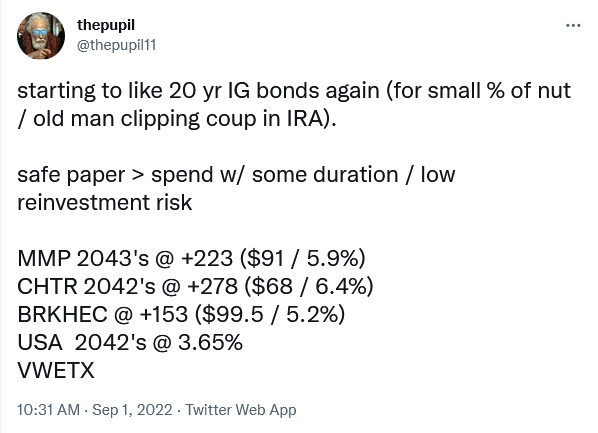
We pointed out that Magellan Midstream Partners, L.P. (MMP) had a 516 basis point spread between its dividend yield and the yield on 2050 maturity. Today, a fellow on Twitter happened to mention a Magellan bond (an earlier maturity, not the 2050) as an investment idea:

We've been asked recently about the advisability of buying CD's (now yielding in the mid 3%-range for a 5 year CD) or investment grade bonds (shown above). 

Before we talk about that, let's go back and look at how Magellan bonds and equity performed since the original ERP strategy post in March of 2021. First, the units:


The unit price is up by about a third, plus there have been six quarterly dividends paid, an additional $6.205, which is a further 16% on original cost. Meanwhile, the bond that we mentioned (the 2050 maturity) has sustained a significant capital loss because of higher interest rates:

The yield on this bond went from 4% to 5.6%, and since it is long duration, the bond fell in price from nearly par to 77 cents, about a 20 percent loss. In the year in a half since the post, that loss has been offset somewhat by 5.9 points of coupon interest income. Still, a 14% mark-to-market decline represents a loss of three-and-a-half years' of coupons.

Something else interesting about this bond price decline is that when we talk about the enterprise value of Magellan, we use the market value of equity (market capitalization) and the face value of the debt. However, we could adjust the enterprise value to use the market value of the debt, too, and as you see on the lengthier maturities it would be quite a haircut. The bondholders' loss is the unitholders' gain.

So, the right trade when MMP bonds were yielding 4% and the units were yielding 9% (the 5% spread mentioned earlier) was to buy the stock and not the bonds. 

What about now? The dividend yield on the units is 8% and the bonds are yielding 5.6%. The spread has been cut in half. Is it time to close out the trade?

We need to account for the fact that Magellan has started returning significant amounts of capital to shareholders via repurchases. The total number of units outstanding was down 5% year-over-year as of June 30th. A quick and easy way to adjust for this is to use their guidance of $1.09 billion of distributable cash flow for the year (which can be used for any combination of buybacks and dividends) that implies a shareholder yield of 10.3%. That is still 470 bps above the cost of debt - the spread has actually not tightened all that much.

Why hasn't it changed, even though the prices of the bond and units moved in directions that should have narrowed it? A key factor: an increase in the earnings per unit of Magellan. As we have emerged from the pandemic, earnings per unit for the trailing twelve months has risen from $4 (for last June) to $4.67 (this June).

This is nothing very profound; it is just why equities have historically outperformed bonds. Inflation is an incredible tailwind to equity investments with pricing power. You just have to avoid being wiped out by a deflationary crash. Is there going to be deflation? While Prechter may still think so, it is a political question. With Pelosi and her husband still daytrading, it is hard to imagine the elites tightening enough to cause a deflationary collapse. The Fed talks a lot about tightening but hasn't done much tightening.

We like ConvexityMaven's theory that the Fed is going to do yield curve control. Instead of letting the bond market crash and taking everything else with it, print money and buy bonds - keep the yields capped. But as the Maven says, in this scenario, "the other side of the balloon gets squishy" - meaning inflation. 

If you look around the world, you will notice tons of countries with fiat currencies are running high inflation rates. Meanwhile, deflationary collapses are rare. Can you imagine the central banks of Brazil, Argentina, or Ghana tightening enough to cause a deflationary collapse? It has never happened, because the path of least resistance is inflation. 

Betting on inflation is the cynical bet. But we have to be cynical enough to realize that the central bank doesn't want us hoarding real assets and is going to try to trick us with jawboning talk. People will believe the talk and there will be violent selloffs. This is why we like "first class" inflation protected assets and not leveraged junk.

If this theory of yield curve control is correct, holders of CD's or investment grade bonds may not lose too much more in nominal terms, since yields will be capped at some level. But they will lose a tremendous amount in real terms due to the inflation. And their loss will be the gain of equity investors in leveraged enterprises with pricing power, like Magellan.

Saturday, August 6, 2022

Pipeline Earnings - Q2 2022 ($EPD $MMP)

[Previously regarding Magellan Midstream Partners (MMP) and Enterprise Products Partners (EPD): Magellan Midstream Reports First-Quarter 2022 Financial Results and Raises 2022 Annual Guidance, Enterprise Product Partners L.P. Reports Q1 2022 Earnings, Pipeline Earnings - 2021, Pipeline Earnings - Q3 2021, Magellan Midstream Partners, L.P..] 

Magellan Midstream Partners (MMP) reported results last week. Highlights from the results and conference call

  • Earlier this morning, we reported second quarter net income of $354 million compared to $280 million in second quarter 2021. As noted in our press release, these results include a $162 million gain in the current period related to the sale of our independent terminals network, which is reflected in income from discontinued operations and a $70 million gain in the prior period primarily related to the sale of a portion of our interest in the Pasadena marine terminal joint venture. Excluding both of these gains, net income decreased about $18 million quarter-over-quarter.
  • Drivers of the increase in transportation and terminals revenue included record high quarterly transportation volumes resulting from additional contributions from our recent Texas expansions and higher South Texas volumes, which moved at a lower rate as well as continued demand recovery from pandemic levels, especially of aviation fuel. For the quarter, total refined products volumes were up 3% versus '21 levels.
  • During second quarter 2022, Magellan repurchased nearly 3.9 million of our common units for $190 million, resulting in total repurchases of 21.4 million units for $1.04 billion under our $1.5 billion repurchase program authorized through 2024. 
  • As we previously announced, we closed on the sale of our independent terminals network on June 8 and have been actively putting those proceeds to work. Including working capital adjustments, we received a total of $447 million for these assets and deployed $190 million during the second quarter into our equity buyback program, underscoring our commitment to maximizing long-term value for our investors.
  • Magellan continues to forecast annual DCF of $1.09 billion for 2022. The recent decline in commodity prices as well as the potential for slightly higher expenses during the second half of the year are currently projected to mostly offset our modest financial outperformance year to date. While management continues to monitor general economic conditions, including inflation and refined products demand, we do not expect a material impact to our annual guidance.
  • In terms of high commodity prices and the gives and puts on demand, as we've mentioned many times in the past, gasoline and generally transportation demand is fairly inelastic. I think we were maybe testing that a little bit in early July with the prices we saw upon them. But we haven't, I don't think, broken that inelasticity. I still think it's very inelastic. So even with higher commodity prices, as long as they stay within sort of an expected range, not too extreme, we don't see a lot of commodity risk up -- whether prices are up or down really driving that volume one way or the other unless you get to an extreme, which again, we may have tested in July, but we've come off of those extremes. 
  • [Guidance implicitly implies about $100 million more DCF in the second half of this year versus the first half of this year. Just wondering if you could walk through some of the drivers?] The first thing I would note is, one, the tariff increase is in the middle part of the year. The second piece I would note is that there is a seasonality to our business. If you look, we often have because of the timing of the butane blending activity, the fall is usually a more significant activity in the fall than it is in the spring. So there's some seasonality that comes with particularly our blending business. And then also our underlying pipeline has some seasonality to it. So there's some seasonality that's just sort of built in. In many ways, the second half of the year just tends to have more activity and do fundamentally better. So it's higher tariff rates, it's more activity due to seasonality in the back half of the year
  • If you look at the forward curve for the differential between Midland and Houston or East Houston, the forward curve shows that there should be improving differentials over time. If you look right now what's happening, I wouldn't say that we're seeing dramatic improvements today in that differential, what we can earn today versus what we could earn yesterday, but directionally speaking, the forward curve is pricing in wider differentials, so we would expect those to improve from here. You're right, production continues to grow. As that production grows, it should minimize through time the amount of excess capacity out of the [Permian Basin], which should continue to drive. So it all makes fundamental sense that we should start seeing some higher differentials. I still think that the question is, when are they going to show up where you can actually realize them and start seeing them in the results. And we're just not there yet, but we certainly see the potential for improvement as we look out over 2023 and certainly as into 2024 and beyond.

The common carrier pipeline system for refined products that Magellan owns is the longest in the United States, extending approximately 9,800 miles from the Texas Gulf Coast and covering a 15-state area across the central U.S. It has 54 product terminals throughout those states. It is interesting to hear their comments that there was only a mild impact on refined product demand even in July. That is consistent with what we have heard from Valero, but not consistent with the gasoline product demand data that has been put out by the EIA - not since they had a two week data delay in June.

They shipped 143 million barrels of refined products in Q2 2022 versus 139 million in Q2 2021 and 132 million in Q2 2019. Aviation fuel volume has recovered to 8 million barrels this quarter, not quite back to the 10 million in Q2 2019, but a big recovery from 3 million in Q2 2020. Revenue per barrel of refined product shipped is $1.73 vs $1.61 in 2019.

Magellan management has said in the past,

"As we go through an energy transition cycle over the next five or 10-years, it's reasonable to assume that you have more refinery rationalization. And typically speaking for a pipeline company that is a net positive, because it creates incremental transportation opportunities basically to fill the hole that if a refinery closure is creating. And we have a system that's ideally situated for that since we're connected to half the refining capacity in the country. And so, we're not supply constrained in any way. So if we have a refinery close in a certain market, we've got plenty of sufficient supply. And in most cases, sufficient capacity to fill that hole with barrels removed over a longer haul, which is typically a higher tariff. So, I think we do have operating leverage going forward around our refined product system."

The current market capitalization of Magellan is $10.3 billion and enterprise value is $15.3 billion. So far this year, they have generated about $490 million of free cash flow (EBITDA less capex, excluding cash from the sale of the independent terminals network). That annualizes to a 6.4% FCF/EV yield. Their guidance of $1.09 billion of distributable cash flow implies a shareholder yield of 10.6%.

Enterprise Products Partners (EPD) also reported results last week. Highlights from the results and conference call:

  • Enterprise reported record net income attributable to common unitholders of $1.4 billion, or $0.64 per unit on a fully diluted basis, for the second quarter of 2022, compared to $1.1 billion, or $0.50 per unit on a fully diluted basis, for the second quarter of 2021.
  • Distributable Cash Flow, excluding proceeds from asset sales, increased 30 percent to a record $2.0 billion for the second quarter of 2022 compared to $1.6 billion for the second quarter of 2021. Distributions declared with respect to the second quarter of 2022 increased 5.6 percent to $0.475 per unit, or $1.90 per unit annualized, compared to distributions declared for the second quarter of 2021.
  • Capital investments were $383 million in the second quarter of 2022, which included $301 million of growth capital expenditures and $82 million for sustaining capital expenditures. Capital investments were $3.9 billion for the first six months of 2022, which included $3.2 billion for the acquisition of Navitas Midstream, $576 million of growth capital expenditures and $157 million for sustaining capital expenditures.
  • Gross operating margin from the NGL Pipelines & Services segment increased 21 percent to a record $1.3 billion for the second quarter of 2022, from $1.1 billion for the second quarter of 2021.
  • Gross operating margin from the partnership’s Crude Oil Pipelines & Services segment was $407 million for the second quarter of 2022 compared to $419 million for the second quarter of 2021. Gross operating margin for the second quarters of 2022 and 2021 included non-cash, MTM losses related to hedging activities of $38 million and $10 million, respectively. Total crude oil pipeline transportation volumes increased to 2.2 million BPD in the second quarter of 2022 from 2.0 million BPD for the second quarter of 2021.
  • Gross operating margin from Enterprise’s Natural Gas Pipelines & Services segment increased 13 percent to $229 million for the second quarter of 2022 from $202 million for the second quarter of 2021. Total natural gas transportation volumes increased 19 percent to a record 16.8 TBtus/d for the second quarter of 2022 from 14.2 TBtus/d for the second quarter of 2021.
  • Gross operating margin for the Petrochemical & Refined Products Services segment increased 29 percent, or $95 million to $421 million for the second quarter of 2022 compared to $326 million for the second quarter of 2021. 
  • U.S. energy independence is now more valuable than ever. It is clear that Russia has a strangle hold on Europe. And Russia and China appeared to be aligned in policies that are in direct conflict with Western Values. Fortunately, the U.S. has an abundant energy resource. It is the fact that our crude oil, NGLs, LNG cargos are the only short cycle resources the world has left. We have tremendous hydrocarbons potential, but unfortunately it is squandered in the current political climate that is intent on restricting its development. 
  • Appalachia alone has over 25 Bcf a day of production upside, that's more than what Europe imports from Russia. However, this potential is unattainable, not by economics or resource, but by massive amounts of laws and regulations that are vague best and consistently applied and consistently. In addition to being the only short cycle resource the world has, our energy is environmentally superior. It's much cleaner because it comes from shale and it's produced here in the U.S. under environmental and safety standards that are second to none, it’s not oil and gas versus renewable debate as so many make it out to be.
  • Enterprise’s view has always been, we are absolutely going to need it all. And what most call energy transition is actually going to be badly needed energy additions that will take place gradually. Oil and gas will be in high demand for decades. People who say otherwise are either extremely naive or have their own agenda. Demonizing fossil fuels, overt restrictions on investments and massive layers of regulation that are designed to keep it in the ground will only creep chaos in the form of ever increasing shortages and high prices.
  • Moving on to distributions and buybacks, we declared a distribution of $0.475 per common unit with respect to the second quarter of 2022. This is 5.6% higher than the distribution that we declared for the second quarter of last year. This distribution will be paid next week on August 12 to common unit holders of record as of the close of business on July 29. During the quarter, we also repurchased approximately 1.4 million common units at a cost of $35 million. For the 12 months into June 30, we returned over $4 billion of distributions to limited partners and $235 million of buybacks. So for the last 12 months, our payout ratio compared to adjusted cash flow from operations was 56%. And our payout ratio of adjusted free cash flow after excluding the acquisition, the $3.2 billion acquisition of Navitas Midstream was a payout ratio was 72%.

The current market capitalization of Enterprise is $56 billion and the enterprise value is approximately $85 billion. Their free cash flow for the second quarter was $1.75 billion which annualizes to $7 billion a year, an 8% FCF/EV yield. The company is trading for 10 times this quarter's earnings

Pipelines are a kind of hedge against over-production by E&P firms. If they bump up against the pipeline transport capacity in a given location (like the Permian), the pipelines' profits should increase sharply since they are bidding for an inelastic supply.

Sunday, May 15, 2022

Magellan Midstream Reports First-Quarter 2022 Financial Results and Raises 2022 Annual Guidance

[Previously regarding Magellan Midstream Partners: Pipeline Earnings - 2021, Pipeline Earnings - Q3 2021, Magellan Midstream Partners, L.P..]

Magellan Midstream Partners (MMP) reported results last week. Highlights from the results: 

  • Magellan Midstream Partners, L.P. (NYSE: MMP) today reported net income of $166 million for first quarter 2022 compared to $221 million for first quarter 2021. The decrease in net income primarily resulted from mark-to-market (MTM) adjustments for hedge positions related to our commodity-related activities in the current higher commodity pricing environment as well as the favorable impact to our prior-year results from the 2021 winter storms.
  • Distributable cash flow (DCF), a non-GAAP financial measure that represents the amount of cash generated during the period that is available to pay distributions, was $265 million for first quarter 2022 compared to $276 million for first quarter 2021. Free cash flow (FCF), a non-GAAP financial measure that represents the amount of cash available for distributions, expansion capital opportunities, equity repurchases, debt reduction or other partnership uses, was $240 million during first quarter 2022 versus $267 million during first quarter 2021.
  • Refined products operating margin was $235 million, a decrease of $26 million primarily related to the impact of MTM adjustments for futures contracts used to hedge our commodity-related activities. Excluding these adjustments, financial results from this segment's fee-based activities increased between periods. Transportation and terminals revenue increased $12 million primarily due to increased transportation volumes as a result of the continued demand recovery from pandemic levels as well as additional contributions from our Texas pipeline expansion projects.
  • Crude oil operating margin was $104 million, a decrease of $6 million. Transportation and terminals revenue decreased slightly primarily related to reduced storage revenue due to lower utilization and rates following recent contract expirations. Otherwise, higher average rates on our Longhorn pipeline and higher terminal throughput fees as a result of more customers utilizing a simplified pricing structure for services in the Houston area offset fewer tariff movements on our Houston distribution system.
  • During first quarter 2022, Magellan repurchased over 1 million of our common units for $50 million, resulting in total repurchases since inception of 17.5 million units for $850 million under our $1.5 billion repurchase program authorized through 2024. 
  • FCF is now projected to be nearly $1.46 billion for 2022, or $575 million after distributions. Full-year FCF guidance includes the expected $435 million proceeds from the pending sale of our independent terminals.
  • Based on actual first-quarter results and current number of units outstanding, net income per unit is estimated to be $4.35 for 2022, with second-quarter guidance of $1.12 per unit.

The current market capitalization is $10 billion and enterprise value is $15 billion. The earnings yield based on management guidance is 9%.

Current dividend yield is 8.5% and their 2050 debt is yielding 5.3%. That's an equity risk premium of about 3.2%. When we first wrote about Magellan in March 2021, it was 5.8%. It has contracted partly because of higher interest rates (and corporate bond yields) and partly because the dividend yield has fallen. 

See how low Magellan's dividend yield got at the peak of the midstream boom in 2014-2015. It was yielding under 3% - yet their debt was yielding closer to 5%. As a negative 2% ERP, the equity was not very compelling, and it subsequently had a substantial decline.

Tuesday, February 8, 2022

Pipeline Earnings ($MMP $EPD) - 2021

[Previously regarding pipeline investments: Hydrocarbon Royalties and Pipelines, Magellan Midstream Partners, L.P. (MMP), and  Pipeline Earnings - Q3 2021.]

Some great comments on our pipeline companies' fourth quarter earnings calls. Start with the CEO of Enterprise Products, Jim Teague, on the EPD Q4 call:

I'll finish with our thoughts on the changing sentiments around oil and gas. For some time now, the sentiment toward all traditional forms of energy, especially in political circles has been very negative. Many said that the world should pull the plug on traditional energy as soon as possible and completely devote our capital and efforts toward renewable energy.

Without a doubt, this was always naive. The world now realizes that an overnight transition to renewable sources of energy is not at all possible as evidenced by the rapid development of various global crises, including high natural gas and LNG prices, high crude oil prices and not seen since 2014 and runaway inflation, not seen for about 40 years. Europe is starved for gas and is faced with heat or eat, while Russia, with its major oil and gas supplier, is amassing troops on the Ukraine border. Try as you may, it's hard to blame this crisis on the pandemic.

Over one-third of the world lives in energy poverty, mainly in developing countries. Europe's energy policies have now made energy poverty a reality in first-world countries. As an oil analyst said, energy is the economy. We, in the United States, live in a country of plenty.

We are a rich nation with the high quality of life of creative culture, now also blessed with abundant energy. Maybe that has distorted our thinking about the situation in other countries or regions. People who don't want developing nations to have what we have are either in denial, hypocrites, or both. At Enterprise, we've been outspoken that is going to take all of the above, not for a few years, but for decades to come.

Look to comments made by a variety of sources, everyone from the IEA to the head of Saudi Aramco, members of the European Union, and even the U.S. energy secretary. Ultimately, they all message the same thing. Investment in oil and gas needs to ramp up sharply in order to provide the badly needed baseload traditional sources of energy that will be needed alongside low carbon fuels and green energy to meet the world's growing demand.

And then the CEO of Magellan, Michael Mears, had an amusing comment on the MMP Q4 call about the

James Carreker
Okay. I thought that might be the case. Just wanted to clarify. And then I guess, kind of, a big picture question, and I know we've gotten away from talking about growth versus normal and x growth projects. But when you look at the 2022 refined product outlook, I guess taking into account growth projects that you put into place, like how normal does that feel relative to, say, 2019 levels? Does that feel like we fully caught up? Do you think there's still some parts of the economy holding back when you look at that 2022 number?

Mike Mears
Well, I don't have the numbers in front of me, but I think just directionally, on gasoline, we aren't quite back to 2019 numbers. Diesel fuel is strong and probably above 2019 numbers, and jet fuel, obviously, still not back to 2019 numbers. But I don't have any kind of percentages on my fingertips here to give you on that. And when I say gasoline is not there. I'm not talking about a big miss, I'm talking about it's not above where we were in 2019. And I think -- and again, and I've talked about this before, it really gets into the geography. I mean, as I said, in the rural markets, it's there. In the cities it hasn't quite gotten back there. I mean you still have businesses that don't have people back to work, which is surprising to us, but it's true. And so I think there's still a little bit of a lag there.

Here are the valuation figures and earnings projections last time we checked on EPD and MMP in November:

  • EPD market cap was $50 billion and EV was $78 billion. For the first nine months of 2021, Enterprise had earned $3.6 billion, had $6.3 billion of EBITDA, and $4.9 billion of distributable cash flow. The first nine months' annualized earnings ($4.8 billion) looked like an 9.6% earnings yield.
  • MMP market cap was $11.3 billion and EV was $16.7 billion. For the first nine months of 2021, Magellan earned $738 million, had $1 billion of EBITDA, and $821 million of "distributable" cash flow after maintenance capital expenditures. They had paid $685 million of distributions and repurchased $473 million of LP units for a total of $1.16 billion returned to shareholders through the third quarter. Their first nine months' annualized earnings ($984 million, FY 2021 guidance of $975 million) looked like an 8.7% earnings yield.

MMP ended up earning $982 million in 2021, including $244 million in the fourth quarter. The current earnings yield is 9.4% with the stock basically unchanged since early November. During fourth quarter 2021, the partnership repurchased nearly 1.1 million of its common units for $50 million, resulting in a total of 10.9 million units repurchased during 2021 for $523 million.

EPD ended up earning $4.6 billion and had distributable cash flow of $6.6 billion. The current earnings yield is 8.7% with the stock up about 5% since early November.

Wednesday, November 3, 2021

Pipeline Earnings - Q3 2021 ($MMP $EPD)

[See previously Hydrocarbon Royalties and Pipelines and Magellan Midstream Partners, L.P. (MMP).]

Two of our pipeline companies, Enterprise Products Partners and Magellan Midstream, reported their Q3 earnings (EPD, MMP) yesterday.

Magellan
Current market capitalization is $11.3 billion and enterprise value is $16.7 billion. For the first nine months of 2021, Magellan earned $738 million, had $1 billion of EBITDA, and $821 million of "distributable" cash flow after "maintenance" capital expenditures. They have paid $685 million of distributions and have repurchased $473 million of LP units for a total of $1.16 billion returned to shareholders year to date.

So, Magellan's past nine month's annualized earnings ($984 million, current guidance is for $975 million) would be an 8.7% earnings yield on the current market cap. Magellan shares trade at the same price that they did in 2013 ($50). What is interesting is that TTM net income then was only $580 million, about 60% of what it should be this year, and the dividend then was a third of what it is now. Which meant that the dividend yield then was around 3% vs over 8% today.

This snippet, in response to a question, was what I thought was most interesting from the Q3 earnings call:

But if you look at the rest of our system, in particular, in Texas, if there is demand growth in Texas, which happens to be especially the Dallas Fort Worth area, one of the fastest-growing areas in the country, we have plenty of capacity to accommodate that without -- well speaking about Dallas, without really any capital investment. And when you think about West Texas and access to Mexico and Arizona, markets are further west. We have opportunities there to expand capacity also. So there are upsides around our system. The other thing I mentioned, I've mentioned this before that as we go through an energy transition cycle over the next five or 10-years, it's reasonable to assume that you have more refinery rationalization. And typically speaking for a pipeline company that is a net positive, because it creates incremental transportation opportunities basically to fill the hole that if a refinery closure is creating. And we have a system that's ideally situated for that since we're connected to half the refining capacity in the country. And so, we're not supply constrained in any way. So if we have a refinery close in a certain market, we've got plenty of sufficient supply. And in most cases, sufficient capacity to fill that hole with barrels removed over a longer haul, which is typically a higher tariff. So, I think we do have operating leverage going forward around our refined product system.

I was most glad to see that net income for the first nine months of 2021 has exceeded the first nine months of 2019 ($738 million vs $734 million). We like when our "dying businesses" have growing earnings. (Of course, the bond market never agrees that these businesses are dying. Magellan's debt due 2050 yields only 3.5%.)

Magellan shipped 142 million barrels of refined products in Q3 2021 versus 136 million in Q3 2019. Even though aviation fuel fell from 11 million barrels to 8.4 million, gasoline rose from 75 million to 80 million and distillates rose from 47 million to 53 million. Revenue per barrel of refined product rose from $1.62 to $1.72 per barrel.

Their crude oil pipelines are operating below capacity, with shipping on their 100% owned pipelines falling from 79 million barrels in Q3 2019 (at 94 cents per barrel) to 40 million in Q3 2021 (at 80 cents per barrel). Their BridgeTex pipeline volume has fallen from 41 million barrels (Q3 2019) to 29 million (Q3 2021).

So it's interesting that the refined products pipelines have carried the company back to 2019 earnings even with crude oil volumes lagging. (Refined products made $240 million operating income in Q3 2019 vs $272 million in Q3 2021. Crude oil made $154 operating income in Q3 2019 vs $112 million in Q3 2021.) Magellan should make a lot more money if and when production in the Permian basin increases.

Enterprise
Current market capitalization is $50 billion and enterprise value is $78 billion. For the first nine months of 2021, Enterprise earned $3.6 billion, had $6.3 billion of EBITDA, and $4.9 billion of distributable cash flow.

So, Enterprise's past nine month's annualized earnings ($4.8 billion) would be an 9.6% earnings yield on the current market cap. Magellan shares trade at the same price that they did in early 2014 ($22). At that time, the TTM net income had been only $2.6 billion, about 53% of what it should be this year, and the dividend then was about half of what it is now. Which meant that the dividend yield then was just under 4% vs almost 8% today.

Here is the most interesting snippet from the Q3 earnings call:

Our businesses continued to perform extremely well during the third quarter. We reported $2 billion of EBITDA even though we were impacted by $30 million of headwinds due to hurricane Ida. Cash flow from operations was a record $2.4 billion, which more than fully funded both our capital expenditures and our distributions. Year-to-date distributable cash flow is almost $5 billion, which has provided coverage of 1.7x and $2 billion in retained cash year-to-date. As we head into the final quarter of the year, while we don't take anything for granted, it looks like our businesses are going to finish with another strong year in 2021. Our results reflect the ongoing recovery in demand for crude, NGLs, primary petrochemicals and refined products as the global economy continues to recover. For 2022, most experts agree on continued strong demand and economic growth worldwide. We believe that economic backdrop plus the need to restock virtually everything will continue to provide strong demand growth for oil and gas, natural gas liquids and plastics. In addition to the record cash flow from operations, we had record profits from our propylene business, which contributed to the record gross operating income for our petrochemical and refined product service sector. Our PDH and splitters complement one another in our value chain, and we were able to take advantage of strong propylene spreads. Long term, petrochemical fundamentals are very strong and U.S. petrochemicals have multiple competitive advantages compared to almost all of their global peers. And likewise, Enterprise remains strongly positioned to provide the petrochemicals midstream services, including feedstock, storage, distribution and exports. It's a footprint that's not easily copied. Our liquids pipelines have substantially recovered to near pre-pandemic levels at 6.3 million barrels a day with gas processing volumes benefiting from higher prices for NGLs. Enterprise's natural gas pipeline and transportation for the third quarter exceeded pre-pandemic 2019 levels at a record 14.6 Bcf a day.

As at Magellan, Enterprise's net income for the first nine months of 2021 has exceeded the first nine months of 2019 ($3.6 billion vs $3.5 billion). Gross operating margin for the NGL Pipelines & Services segment (the largest) are up slightly vs 2019, Crude Oil Pipelines & Services and Natural Gas Pipelines & Services are both down somewhat, and then the Petrochemical & Refined Products Services segment earnings are up 42% since 2019, bringing overall gross operating margin to $2.08 billion for the quarter vs $2.05 billion two years ago.

People are unhappy with Enterprise for refusing to buy back units and for spending money on growth capex when units are trading so cheap.

Convexity Idea
It is really interesting that these pipelines yield so much more than they did in 2014, especially with interest rates lower. Magellan yielded 2.9% when the ten year bond yielded 2.4%. Now the ten year yield is 1.6% and Magellan yields 8%. The story with Enterprise is basically the same.

What if these pipelines re-valued? Suppose that gasoline consumption and vehicle miles traveled hit new all time highs next year. Even without growing earnings, if Magellan traded to a 5% dividend yield (where it was in 2017-2018), that would be 60% upside to the current share price, or $80. A $60 call for Jan 2024 last traded for $1.30. If the stock revalues between now and then, that's 15x upside. [An ATM $50 call has IV of only 13% and trades for $4. That would be 7.5x upside with breakeven at $54 - MMP traded at $53.5 in June.]

What's interesting about these calls is that they have upside to improving fundamentals and lower dividend yields but they are also an option on inflation. How much might the currency devalue between now and January 2024? Is 13% implied volatility the right price? 

Note the last two comments on our Rethinking Inflation post, recent quotes from the two smartest options traders that we know: the "distribution of future inflation has a fat right tail" and "Implied Volatility is way too low since the range of outcomes is now much wider."

Wednesday, March 3, 2021

Magellan Midstream Partners, L.P. (MMP)

We had a good exchange in the comments of the Hydrocarbons and Pipelines post in which we established that pipelines are probably the best part of the oil value chain. (And remember Arman Alchian wrote about how pipelines have so much bargaining power - in the absence of regulation - that producers and refiners are "hostage" to them.) I also posted a good link to Convexity Maven in the February 26th Links about midstream investments (e.g. AMLP):

The AMLP listed ETF is a collection of the larger fossil fuel MLPs that have not converted to a C-Corp profile. Notwithstanding its disadvantageous tax structure, its current yield of nearly 10%, or about 825bps wide to the T10yr, can only be explained as either a stupendous tax-loss motivated liquidation, or the realization that MLPs are a feat of financial engineering that is inherently flawed. Fossil fuels will not be eliminated in the near future, and their transportation from the ground to the gas tank is a necessary function that at some point must be a profitable venture. It is my fervent hope that MLPs are not the subject matter for Betheny McLean’s next best seller. A 10% dividend for a listed 20-stock Index is the wrong number; either AMLP will rise in price, or the 19.5 cent dividend will be reduced to 14 cents. I suppose it is possible that the underlying MLPs are functionally a $200bn Ponzi scheme that relied upon rising oil prices to maintain the illusion of profitability; but I suspect the answer is a bit more banal. What we likely have here is a mismatch in capital where Retail investors have tossed in the towel and Institutional investors can't or won't buy a (K-1) partnership structure. 

One midstream company that caught my eye is Magellan Midstream Partners, L.P. (MMP). Their business is slightly different than the stereotypical pipeline (which drains a producing, depleting basin). See this asset map of their refined products pipeline and terminals, and their crude oil pipelines, and how they describe their business:  

We are principally engaged in the transportation, storage and distribution of refined petroleum products and crude oil. As of December 31, 2020, our asset portfolio consisted of: our refined products segment, comprised of our approximately 9,800-mile refined petroleum products pipeline system with 54 connected terminals, as well as 25 independent terminals not connected to our pipeline system and two marine storage terminals (one of which is owned through a joint venture); and our crude oil segment, comprised of approximately 2,200 miles of crude oil pipelines, a condensate splitter and 37 million barrels of aggregate storage capacity, of which approximately 27 million barrels are used for contract storage. Approximately 1,000 miles of these pipelines, the condensate splitter and 30 million barrels of this storage capacity (including 24 million barrels used for contract storage) are wholly-owned, with the remainder owned through joint ventures.

The stock is yielding almost 10%. They distributed $927 million last year (current market cap $9.7 billion) versus cash from operations of $1.1 billion. What's the deal - is this a wasting asset? Here is a risk factor that they disclose in their annual report:

The demand for refined products in the market areas served by our pipeline system has historically been stable. We generally rely on recent historical trends on our system and third-party forecasts in assessing future refined products demand, and those forecasts vary both by forecaster and by product. While increases in vehicle efficiency and more widespread penetration of electric vehicles are generally expected to reduce demand for gasoline over time, distillate demand is expected to be less affected, while demand for aviation fuel is expected to grow. Projections published by the Energy Information Administration in February 2021 suggest that overall demand for refined products in the market areas served by our pipeline system, primarily the West North Central and West South Central census districts, will decline by approximately 0.6% annually over the next ten years, when compared to the more historical demand levels of 2019.

If demand for refined products actually does fall single digit percentage a year, pipelines and hydrocarbon land owners will do a lot better than refiners. But look at where Magellan's pipeline runs - from the Houston Gulf Coast refining complex north to the Great Plains states. Are people in Minnesota, Iowa, Illinois, etc. really going to be using less fuel in the years to come? This subject came up at Magellan's investor presentation yesterday:

It’s hard for us to see the work from home trend really distinct in a material way, especially in the markets we serve in the Mid-Continent. So we don't anticipate that that to have a long term effect on gasoline demand. And I think, for that matter, especially in our part of the world, even when people are staying home, they're not really staying at home, they're still out and being mobile in their cars, rather than taking mass transit, or those sorts of things. So we're not expecting long term gasoline demand destruction from COVID on gasoline. And diesel demand, we expect to recover nicely, both with just a recovering economy and the diesel demand needs for transport of goods. We also serve a very large agricultural sector, which we expect to continue to do well overtime. So we don't really expect any long term impacts from diesel demand destruction.

In other words, people with real jobs still have to show up to work in person, and they aren't buying flaky electric vehicles that you don't work on farms or in the winter. But in response to the electric vehicle and work from home and covid related uncertainty, they commented that they

"significantly reduced any [capital expenditures] where we are taking speculative positions on the outlook for the market over 10 or 20 years."


Uncertainty about the demand outlook means capital expenditure discipline. That in turn means rents stay high and more of it can be returned to shareholders. It’s like tobacco!

What is amazing about the 10% dividend yield is that MMP's 30 year debt yields 3.8% with 9.6% dividend yield. It is strikingly similar to the equity risk premium at Altria, whose 30 year debt yields 4% with 7.7% dividend yield on the stock.

See how low Magellan's dividend yield got at the peak of the midstream boom in 2014-2015. It was yielding under 3% - yet their debt was yielding closer to 5%. 

Wow: if you had followed the equity risk premium as a signal to chose between owning the stock or the bonds, you would have been in their debt instead of their stock given the -200 bps spread. Now with a +580 bps spread it seems to make more sense to own the stock.